Alarmed Entanglements
Möchten Sie mit dem Bild schlafen?
Would you like to sleep with the painting?
I was in Munich, on a weekend getaway. And at a modern art museum which shall go shamed but unnamed, I had come dangerously close to a Cy Twombly painting.
Lepanto V, which hosted a scattering of ships on a fragmented pale blue background, had drawn me in with crayon and graphite, colluding with my poor eyesight to beckon me closer and closer until ah! a step too far—past a non-existent floor marking—and the alarms sounded. The (almost) haptic replaced by the (crushingly) sonic.
I stumbled back, apologetic and dithering, straight into the security guard whose pursed lips and clasped arms caught my fall. She was not best pleased, and uttered the question above. I’m sorry? I understood her loud and clear, but hoped a transition to English would allow her to rephrase her (rhetorical) question. It did not. I said, you seem so in love with the painting, you should just sleep with it! Why would you get so close? I hadn’t been thinking, I wanted to admit, only feeling. I knew, however, that was no response to her authority; to touch was not to protect, to puncture was not to repair, at least by her precepts.
I knew it was right—or at least, correct—to apologise, and did so with adequate fervour, though not without acknowledging that her question had caught me off guard. I even conjectured that a gentler tone would have been appreciated. But I had already been deemed a degenerate, a monster of the gallery. She huffed, walked off, and for the rest of my time in the Lepanto room, I could sense her stare, attempting to cut into my looks of desire, or perhaps into me. At the end of this optic chain lay the Twombly, none the wiser about the scene which had just unfolded before it, in its name.
In the lower third of Lepanto V, there’s a burst of pink-lilac. It’s almost three-pronged, posed like a trident, perfect for one’s hand to hover over. Wollte ich mit dem Bild schlafen? I’ve been thinking about the question since. It wasn’t such an explicit act I sought, but there was a physicality I felt moved to perform. And if I did want to touch the painting—hug it, caress it, brush it with my fingertips—would that have been so strange?
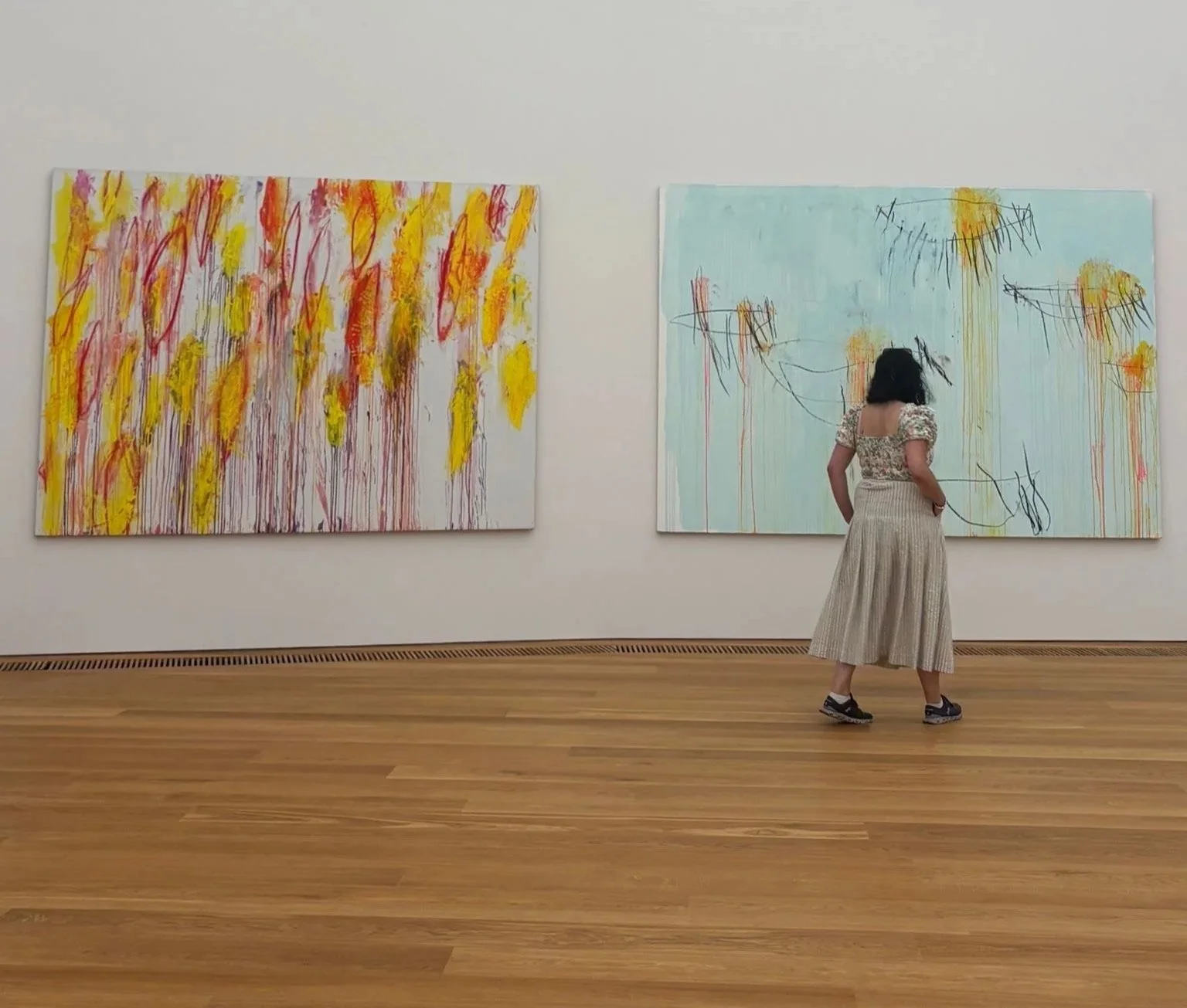
Before the alarm. Courtesy of writer.
*
There’s a famous story in the Amores, an imperial Greek dialogic text comparing types of love, about a young man who fell in love with the statue of Aphrodite of Knidos by the sculptor Praxiteles. Initially giving the impression of immense piety, he would spend his days at the temple staring down the moulded goddess, whispering sweet nothings in her ears, scratching messages of love and love’s partner, hate, onto the walls around her. One night, his passion escalated into a sex act, leaving an amatory blemish which tarred Aphrodite on her thigh, and the boy himself was driven to suicide, hurled over a cliff, or deep into the sea’s waves.
After hearing the tale, the Amores character Charicles, who had himself run up to the Knidia earlier and kissed her with slobbery lips, wonders whether the boy’s response would have been even more heightened, had the ‘beauty’ (κάλλος) at hand been truly alive and breathing. But is it not the fact that this Aphrodite cannot be real—that her being an object rebuffs these men who want to engage with her as an objectified person, crucially a living one—the very point? (Pseudo-)Lucian’s exposition tells us about the goddess’ arrogant grin, her eroticised thinly-parted lips, the one hand which loosely covers her nether regions. One wonders whether the sculpture is meant to “know” about her allure; whether she flirts with the idea of her unattainability. Or is all this to project too much onto static Parian stone, whose materiality is made all too evident?
The stain the obsessed youth leaves stands out as a black, damning spot against the brightness of the remaining marble, its ‘unsightliness’ there for all to see. An excitement, an embarrassment, a transgression, his overfamiliarity with a work of art—with a statue of a goddess, no less—will damn him to obscurity; with this deed, the boy is condemned to be nameless, while Praxiteles’ art will live on. Even if Aphrodite’s beauty is exceedingly (a)rousing, even if her sculpted back and hips seem to invite approach, (Ps.-)Lucian’s tale goes, to make sexual advance on a piece of art is a step too far, an irrational act which flies in the face of sophisticated aesthetic reception. At the same time, this irrationality seems to plague all the men in the Amores narrative who encounter the Knidia, as if their erotic projection is the most natural reaction in the world. After all, women inspire love, even when made of stone–to quote Charicles’ assertion.
The temple woman who found this amatory aftermath the following day would have perhaps wished for the modern museum’s alarm system.
*
The hermeneutic quest is always founded on the repression and perversion of desire; the objects of understanding are always bare. The long gaze fetishizes, and so too, unequivocally, does the handling of the object that signifies.
In the chapter ‘Arousal by Image’, from his book The Power of the Image, art historian David Freedberg will (try to) untangle the question of the ‘desire to gaze on representation’ and the implications (and parameters) of sight’s ‘male conditioning’ in thinking about the image and its reception.
Reading Freedberg’s text, I could not help but think of the noblewoman, and artist, Emma Hamilton, and the male ‘long gaze’ displayed towards her ‘Attitudes’. Lover then wife of Sir William Hamilton, Emma’s eighteenth-century performances of female mythological figures—subject to painting, etching, caricature, diary entry, praise and, also ridicule—were a sensation. Pushing tableaux vivants—‘living pictures’ of famous images from art, literature, and mythology, achieved by the silence and stillness of posed (usually female) actors—to motive and emotive limits, Hamilton arguably became something of an artistic canvas (a Knidian marble, if you will) onto which famous, Grand-Tour-hopping elite men would project the images found of the vases of William Hamilton’s vast collection, and more abstractly, with which they could launch their classical education onto more tangible Graeco-Roman fantasies.
One such man would be the writer and all-around intellectual Johann Wolfgang von Goethe, who wrote about having enjoyed multiple nights of the ‘Attitudes’ in the town of Caserta, as part of his quasi-pilgrimage around the Italian peninsula:
She knows how to choose and change (zu wählen, zu wechseln) the folds of the veil for every expression, and makes a hundred kinds of headgear with the same scarves … He finds in her all the antiquities (in ihr alle Antiken), all the beautiful profiles of Sicilian coins, even the Belvedere Apollo himself.
The German polymath, through his non-fiction Italiänische Reise, memorialised in written form his visual encounter with this interesting intersection of material-human spectacle: between the objects and characters of antiquity, and the real woman bringing them to ‘life’. Goethe’s approach is to collapse the distinction, as he sees in Emma whatever of Graeco-Roman past he would like displayed. It is an enthusiasm which tries to subsume, almost totally, the person into the plastic. And yet even in this passage there is a glimpse into Emma Hamilton’s autonomy, into her variation of movement, gesture, and expression, into her appreciation and application of her own appeal. She carries out a form of classical reception which is itself undesiring but, intellectually, understands the nostalgia for antiquity others possess.
Emma’s act of ‘self-handling’ is aware of what her body, and its various forms, can signify, and so she proceeds, knowingly toeing a line between reality and story for an audience who provide excessive longing in response to her detached—but nevertheless intentional—embodiment. So, while a perverse form of Goethe’s desire unfolds in his tale, as he pays no heed to—say, represses—Emma’s, there is still something so poignant in her ability to move that Goethe’s viewing, and also ours, must take stock, even if his narrative attempts to dominate with his gaze. She knew how those eyes (like Goethe’s) could, and would, desire her—as art, and as person.
Maybe, meandering between (Ps.-)Lucian and Goethe, it is easier to see why my closeness to the painting came across as an affront. Like the youth’s stain on Aphrodite’s otherwise pure marble in the temple, it constituted the breaching of a social contract in a space I had entered, in this case as a viewer within a museum. But unlike Goethe’s (attempts at an) erosive and erasing ‘long gaze’ onto Emma Hamilton, and unlike Charicles’ ‘relentless’ embraces of the Knidia, I like to think I looked upon Lepanto V quite differently, “touched” it differently, too. Sure, I also projected on Twombly in that very room; his lines and colours could be whatever I wanted of them, whatever I saw in them. But there wasn’t the same predation, the same prodding, the same assumption of power: I didn’t want all antiquity, nor to partake in the objectification of women’s bodies, in stone or flesh. My eyes didn’t propagate an ‘ideology of men’; instead they sought a non-normative tilt, a queerness of clasp. Could I see, here, the Trojan ships? Could I nestle there Achilles Mourning the Death of Patrocles in another form? Only painterly intimacies could reveal the (perhaps manifold) answers, only closeness could tell.
Here are lesbian roses, I thought. I had walked into the room over from the Lepanto cycle, into a gallery blooming with Twombly’s roses. There they towered, dripping in red, pink, orange, and yellow, my lesbian roses. Accompanied by Twombly’s verse adaptations of carefully selected poems, the Untitled flowers which housed Emily Dickinson and Patricia Waters in their layered petals spoke to me the most:
The Soul has / moments / of Escape / When twisting / all the doors / She dances / like a / bomb / abroad / and Swings / upon / the Hours
After Emily Dickinson, ‘The Soul has Bandaged Moments’ (1862)
ROSe / brief, / brief in its beauty / but the / Scent / better than Fame
After Patricia Waters, ‘The Ordinary Sublime’ (2006)
The poems were written and rewritten, scratched in to-and-fro, papered and plastered over, with the outcome of near intelligibility. These were differentiated inscriptions worth transgressing for: I was being asked to point at their gaps, trace their textures. My liaison coaxed me in more ways than touch, however. Engulfed in the Roses’ embrace, my soul had its own moment of Dickinsonian escape, even transport. Images lingered between my eyelids, words impressed on my mind; both tugged on me, the bomb abroad. And if I leant in, I could even smell their Scent, better than Fame. I couldn’t not get close. But should I be allowed this closeness? I wondered as the beauty, far from brief, washed over me again and again.
Then I read We the Parasites (2023).
*
In her five-part essay-memoir, critic and art historian A. V. Marraccini writes about the experience of critique, and the relationship criticism bears towards its source-material. ‘We the parasites, feeding on the art to make reviews and papers’ forms part of her pluralising declaration. Throughout the book, the critic is a parasite, elsewhere a wasp, and not the fig onto which they latch; the critical gaze ‘tear[s] apart’ and ‘claw[s]’ into the ‘soft, central flesh of the tree bud’, analysing with an ‘erotic’ bent of desire, as scholars wanting texts to mesh and interact for their own means, acting ‘like children who make two dolls “have sex”’. A language of violence emerges, of leeching and mooching; crucially, the parasite is sustained (however temporarily), if not ‘fed’, by the writing and artwork into which it burrows itself. The nature of the critic’s task revels in—what is to them, sweet—darkness, as they inhabit shadowed crevices of ‘novels and paintings and poems and architectures’ which, though not originally in their possession, are then (somewhat and somehow) made theirs.
These ‘parasitic’ images are to be found all the way back in Hellenistic and imperial Greek epigram (AP 11.321, 11.322, 11.140 of the Greek Anthology, for example), wherein pesky grammatikoi are imaged as ‘bookworms’. Playing curious commentators, they treat poems’ ‘roots’ as sites of exploitative exploration; casting darkness onto children starting to learn, their greatest trespasses are to do with consumption, with how they bite into euphony, how they weaponise monosyllables, and chew up critical conjectures only to spit them back out. Their sustenance—the text—is also the object of a kind of intellectual ire, on which they leave marks and holes and which they render less intelligible in the materially destructive process. And how could this seemingly endless grubbing-about end?
With death, Marraccini tells us. As an ‘inverted flower’, the fig needs to be pollinated to make its edible fruit. Where does this pollination come from? It is the very nestling of the fig-wasp, who ‘crawls into [the] female fig, where she starves and dies’, which causes the inverted flower’s blooming. In a warped (and what Marraccini calls ‘queer’) process of regeneration, the critic-as-parasite is revealed as taking part in a somewhat natural cycle—of feeding, death, and pollination—by which the fig-as-art is given new purpose, and given the means to create new life, too. Muddying the waters between host, parasite, and the sexual movement and biology in between, Marraccini’s fascinating description of criticism does not want to paint a dichotomy of readerly abuse and material victimhood. Thus, inspired to exist in an ecosystem which in fact requires human observers and commentators, my viewing (and my view of my viewing) has taken on a more generous form, whereby embodiment, desire and responsiveness are deemed critical mechanisms, but not terminal ones. Marks of zeal can change once more into mended patches, one’s consumptive passion can become a new realm of reception and revitalisation. When criticism is queer, the worlds of destruction and creation need not be so far apart. This much I now know, and can forgive myself for.
In Part One of We the Parasites, in fact, Marraccini references the so-called ‘Phaedrus incident’, the kiss which was planted unprovoked on Twombly’s snow-white triptych in Avignon. The Cambodian-French artist Rindy Sam left a crimson embrace which could not—even after much labour—be removed. Overcome, it seemed, by desire for Twombly’s art, Sam stood by the following justification: j’ai fait juste un bisou … je pensais que l’artiste, il aurait compris (It was just a kiss … I thought that the artist, he’d understand). Whether or not Twombly ‘understood’, Sam’s defence team argued for a harmless crime, an artistic entanglement which evinced passion, not malice; the symbolic one-euro Sam was ordered give Twombly (alongside 1,000€ to the painting’s owner, and 500€ to the Avignon gallery) maybe argues otherwise. Or it symbolises what is ultimately a concerned rap on the knuckles—and nothing more—for a ‘misplaced longing’, which is a phrase Marraccini uses as she muses on the act: ‘to be a critic and to be queer both are exercises in denial’.
In Plato’s Phaedrus, when relating how a lover (erastes) and beloved (eromenos) might enter into mutual longing , Socrates narrates a scenario in which both halves eventually reciprocate equal(ish) erotic feelings, as their compulsion to touch each other, kiss each other, lie down together grows more mirrored. In Rindy Sam’s trial, Agnès Tricoire (sadly not Tricolore), the ‘avocate des parties civiles’—shall we call her the victim’s lawyer? Is a painting a victim? Or is it the painter?—emphasised the very non-reciprocity of the ‘Phaedrus event’: Pour moi, en amour, il faut être deux et consentants (For me, in love there are two people, two who consent).
Tricoire continued, likening Sam’s kiss to the aggression of a punch: c’est aussi difficile de restaurer un coup de poing qu’un baiser. But must a kiss always be undone? Must the white, unembraced ‘Phaedrus’ be restored? I’m not sure. This erastes-eromenos relationship is not so easily dichotomised.
*
Did I look too closely at the Twombly, with too much longing, with too deep a gaze? Did I take a step (too far) to crawl into the fig, and if so, where in the queer cycle did I fit? Did I have a right to see lesbianism in those roses? Or did I border on the parasite then?
Do I border on it now, as I write this piece about the experience? Or was it just a(n imagined) kiss? Would Twombly understand? Do I owe him a symbolic euro (€) for my (near) embrace? Am I in critical denial?
It’s hard to answer these questions with any precision; the haziness might be the very point, like the puckered outlines which remain from Sam’s Rouge Best. But I do know that my response wasn’t as unnatural as the security guard made out. Queer, yes, but in a different way. And as an entanglement, maybe it didn’t have to cause so much alarm.
C’est un geste d’amour, quand je l’ai embrassé, je n’ai pas réfléchi …
Cover image: Writer observing the painting (before the alarm). Courtesy of writer.