Beating the Bounds of Stroud’s Heavens
Through high summer we beat the bounds of the Heavens, my little brother and I. Great sticks thwacking down nettles. In winter it was briars and brambles, in autumn mulched leaves, and in spring – mud. We walked the perimeters of fields, sticking to hedges and stopping at aluminium gates. As we grew bigger, we climbed the gates, pulling down on already sagging hinges. We’d prise apart barbed wire, tugging down temporary fences blocking footpaths. Keep Out signs read like invitations to us.
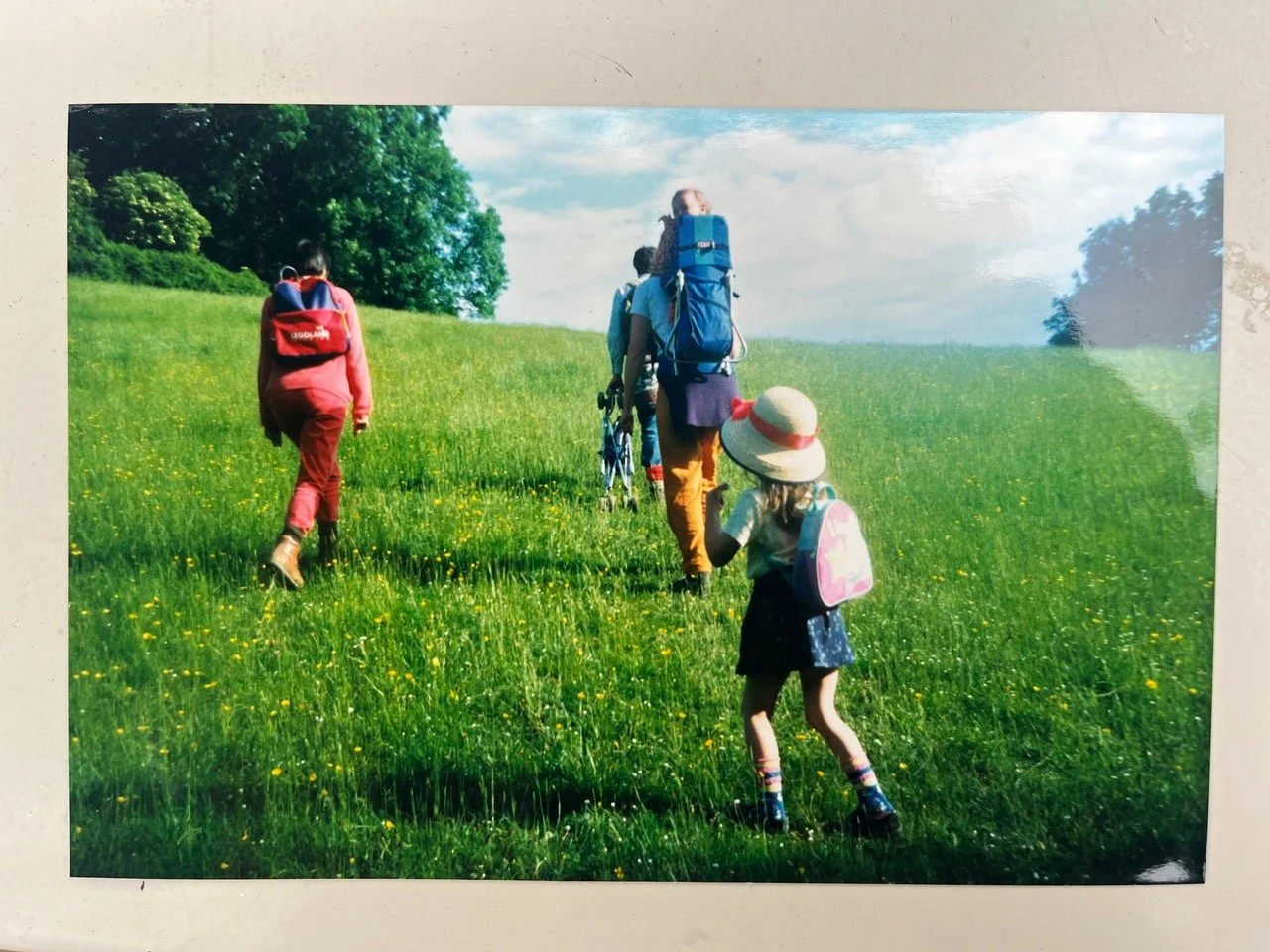
Elizabeth and her brother as children in the Heavens
Beating the bounds is an old, old custom, in which villagers and townsfolk stomp the perimeters of their parishes to pass down - to their children and children’s children - a mental map of the land’s edge. It seared the precise location of boundaries into the memory of the communities, protecting against encroachment and loss of common grazing land. The practice was a vital way of knowing the shape of a place. Thwacking the edges with willow and birch rods laid claim to this space, lodging it so deeply into peoples’ beings that testimonies based on the custom stood up in land disputes.
The ceremonies created a living record of the parish's boundaries, a link between old and new generations.
Processions were led by parish dignitaries, with village children brought along to be taught. The teaching often involved pain – heads knocked at important boundary-stones, feet tripped into nettle-filled ditches. Once, I shoved my little brother into a deep patch of nettles. He was seven and I was ten, (almost) old enough to behave better. I was growing into a robustness he hadn’t quite caught up with, and I sulked about it, the smallness of my playmate. It was alongside a tributary in the lowlands where the Severn runs close to Tewkesbury Abbey, where it breaks its banks and floods the fields. I could take you back to the exact stile.
The Heavens and the Horns, the landscapes of my childhood, lie at the end of Bisley Road, Stroud, Gloucestershire, England. Go down past the allotments to find the Heavens or up between the two cemeteries into the Horns. We were told about them the day we moved in. To a little Catholic girl, it felt as if I’d find great swarms of devils and angels at the end of my new street. But instead I found the Horns, a dank wooded valley with mossy paddocks, and the Heavens, a gentle dip of meadow between hills we’d soon grow big enough to careen around in. The Heavens became the place I went to whenever I itched with restlessness and despair and melancholy, seeking solace in the big clumps of cow parsley and sunshine haze of midge clouds.
The Heavens are full of the folk stories of my childhood – the rope swing cut down deliberately overnight, rumours that it was a parent whose child had fallen and broken bones. Of warm tins of cider in the dark of late summer nights, clusters of underage drinkers in among the dozing cows.
Sometimes we heard tell of a farmer coming to chase us away, but no one ever saw him, and the land was ours. All summer we tramped through the dipping fields with grass knee high and the valley opening up to our left.
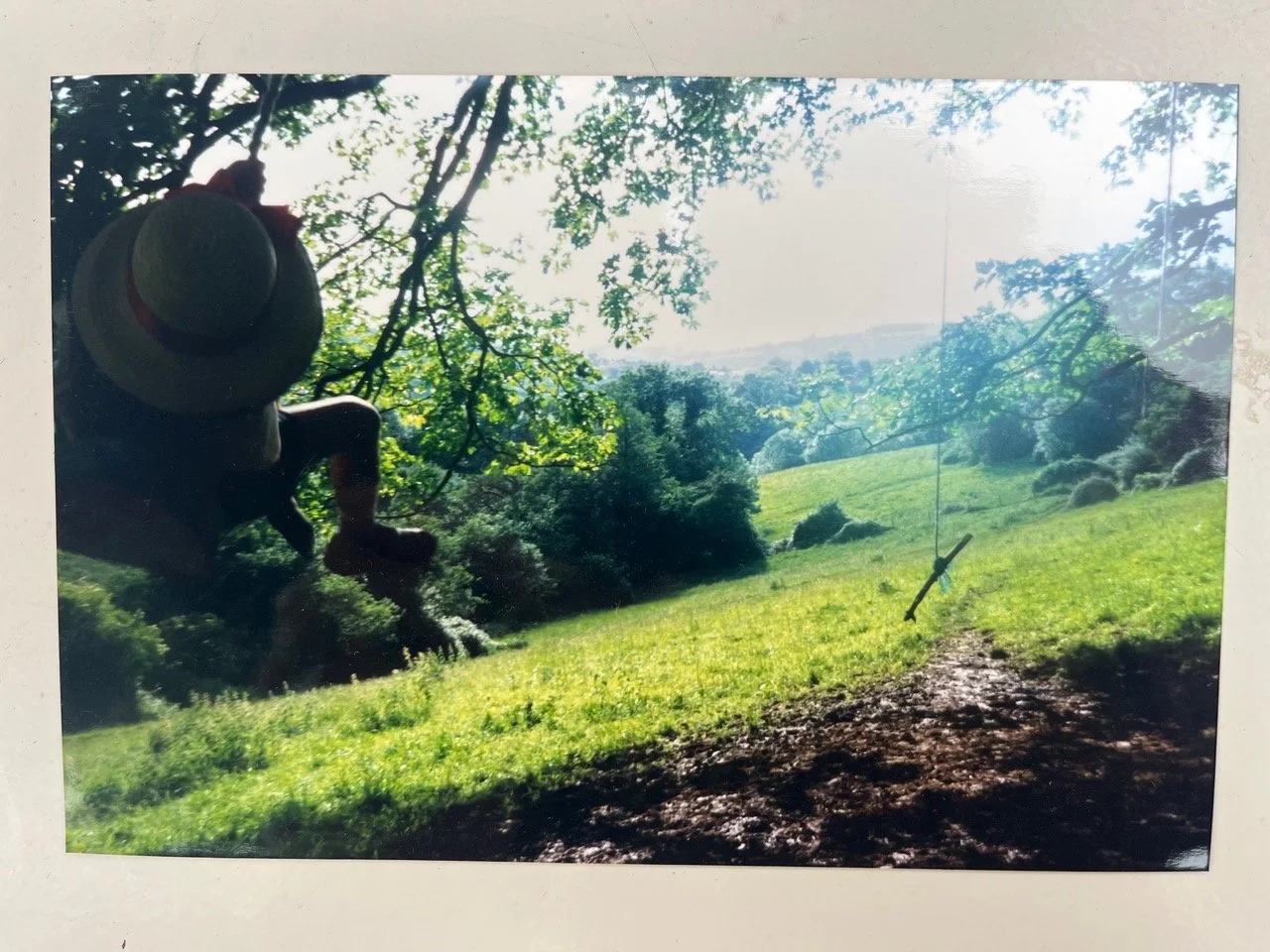
In early 2024, the Heavens were put up for sale. On the listing it was called Thrupp Farm, 102 acres, poor access, £750,000. I’ve never walked through Thrupp Farm, but clicking through the listing photos I come to the undulating swelling field of the Heavens I recognise so well. It echoes the enclosure acts of the 16th century, the acts that ate into the common lands. In 310 years (1604-1914) 5,200 Acts of Parliament were passed, creeping more once public land into private ownership. Phrases like ‘waste land’ (narrow strips of field usually farmed by the poorest peasants) and new Acts to ‘tidy up’ previous bills are strewn across the internet and journal articles about the Enclosure Acts, words that condense, diminish, remove. Gloucester born 16th century poet John Taylor damned the landowners who took from the common folk:
One man in garments he doth wear
A thousand akers on his back doth beare
Whose ancestours in former times did give
Meanes for a hundred people well to live
Now all is shrunke, (in this vaineglorious age)
T’attire a coach, a footman, and a page.
Public meetings were called by the townsfolk in the Stroud Subs Rooms (a hulking stone building erected using funds raised by public subscriptions in 1833). Google forms circulated asking for submissions of memories, photos, ways of proving that the landscape had been used for the past ten, twenty, thirty years by the people. The testimonies of a community were vital for strengthening applications for protections, for securing statuses that would preserve access to the Heavens, stall the sale. A band of residents were trying to get it registered as an Asset of Community Value, a modern Beating of the Bounds, a stamping of rights and belonging into clover and grass and mud.
Access to the countryside gives me solace and joy and kinship with the ground. Lying in my yellow lands of buttercup fields I roll around in delight and look up and all I can see is a vast expanse of blue with freely shooting wisps of white cloud. When I stand up I am alive and full and there on the ground are the crushed buttercups and clover marking the space I had been and I am tangible again. I want to lie and roll in that grass, that field, those lands for forever but I feel the damp of the evening and cuckoo spit on my shins. Still, I lay there long enough to want to reach out and touch the whole world and this tiny bit of it, this exact path. These are the bounds I beat, the edges of myself and my world.
Support for campaigns like Right to Roam are on the rise, but so too is a new era of land encroachment. An ongoing legal battle led by landowners is trying to revoke the 1985 law which allows "access to the commons on foot and on horseback for the purpose of open-air recreation". Cirencester Park, part of the Bathurst Estate, has recently introduced a £4 entry fee to a tree-lined walkway that had been publicly accessible for the preceding 326 years. At secondary school, we’d cut class, loping across the sports field and over the fence, winding through the park to emerge cackling into the town. I didn’t know we were inhabiting the same acts people had done for centuries, marking the peripheries of our worlds.
Like John Taylor, after school I left Gloucestershire for London. Now the bounds I beat are the wet soft shine of Chinatown streets, tumbling out of Soho with sweet fuzz on teeth from the French House cider, drips of earlier rain sliding off the awning. My parents always told me stories of their time in Soho, around Archer Street, the Pizza Express that plays live jazz. I knew the shape of the place before I stepped foot into it, and then I reenacted their edges. I carried the rituals of the land into my new landscape, bringing the countryside in my pockets. Traditions seep beyond the boundaries of country/city, sitting deep in our bones, waiting to be refashioned by the folk who enact them.
Not all boundary stones are imprinted through pain memories: the bound-beating processions pause for a glass of beer or snack too. I don’t like cider, just the idea of it. Each time I think it’ll be a glass of cloudy apple juice mixed in with Laurie Lee Stroud lanes, late summer bonfires, coarse stubble grass in ruts of fields. I think it will taste like the Heavens, but each time it doesn’t and the sticky sweet in my mouth disappoints. The Breton cider from the French House, a waymark of my adult edges, is the closest I’ve found. It reaches back to child me, perpetually grubby-footed me, the me that clambered over fences marked ‘private land’. I’ve been given the privilege of a deep-seated delight in being where I shouldn’t be, of claiming spaces as my own. Sometimes this is as simple as sitting on a soggy street on a plastic chair, pushing away the list of guilty tasks pressing into the back of my thoughts with not enough time, but taking that time.
That sense of freedom through trespassing.
On 27 November 2024, The Heavens Valley Action Group reached their target of £350,000 and purchased the land for 700 equal shareholders.
Cover image: Family photo. Courtesy of writer.