It’s Okay to be Real
I rarely write things this real, was planning on writing nothing but poetry in Texas, but when someone tells you a story and your first and enduring thought is, Iggy Pop needs to hear this, what else can you do?
It started with Gatito driving alone towards North Beach. 79th Street Causeway, traffic barely moving. Looking out through his open passenger window, Tito saw, through the open driver’s window of a Rolls-Royce Phantom, a very square jawline and this shoulder-length blonde hair that seemed to mean something or be from somewhere.
The traffic picked up after the North Bay Village exit, the Rolls pulled away, and the last thing Tito noticed was the driver’s hairless arm, resting on the door, hand tapping out an unheard drumbeat. White but deeply tanned, the arm was creased and veined like – and Tito doesn’t say this, this is me – the surface of Mars in imagery we get from orbiters and probes, those arid rivers and gullies that make up what we’ve called Osuga Valles, Newton Basin. It was Iggy in the car and, for another project I can’t get into here, I’ve spent hours zooming into high-res photos of Iggy’s long limbs, his bared chest, the waxed cartography of his outer self.
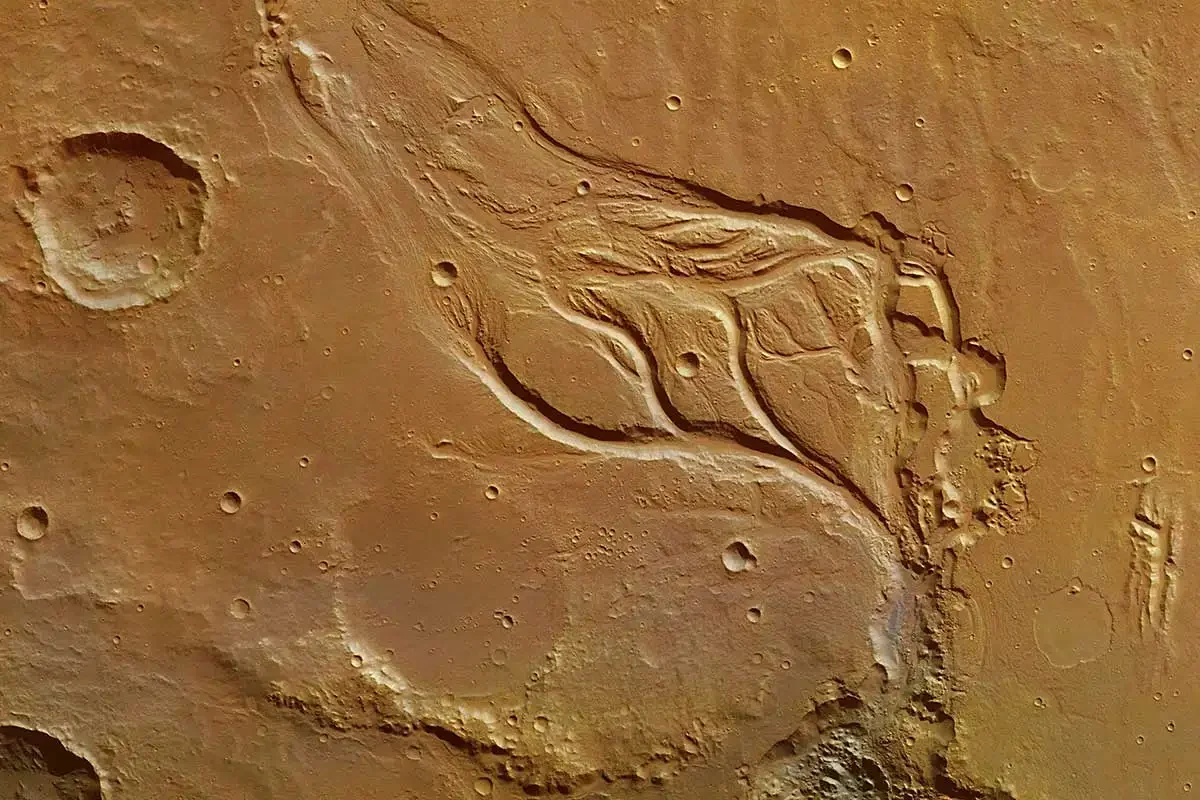
An image of the Acheron Fossae region of Mars, taken by the European Space Agency's Mars Express orbiter on Oct. 24, 2024. Sourced from Space.com.
I’d no idea it was Iggy when I saw this, Tito’s telling Geo and me, didn’t even know he lived in Miami. Omar told me that, months later.
Omar from Gander & White? Geo asks.
Right right right, says Tito, that Omar. I miss him, sweet Omar, haven’t seen him in too long. He got sick, you hear?
I didn’t, says Geo.
You ever know his last name?
Geo shakes her head, I barely met him.
Tito, GeoVanna and me are in Legion Park, my last day before flying to Dallas for the residency in Corsicana. My first trip to Miami since the pandemic, I’ve missed these two like exiled family. There’s a birthday party with Bluetooth cumbia around the wooden picnic tables. A booming coach conducting a frantic children’s basketball class. A couple in washed-out pink smocks keening over the drone of their harmonium in the shade of the mangroves, though we hear that only in the gaps between songs on Tito’s playlist. 55 hours of Beverly Glenn-Copeland and Mercedes Sosa, Bola De Nieve and Hailu Mergia.
I Wanna Be Your Dog had come on, that was when Tito started telling us about the Rolls, the jaw, Iggy’s arm, and what ludicrous synchronicities we sometimes need, what flukes of oscillation, a minuscule slowing down or speeding up, that tap-tap-tap to align the stroboscopic dots so that a new track can nestle into what’s already playing, ready for its volume to be nudged up, up, until it’s already there. The lie of anything having any real beginning, proven once again.
64th and Biscayne, tiny, not even green on Google Maps, Legion Memorial Park in the Lemon City neighbourhood of mainland Miami is a sliver of thick grass and old tree bliss in this mostly parkless city. Banyan fig trees fingertip-perched on their prop and aerial roots. Live oaks elbowing each other out the way to get some sun. Squirrels arcing like foxes over snow for the grapes we throw. Geo had told us about the Million Trees Miami mission her friend was working on, its goal to shade 30% of Miami-Dade County with an urban tree canopy, to try and reduce the heat island effect, rinse carbon from the air, soak up more groundwater than the tens of thousands of mostly useless palms. A rain bomb had hit the last time I was in Miami. I’d watched the edges of the streets gather puddles, runnels. Went over to Tito’s second-floor apartment to see slow cars throwing out wakes behind them. Called to check on Geo in her tiny-home truck as the wheels of the parked cars we could see, including Tito’s, disappeared under oil-scummed water.
Tito and me had arrived before Geo. Watching turkey vultures coasting in the updraft around the late-70s Palm Bay Towers, I told him how Sam and I had become bird-people during the pandemic. Obsessing over Berlin’s buzzards and kestrels as we knotted the city in useless loops. Falling for each other as we fell for the swifts and swallows that came, went. Swapping J. A. Baker for T. H. White, sending links – after Sam had to return to London – for things like Helen McDonald up among a thousand shuddering songbirds as they migrated past the Empire State Building.
Tito nodded towards the nervous white bird that had been strutting around us, prodding as the dry ground with its curved, pink-orange bill, the same colour as the circle of featherless skin around its Camel-blue eyes. That’s where my name comes from, he said, Cigüeña, heron.
I gave it a beat, told him, That bird right there is a white ibis, and we cracked up, tapped our cans of Yuengling together because he’s drinking again, but only on weekends; and I trusted him when he said, It’s okay, I’m back in the studio, I’m making.
We were working at the Bass Museum, Tito tells us, prepping and painting walls for that Ugo Rondinone show. Gander & White had been booked for the install’s grunt work, so me, Omar and a few others were getting that done, while Ugo’s team uncrated and set up all those creepy clowns.
Gander & White are one of the world’s biggest art handling firms. Most of the artists I knew in Miami worked for them either regularly, or during Art Basel. All of them freelance. Custodians of the Irreplaceable. By Appointment to HM The Queen.
The Ugo Rondinone piece is called vocabulary of solitude. Each of the 45 human-sized, hyperreal clown figures frozen in walking or reading, showering or thinking, pissing or dressing. Cross sections from a mundane Ugo day that come together to describethe anguish of human solitude. It’s not the worst gallery text I’ve seen.
I read for them, in my most put-on English accent, the title for the film installation in the same show: It’s late and the wind carries a faint sound as it moves through the trees. It could be anything. The jingling of little bells perhaps, or the tiny flickering out of tiny lives. I stroll down the sidewalk and close my eyes and open them and wait for my mind to go perfectly blank. Like a room no one has ever entered, a room without any doors or windows. A place where nothing happens. (1998).
I’d seen it in London, years before. The room bathed in lavender-blue from ceiling lights. Six large, grainy projections showing slowed-down scenes of people, each alone in a frame, performing what weren’t called, but could easily be thought of as, clown turns titled things like ‘Tearing Down the Wallpaper’, ‘Struggling in Water’, ‘Opening an Apartment Door’.
We pass around fried plantain slices, Mrs. Peter’s fish dip, the white ibis gone. A breeze came across the water where, through the mangroves, we can see some of the spoil islands Christo and Jeanne-Claude wrapped those pink polypropylene snoods around in the early 80s, a brief flare of queer joy just before the AIDS crisis wildfired through America.
Omar is this kind of quiet guy, Tito says, but one day on that job he mentioned – no, it was someone else on the team, Jan, I think, yeah, it was Jan. They were good friends, a double act, Abbott and Costello, Jan and Omar. It was Jan who asked Omar something about Iggy, but before Omar answered I jumped in, because that’s when I knew who I’d seen, in the Rolls: Iggy! I told them I’d seen him, the Rolls, the jaw, the arm, and Omar was so happy. I’m a huge Iggy fan, Omar told me, huge-huge.
I lie back as Tito veers off to a recent visit to Coral Castle. Don’t go – he’s telling Geo as I watch the turkey vultures carving out language from the sky – they made it real shitty. They have these tour guides now, trying to make you laugh, out-of-work actors; they don’t let you alone.
Tito first went to Coral Castle when he was 20, not long after sending himself to Miami from Araucanía, to get away from the drugs. It was built by this Latvian guy, Tito says, single-handed. Took him decades, thousands of tons of oolite. He was in love with this 15- or 16-year-old, and made the castle for her, I think. Or maybe because she wouldn’t get with him.
Gross, says Geo.
Totally. It used to be so magic, the castle, all that oolite. It was at the castle I learned Miami’s built on it.
I prop my head up, tell them that oolite is made up of millions of egg-shaped grains, carbonate of lime; that the name comes from oo, Latin for egg. They look at me, as they often look at me, like I’d just shown up at The Corner wearing a banana costume.
This guy never told people how he did it, Tito says, so all these rumours fly around that he used ancient techniques, Egyptian, Medieval, mystical. He talked a lot about magnets, so people said that he used these magnetic forces to move the coral, which makes no sense.
I was thinking, as Tito talked about the gross magical castle, about all the art handlers I’ve known. All the things they’re paid to crate and lift, inspect and log, don gloves for, forklift, foam, winch, mount, level, move to the staircase for a dinner party, to the atrium the next day because the staircase wasn’t right, back to where it started because a thousand dollars a time is nothing for the NBA players of Hibiscus Island, the talk show hosts of Fisher Island, the tech entrepreneurs of Star Island. And all the things they’re not paid to do, like lick a Rembrandt.
The sun is just about below the line of buildings on Biscayne, Geo and Tito agree it’s getting cold. I check my phone. It is 28 degrees Celsius, 82 degrees Fahrenheit. I tell them they’re ridiculous. They tell me I still look transparent.
We drive to Kush Café, which has become Don’s Diner, with Don’s 5-Star Dive Bar below it. They’re setting up for a comedy night down there, and I’m no good at lying, the barperson tells us, so I’ll just say that some of it might be alright, most of it probably won’t.
We sit outside, our table overlooking Little River, an older woman in bright yellow board shorts and a vintage Cape Canaveral vest lying on a cushioned bench along the far wall, easing a sundae into her mouth with one of those long metal spoons. I love Miami for ten thousand reasons none of which I could ever write down without seeming daft.
After watching a boat emerge from under the bridge over Biscayne – Idle Speed / No Wake – Tito says, Right, the boat, as if this was what he’d needed all along. Tap-tap-tap.
Tito tells us that after a few shifts working together me, Omar, and Jan end up back at Omar’s place, we had to fix and waterproof these pedestals the museum kept messing up, needed more tools, more space, we’d been around the museum too much, long hours, nights, anywhere that wasn’t the museum – and those clowns – was where we had to be.
So we get there and Omar’s place is full, just like full of stuff, projects, art, I mean it was everywhere. It looked like trash, you know, but then you saw all this manic care, the focus; man it was incredible. There were shelves and shelves of these bottles painted with acrylics, and other things he’d been at, soft toys, clothes, I can’t even remember. I pick up a wine bottle that’s got this full-length portrait of Iggy on it and Omar starts telling me about all the bottles he’s thrown into Iggy’s backyard.
I laughed. Tito says, how was I supposed to know he was serious, but Omar carried on: someone had told him that Iggy’s got a house on a small canal, Coconut Grove, right off the bay. So he found the address, zoomed in on Google Maps, and took his boat down there. It’s one of those backyards that dips right into the water, no fence, nothing. So that was that, Omar told me. He starts boating over there at night, throwing his bottles and other works into Iggy’s yard. Not all that often, he told me, just enough. That became part of his practice, I guess.
Then Omar went quiet. I could tell there was something else, but he said nothing. We get the work done, take the pedestals back to the museum, that’s that. But next time I see Jan I have to ask what he knew. He laughs, tells me Omar wouldn’t want to tell me this himself, because it might seem like boasting, but over the next months and years, Omar’s work starts showing up in documentaries, interviews, magazines. Iggy even mentions the pieces a few times, saying they’re part of my collection. Tito cannot do an English accent.
Then this one time, Jan tells me, a friend of Omar’s gets this job at Iggy’s place, installing some weird-ass animatronic sculpture. This friend sees all those bottles on the shelves there, recognizes them as Omar’s, asks Iggy about them, trying not to give anything away.
Iggy smiles, tells this guy, These are gifts from the River God. The River God sends me these things, so I hold onto them, protect them, and they protect me.
Damn, Jan said, I wish I’d have been there to see Omar’s face when he heard that.
We went upstairs for Don’s all-day breakfast, ordered old fashioneds we didn’t know were made with a Biscotti-flavoured liqueur and served with the glass in a wooden box alongside an actual biscotti. Tito sent his back while trying to remember the documentary about Iggy that Omar appears in.
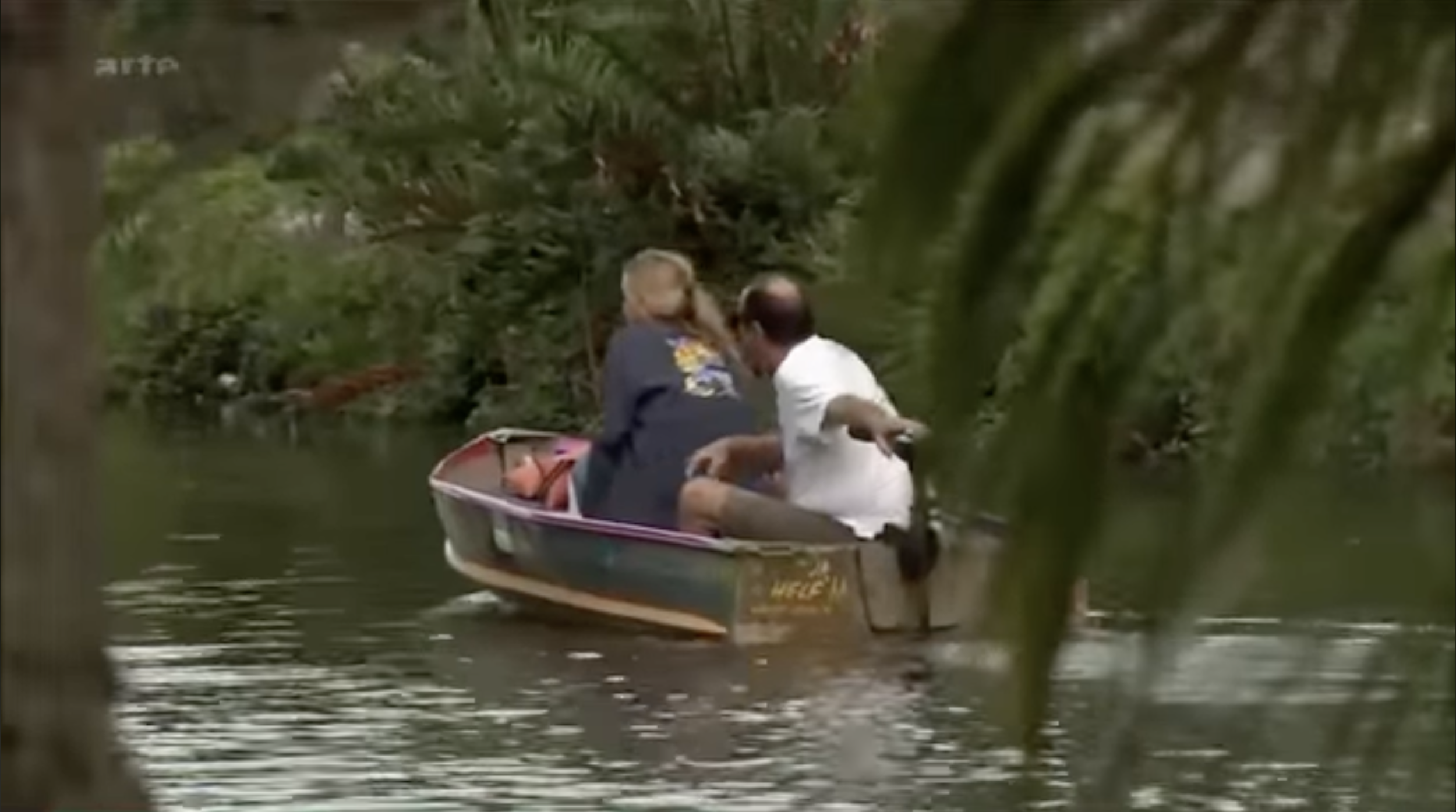
Cover image: Still from Call Me Iggy, 2012, Dir. Jean Boué. Screenshot from YouTube.
Call me Iggy, directed by Jean Boué; the only version I can find has a French voiceover on top of the English audio. 29 minutes in – this is at MIA, I’m waiting for my flight to Dallas – you see Iggy down at the water’s edge of his backyard, topless, staring down at what a cut reveals to be a manatee loafing at the surface, then slipping down into the green-brown water.
Later, Iggy’s lounging in a wooden chair. Hair scraggly, not combed or washed. He seems relaxed, peaceful, right hand tucked in behind his head, revealing one of those extraordinarily long upper arms, left fist curled under his chin.
The soft whirr of a boat fades in from the left – I’m listening on my headphones, my gate just announced – and we cut to a small fibreglass dinghy. And that’s Omar, Tito had told me, that’s actually him. There Omar was, at the tiller. White T-shirt, black shades. His wife upfront.
That’s a nice boat, Iggy mutters to himself, all different colors. He shouts: That’s a nice boat! Omar beams, nods; his wife gives a thumbs up, whatever it is she shouts back lost behind the French dub, C’est Miami.
And even after 20, 50 taps to rewind, I still can’t hear her actual words, or work out why they were translated like that. Iggy watches as the boat passes, then sits up: Oh, he’s got a little, that’s an electric motor, how cool, a silent motor, that’s so – a dog barks – hey, is that the dog, I heard a dog.
We get one last shot of the back of the boat, the name Helf or Welf in faded paint on the stern, Omar’s circular bald patch.
The film cuts to a close-up of Iggy indoors, velvet jacket, white collar, hair clean and straight. Well then what happened, Iggy says, responding to an unheard question, what happened was it became so difficult to maintain Iggy, to keep being Iggy. Some of the time because I was a mess, some of the time because I was just this boring shit in the industry. It became so difficult, it just wasn’t much fun, being Jim.
His face twitches at that slip of calling himself his real name. But watching again, here in Texas (where, ludicrously, the only other artist here – Johnny, a painter from Arroyo Honda – knows Omar, his art, his bald spot, that kindness) I want to tell Iggy it’s okay to use real names. To tell things as they are. Throw bottles. Believe in gods.
And if there’s anything you want to say back to Omar, then now’s the time.
His boat’s almost out of shot, that manatee corkscrewing after him in the soft churn of the propeller. The French isn’t making much sense and the dog’s at it again. But it’s okay to be real. So let’s make this happen.
Iggy, meet Omar.
Cover image: Still from Call Me Iggy, 2012, Dir. Jean Boué. Screenshot from YouTube.