Q.E.D! or The Mathematical Proof of the Evanescence of Desire
You meet at the Lycée’s decathlon for science in Molyko; he is laughing at something someone just said, and you are ready to leave. But the sun is blazing, and your brother is still roaming, so you duck into the canteen's shade to wait. When your eyes meet again, he is buying water from the woman beside you. You are not sure if he is smiling at you, or if it’s just the last drop of his previous laugh left hanging on his lips. But you need water too, so you walk up to the woman and say ‘hi’.
‘Hi’, he responds before she has the chance to, and you’d always think of this moment as the time he snatched the water woman’s pleasantries. You’d always imagine it – a nice little thing you had thrown to her, and how he had grabbed it halfway like he’d needed it more than she ever would, tossing it in his pocket, for keeps.
And he had held on to it too, so that after that day there’d be no need for pleasantries between you two. No need for ‘hi’s on the phone since the one in his pocket was still safe, still viable. And you’d sit together many times to talk, sipping water, or Coke, or Satzembrau, and you’d realise that he was a lot older than you thought, perhaps older than your father would have been if he were still alive. You’d sip and stare at the wrinkles on his arm, at his shallow dimples, and scientific curve of his lashes as he reads the components of every bottle he drank from: Calories 92, Carbs 6.6g, Alcohol by Volume 5%; fixating on the black patch on his grey hair, a riot resistant to age.
He’d tell you he is a mathematics teacher; you’d tell him that you were going to get a degree in Statistics, but then you had to drop out to take care of your brother. He’d look at you blankly, tell you about his twins, the boy and the girl, who should be here now winning all these math prizes, but do you know they decided instead to be fashionistas? You’d laugh, tell him about your brother whom you could scare the shit out of by simply switching off the lights and whispering in the dark that Trigonometry was coming. And he’d laugh too. But you won’t talk about your father, or about the fact that your brother was really your son, and he won’t talk about his wife. You’d bond. Over the stories you can share and the ones that you can’t. Over your mutual hate for heat and your mutual love for math. And for the longest time, it won’t occur to you that you found math appealing for the exact opposite reason he did. That it was for him, the exactingness of it, the precision and the way adding two ones will always give a two; the way calculations are trustworthy, and formulae used right will always birth the same result. The facts. The rules – anything raised to the power zero is one. You, on the other hand love Probability and the possibilities of otherness, you love the polymorphism of x and how it shape-shifts per equation, the mystery of something always being searched for, sometimes unveiling itself as more than one thing at once – a mother/sister – even in the same equation, quicksilver, liminality, a flickering between negatives and positives: x equals plus or minus two. The unpredictability of something that continues to reinvent itself.
Over the years, you’d forget the order in which the events unfolded. It’ll sometimes be a haze, which one happened before which: your brother flunking out of school for the fourth time before you finally gave up, gave in, selling your shoe shop and sending him to go live with the relative who always insisted you remind her of younger self; go live anywhere he could survive without SinӨ. Or did you meet the twins first, and were flabbergasted by how much the boy looked like their mother, how much the girl looked like their father? Was it the boy or the girl who had said God was in her practical jokes bag when she crafted their famille?
You’d learn things about him: how he liked to romanticise math. You’d heard him ask his students once to define their lives as a factor of x. Straight-faced, watching them watch him humourlessly. Was it a real question? You had swallowed, made a mental note to wonder properly later what your answer would be. At a school fundraiser, he’d gone on a tirade about the indecency of youth, which had segued to a lecture on elegance, ‘Strive to be like the integration sign,’ he’d said to his children, explaining its svelte gracefulness and regal uprightness, like a special species in the family of S’s, that has been taught to always stand up straight, to always walk tall.
You had rolled your eyes playfully, half jealous of the poor symbol. ‘Are we now comparing the leaders of tomorrow to pseudo-hieroglyphs?’ His son had said, and his daughter had added – ‘So basically, you’re saying to stand out we must integrate; or worse, become integration itself.’ You all laughed, he shook his head, and you would come to understand that this is pride, having children you can argue with.
And the truth was that you too enjoyed your banters with him, liked how they sent you nose-deep into dogeared dictionaries and science and history and thoughts, scavenging knowledge, hankering for more. And then one day, when he asked you how far the new achu restaurant was from campus, and you told him, by foot, three plays of Richard Bona’s Dipita and a verse, he had smiled and said you reminded him of his late wife. And it would be the only time he’d ever speak of her.
But you had heard about her, threw your ears towards rumours and gossip that concerned her. And they returned with fast stories of impracticals, her backbone of grace and the legend of their union. It had been fourteen years since she passed; fourteen years, and he had remained unmarried. The kind of woman no man could truly get over, except of course the truck driver who had done exactly that, leaving her lifeless body on the tarmac, leaving her husband a confused widower, with two toddlers to look after.
You wonder if he had heard stories about your father, too. There was not much to hear really, apart from the fact that he had spent his life beating the tomboy in you dead. Pried the plier from your hand and replaced it with a ball of knitting yarn, disappeared your baggy shorts, your worn, torn, dungarees, fitting you into these dresses longer than pre-reception speeches. Everything worsened after the pregnancy. You wonder if he knew about your brother as your son. Wonder if he knew you could still hear your father even after all these years, yelling for you to sit like a lady, for you to close your goddamn legs.
And then it’ll happen, a few weeks after your brother travels, after you meet his children, whom he never called ‘the twins’. It would be after he’d asked you if you still wanted to pursue a degree in Mathematics, and you’d said yes, yes o! He’d started to teach you then. Polynomials, Vectors, Graphs. And on one rainy Saturday, after a flood announcement on the Pidgin News, he would scribble an equation on your palm like a phone number at a bar, and ask you to plot it.
(y² + x² - 1)³ - x² y³ = 0
And even though you are intimidated by the cubes (can handle the squares), you stay up that night trying, flipping through Core Course, as beads of rain scatter on the pavement, fingering pamphlets for help until you eventually get it. Math was a responsive con in that way. You plot it across a graph paper. When the dots eventually connect, you see it emerge, a large diagram of a heart forming, pinning itself on all of the axes.
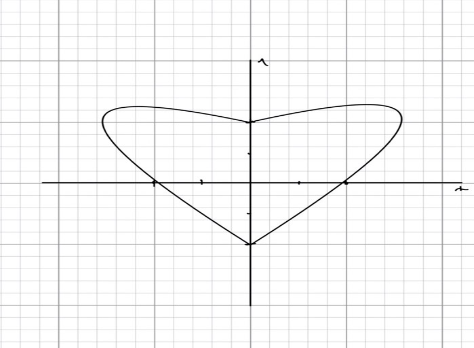
(y² + x² - 1)³ - x² y³ = 0
The twins are excited for you, and something about their excitement grounds you. You call your brother, ask if he is doing fine. He is, he says, but since when do you care? You are silent and he says sorry. You tell him you are marrying the mathematics teacher and he laughs, ‘isn’t the man more than twice your age,’ he says, ‘older than fucking Methuselah? Doesn’t add up.’ You laugh. You want to say that the man is only in his sixties, what is so old about that? But you don’t, you just keep laughing, and when he says he is serious, you ask him to shut up. What a convenient time for his arithmetic to kick in. ‘Doesn’t add up!’ you mimic. You laugh.
When you are married, you learn more things about him. Like the fact that he is rich. Tons of money his wife left, joined with his own savings for the past two decades. He has property in places you only know by name. He only spends on his children, and his suspenders, and now on you. You don’t know the amount exactly, but it is something you are sure your brother could never calculate. Perhaps an amount so much it could pass for illegal. He offers to pay for your Statistics degree, to open another shop for you if you want. You look around the house and think about all the hardship you have been through, how good things came in old greying packages. No more slaps across the face or beatings with gas tubes, no more running behind unwilling passersby, cajoling them to buy rubber boots. No more hardship. Now, everything about your life is soft – the sofa, your slippers, your name on his mouth – and as you would come to learn soon, his penis.
The first time you try is on your wedding night, but he falls asleep as soon as you touch him, and you slap your head, tell yourself no one actually has sex on the wedding night. Not after all that dancing.
The next time, you wear lingerie and bring coconut oil for massages. You kiss and fondle each other for several minutes, you tell him how good he looks, the most handsome sixty-seven-year-old on planet Earth, he laughs, tells you you are the most beautiful woman in the world. You both know the lies, understand the exaggerations, but you do it anyway. You peck and neck and smack and moan, and then you are ready to receive him, but he does not rise.
The next morning, you make breakfast. He sits on the table, silent. You try to play it off, act like everything is alright. You ask about the twins, anything to take his mind off. ‘Fine,’ he says. You do nothing sexual that day, nothing that week, let the pressure fall, let his mouth open. Let him come back home from class laughing, saying that you won’t believe it, that Mr. Kedinga, the other mathematics teacher, choked on the quadratic formula. ‘Can you believe it?’ You laugh,
‘x equals minus b, plus or minus the square root of b square minus four a c, all on two a’
You say, and he seizes you, kisses you, tells you you are smarter, way smarter, than that phony. You give in, throw your arms around him, hoping something will come of this, but then he stops midway, tells you he has to grade these exams; the students are expecting it tomorrow. You want to tell him his wife is expecting it today. But you don’t.
You smile and ask if he wants some tea. He smiles back and says yes, two bags in 250mls of hot water. Before you go, he kisses you on the cheek. You smile.
The twins come to visit. You have always thought of twins as two sides of a coin. The “good” one and the “bad” one, the loud one and the quiet one, the smart one and the slow one. But the twins are the same, both loud, and unlike their father. And perhaps from the stories you have heard, unlike their mother too. They hug you at the gate and tell their father he looks healthy because of you. He says of course, very few people understand measurements, very few people understand care.
The twins are working on a project for school, redesigning some of their mother’s old clothes to give them a touch of modernity. But they don’t want to alter the originals, so they take pictures, buy similar fabrics, and try with those. They show you to a hidden closet where all her clothes are lined, clean and pressed as if she was just on vacation in the grave and could waltz in anytime now. You watch the closet, the thick fabrics you’re certain they couldn’t find just anywhere these days. ‘She had good taste,’ you say.
‘Right?’ The twins reply.
‘That’s who we get our style from, not papa.’ And then they laugh.
‘Your father has good taste,’ you tell them.
‘In women maybe, but we’ve told him, you can’t bring back suspenders if you don’t believe they ever left in the first place.’
You laugh. You like having them here. They are closer to your age than their father is. When you ask them how much longer they are staying, they laugh and say, we know we are interrupting your nightly activities, but we promise we won’t overstay our welcome.
What? You laugh, startled. And when you look at them, you are almost convinced they are waiting for details. You stammer. They laugh, ‘Ew! Please, we don’t want any details’, they say, as if they were hearing your thoughts.
When the twins leave you go to the rental shop and buy a porno DVD. You are not sure why but something about interacting with them made you think of this. You shave your legs and when he comes home, you try to get him to watch it with you. It could help with the situation. You look at him, try to not get offended. He adjusts himself on the bed as you creep onto his chest, playing with the hair around his belly button. But it is barely two minutes in when he starts to move, starts to get irritated by the loud fake moans, too disgusted by the act itself displaying from the TV his children had put there for him to watch football. He throws up, on your legs, on the bed, emptying his gut, coating everywhere a slimy yellow, with veggie toppings.
In the coming weeks, as a peace offering, he will try all the things you want. He’d dress up as a butler, and you’d dress up as a queen. He’ll be a patient and you’ll become a doctor. He’ll be a convict, the notorious gangster terrorising the street, and you’ll be the police, cuffing him to the bed, registering his discomfort even through the laughs. You’d switch it up, switch roles up, he’d be a plumber and you’d be a damsel in distress, wet from the shower leak, you’d be a celebrity, walking around your mansion with nothing but a see through kimono, and he’ll flip pancakes in the kitchen, your chef. He’d be a fire fighter, and you’d almost burn down the house trying to create a fire he could put out. You’d try everything you can think of, but always, it’d end in disappointing sighs, the only thing rising the heap of worn and dumped costumes on the slab.
The doctors say it is normal. That a man his age can start losing libido. You roll your eyes, think of calling a friend, but you don’t have any you can tell something like this. So, you go to the women who sell where your shop used to be. You did not like them at all when you sold there, just a bunch of gossip champions, you’d tell your brother. They shout when they see you, tell you you look so good, so well fed. ‘Haya!’ Look at your nails, your hair. You make small talk, laugh, and inch the topic in, prefixing every request with ‘my friend wants to know if –’
You suspect that they know there is no friend, that they know it is you who needs help, but you are too desperate to care. So, they lead you to a dodgy shack where two men sell what they call EP, aka Erection Power. You try not to think about the name. It is a brown powder in a little plastic bag. At first, the men try to make a pass at you, ask what you are doing with a man who needs this to perform when they could handle business without it. You laugh, nervous, and they stop suddenly, straightening their faces as if ordered by something, someone you couldn’t see. They spell the instructions out, three times, verbatim, like it was a recording. You repeat it: ‘Mix a pinch in one teaspoon of palm oil until it is a paste, and then ask him to lick it all.’
When you are leaving, you thank the women from the shop. They raise their hands in greetings, tell you they hope it all works out well for your friend.
You contemplate the issue. If you should let him know where you went and how you got it, what it is for. Or if you should just mix it in his food and see how that goes. You decide on telling him. It is always better to be upfront about these things. He looks at you, defeated, and you can tell that he does not want to do it, but then he says ‘ok,’ and asks to try it. You kiss him. And when it starts to rise, you feel your own excitement from your gut, when you touch it, it is hard. Hard hard. You jump up, life is so repairable. But then he starts to scream. Shouts that it is burning. He runs to the bathroom, and you follow him, trying to help. He has stripped down to nothing. He is under the shower, and you are scooping bowls of water from the reserve and pouring it on the erection. Not too little, not too late. When it is all over an hour later, he sips his tea and tells you calmly that he is not trying anything you suggest anymore.
You don’t talk for a while. You cook and make his tea and leave it on the table for him. He eats, drinks, and drops a necklace for you on the headboard. This goes on for a while. You call your brother, but he does not answer, so you call the twins. They are bubbly as ever. For a minute, you wonder what it is like for them having him as their father.
When you start talking again, you don’t mention sex. He’d come back from school and fall asleep on the bed, sleeping, knees bent in a position that makes him look like the question mark. And you’d cuddle him from the back, making him the small spoon.
One day, bored, curious, you walked around the house like an inspector, checking crannies and crevices. There is a picture of his late wife in every room. She is the kind of beautiful that remains with you. That leaves an aftertaste. You wonder why they all think you look like her. Remind them of her? When you get to the room where her things are, you study them, try on her shoes. They are all small for you, and you laugh; it is funny, you had always thought her shoes would be too big for you to fill. You tried on her clothes, they fit perfectly. You pry in front of the mirror, they are flare and flowery, you spray the perfumes from the drawer. The bottles are mostly empty, but you can still get a semblance of scents, so you do it anyway. You look in the mirror again; you are the perfect woman your father wanted you to be.
You wait for him in bed in her clothes. You dim the lights and put fire on the candles. When he comes home, you play Grace Decca’s Besoin D’Amour, only because you had seen the CD cover in the perfume drawer. He is startled when he sees you. He tells you you are the most beautiful woman in the world and this time you believe it. But only because you think he is talking about her. For the first time it works, you have sex there on the floor; your bodies a merging eureka. You fall asleep constructing a three-variable equation, which you know is at best, nonsensical, at worst, forgettable.
When you wake up, he is making akara banana, and you can hear him singing from the kitchen. He is happier than you have seen him in a long time. He brings some akara to you. Feeds you the first one in bed, and then rushes back, and you laugh as he dances about, as he turns to you and winks. ‘Come downstairs when you are done.’ He asks, ‘Would you?’
‘Yes,’ you say.
And you love him, you really do. His joy is a soft tap of sweetness on your tongue. But as you eat, you think of your father, and how he had beaten you into the girl he wanted you to be. You think of your son called brother, and your life on hold, your education, for him; you think of his father, who had turned you into a mother at sixteen, and then disappeared forever, click, like a dark magic trick. You eat the last ball of akara, and feel a pinch in your chest. What did it mean to have sweet on your tongue and acrid in your gut? This you didn’t know, but you know you’d be damned before you let him try to change you into the wife he had lost.
When you go downstairs, he is on the phone, perhaps with the twins. He is talking about sending them money, about setting up to pay your fees because who else is meant for grander things than you. ‘Best school I can afford,’ he says. His eyes are shiny, the white t-shirt he is wearing, and something else in his gait makes him look emerging, baptised. He is laughing at something the person on the other side of the phone had said. You are counting your breath, reeling in equations, plotting all of the ways you could leave.
Cover image: handwritten mathematical proof, courtesy of writer.