The older one becomes, the more the present becomes invaluable. And just so, for 71-year-old Marta Masson, every day wanted its maximum utilisation.
So, when she said, during our first meeting, ‘I cherish you, even now,’ it was neither brash nor off-putting. But did prove significant.
‘Don’t worry, Sophie’, she pressed on, ‘I’m not expecting anything in return. Nothing, likewise, as demanding, at any rate. It’s just that at my age I don’t have the luxury of languishing.’
I was in Paris with this singular lady – painter, poet, philosopher – to do a series of interviews for an article attached to the Smithsonian.
Our initial meeting took place in her spacious fourth-floor apartment on Rue Mouffetard. The walls and furniture were bone and ivory white, which allowed for the vibrant and sometimes violent explosions of colour that commanded the space in the art and decorative pieces astutely displayed. Exclamation marks in a life made of them.
Marta either invented elegance or redefined it, I thought, as she glided across the hardwood floor, sheathed in a shimmering black, full-length dress and sat on the white leather couch, punctuating the room with flair.
‘So, you’ve come to unmask me – is that it?’ she said with a disarming, coy smile.
‘Given the depth and breadth of your work, I doubt you’ve left anything out.’
‘Oh, but there have been omissions. That’s why we’re here; to clear the air.’
Her response provided an opening for which I wasn’t prepared; an inference for which I never could have been. So, instead of ‘what omissions,’ I played to my practised script. ‘There’s something beyond your canvases,’ I said, ‘beyond the book-some essence, some aura that gets at everything else. I thought we’d try to mine that.’
‘Are you mixing your metaphors?’
A puzzling sense of disquiet had overcome me in Marta’s presence, so I answered. ‘Probably. I confess to being…nervous, for want of a better word.’
‘But, darling, despite my reputation, I’m not going to devour you. That would be untoward.’
‘You don’t do interviews, as a rule,’ I reminded her and interiorly attempted to use the observation as an excuse for my unease. But, of course, the reason proved much more profound.
‘If you know my art, then you know how I feel about rules.’ She arched her eyebrows and sat back into the couch, teasing me.
‘Well,’ I said. ‘I hope I can keep up.’
'I’ll talk slowly,' Marta answered.
And so, it began –my journey to redemption, engaged in an intricate dance with a woman who lost her parents to a genocide, a husband to an accident and a son to a war.
'But those are details,' Marta told me as we carried on. 'A catalogue of traumas unique to myself, but not unique unto themselves.'
'We’re each of us victims,' she added. 'It’s what we do with victimhood that matters. How we surmount it.' Marta leaned into me then all intensity and regard. 'Have you vanquished yours?' she asked.
Surprised to be scrutinised, I went momentarily quiet.
'Come on, now,' she prompted. 'Since you know so much about me, let’s level the playing field. Who is Sophie Robin?'
'A survivor,' I told her, not wanting to stray from my purpose, but sensing our roles being reversed.
'Is surviving enough?' she asked.
'When it’s all you have, it’s everything,' I answered, fending her off.
'Yes, it was like that during the war, but you’ve been fighting different sorts of battles. Is that it?'
'Nothing like those which informed your work,' I said, attempting to get back on track, deflecting her probing. 'And cost you your family,' I dared add.
'That’s not unusual, Sophie. Europe was amuck with orphans and widows when the slaughter stopped. All of them traumatised. '
'You gave those survivors words and images to speak for them.'
'So it’s been said. Perhaps too often. But how do they speak for – to you. My inquisitor?'
This second question repurposing our time together gave me further pause. It felt more than a little disconcerting. She studied my reaction, awaiting an answer. I considered a myriad of responses. None of them appropriate, given the circumstances, but all of them germane to what she said next. 'Of course, you’re struggling with something personal, I feel. Personal, and yet also universal.'
'Dare I say suffering is universal?' I responded.
'It may be omnipresent, Sophie, but we shouldn’t serve it as a god. Or allow it omnipotence or omniscience. It’s not everything we can know.'
I pushed back. 'Yet, much of your work seems rooted in adversity.'
'An inadequate word, but we can’t allow the monsters to lord over our emotional landscapes. Inspire them, maybe. Yes?'
The intensity of her blue-grey eyes held me, pierced into me. She’d grown up orphaned, her parents Jews to be exterminated. Their miniature photos were hidden inside her bedding. I see them now – mother and father framed – from across the room on the white baby-grand piano.
I think of the faded Polaroid of my mother and me. We aren’t touching. I’m eight in the photograph and ripe for abuse.
'Someone said, out of great misery comes great art,' I deferred. 'Your parents’ images, for example. You made them iconic.'
‘It was something I needed to say. Yes. Needed to expiate. Their lives and their deaths wanted meaning.'
'Some have suggested you’ve exploited tragedy.'
'Like journalists, you mean? Capitalising on the mayhem and murder.' She spoke without rancour.
'We ink-stained wretches are trying to make sense of it,' I said.
'And have you?'
'No.' I admitted.
She smiled and nodded 'Perhaps you should begin with yourself now,' she said. 'Come to terms with your own experiences.'
My own experiences had nearly crippled my psyche. They had no place in this conversation. I strove to maintain some sense of professionalism by taking refuge in a line from her most recent book. 'It’s impossible to make sense of the insensible. Make art, yes.' I parroted.
She reflected the reference back at me. 'And just so, you became a writer and do these in-depth interviews. For your own sake, perhaps? Looking for your meaning in others. A sort of rectitude. Is that possible?' Marta smiled – inviting confession. 'You have so much to tell me.'
Me tell her? This ongoing thwarting of my intention was off-putting, but her prescience was difficult to resist. Her sincerity, impelling. That and the recent death of whom I thought was my mother nearly breached my facade, triggering the impulse to share my fraught past. Why not – at least tangentially? Such surrender, I thought, could result in a more reciprocal exchange from her.
But where to begin?
With the 3 a.m. phone call three weeks ago announcing mother had died? Alone in an assisted living facility. I rushed to find her beleaguered body waiting for me. The accumulation of eighty-two years had vanished in a whisper of farewell that I didn’t hear, having kept the ravages of her old age and the terror of my childhood at bay.
Her death brought to the surface the accumulation of suppressed childhood memories not even my psychiatrist could countenance. Years earlier, deep into our sessions, while I described one of so many traumas, she closed her notebook, capped her pen and said, 'I’m sorry, but I can’t do this any longer. It’s either the cruellest fiction or the most horrible truth. Either way, I can’t be a witness anymore.'
But all that would be too much exposure, distract even more from my purpose and unsettle me once again.
'My mother died last month,' I offered Marta as if it served.
'Ah, mothers. Fascinating creatures.'
'Your mother especially,' I countered, still attempting to forestall her probing. 'She was a firebrand. According to your memoir.'
'A communist when it was fashionable and Jew when it was not.'
'So much of her is in your work.'
'Just as much as your mother is in yours, so it seems.'
I missed the clue in her hesitation before speaking the word mother, but the 'So it seems' suggested she had done her due diligence. Investigated me. Maybe that’s why she agreed to my access. She recognised a kindred spirit. Or was that making too much of myself?
But what prompted such relentless focus on this stranger? A woman she’d never met?
Marta continued, ‘Maybe that’s why I pressed on with my art. To make peace with my mother. The loss of her. And to leave something behind. Live beyond the grave – if you’ll allow me that cliché.'
'Well, you’ve certainly managed that,' I said.
'In more ways than I had imagined. Until recently,' Marta returned.
'So, there is more to your story.'
'Oh yes. An exclusive. Exclusively for – through you.'
'I appreciate that.'
'We’ll see,' Marta said, and added, 'Your life doesn’t need any more complications, but there you are.'
A slight irritation flowered in me. The presumptive nature of her responses goaded, and I replied, 'So, I don’t really need to tell you who I am. Apparently. You’ve done your research.'
'I did. For certain. But your essence is what wants mining,' she said, faintly mocking my earlier journalist-speak.
I poised to respond, 'Touche,' but she stood, saving me from that banality and said, 'But enough of being dreary. Let’s get out and breathe some of that exotic Parisian air. I’ll change, and we’ll go.'
She exited ever graceful and self-aware. I crossed to the window, spying on the passers-by four stories below – my frame of mind as dank as the day,
I remembered the caress that became a violation. Violations ad nauseam.
The familiar ache welled up in my chest, and I wept. This silent, cascade of tears wanting their release.
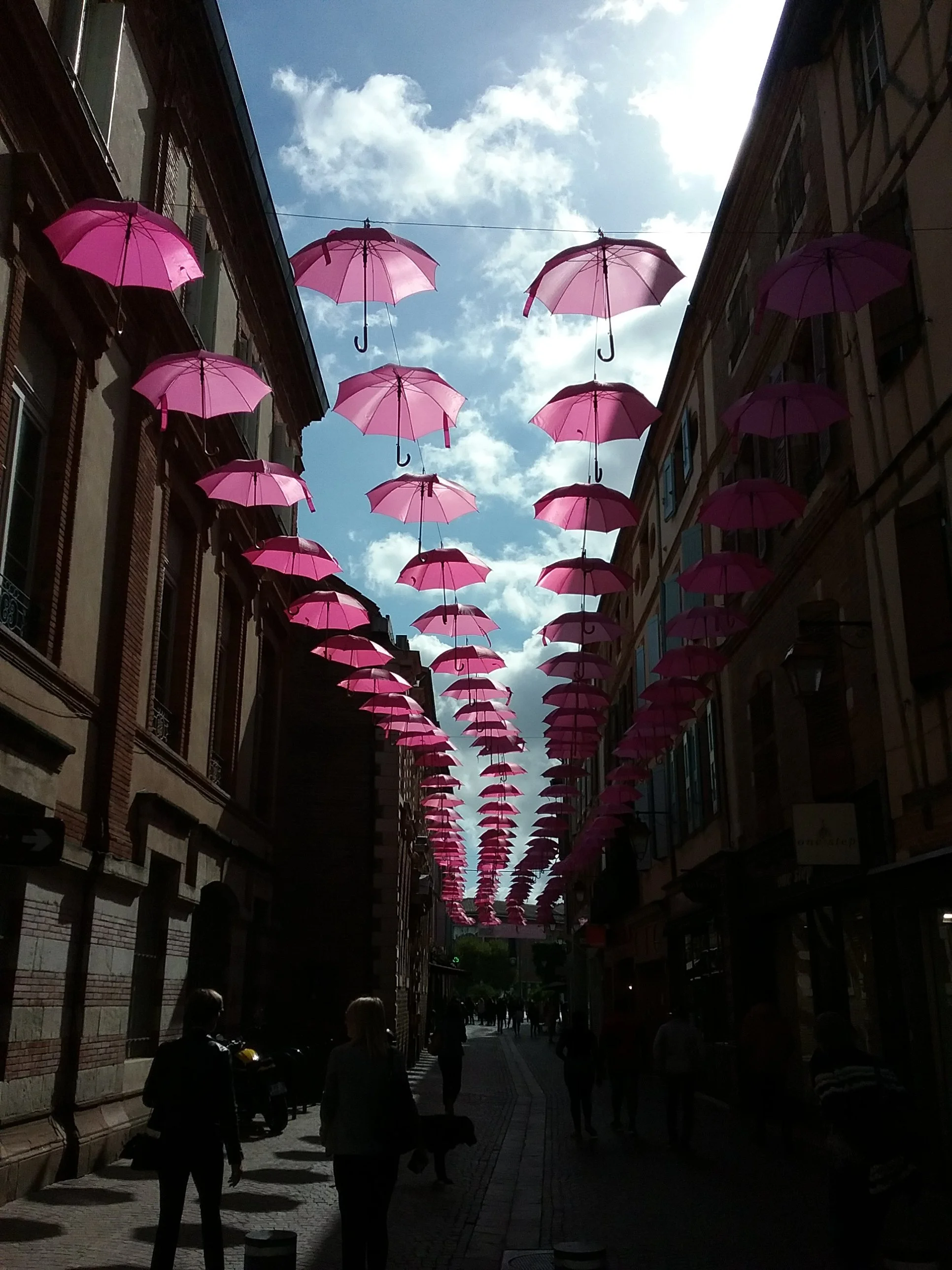
Street in Paris. Courtesy of the writer.
I heard her return and she wiped my face.
But she, of course, sensed my distress. 'Can I hug you?' she offered.
I nodded.
She wrapped me up in her arms and spoke softly, 'Sometimes it’s overwhelming. I know. I know.'
'I’m sorry,' I said.
'No need for that, my dear. I’m thinking the world owes you an apology. And me. Till then, come along. We’ve only just begun.'
She escorted me out the door.
While we walked, she linked an arm with mine. It meant more than I realised.
We sat at a corner window in a plant-festooned café on Rue Montorgueil. Coffees warmed our hands and bodies. Ever Parisian, ever fashionable, Marta dressed in black pants, a white pullover, and a black and white checked coat with a carmine-red scarf. Her array of silver-grey hair, as untamed as her work.
Passers-by marked her. She’s somebody to know their glances said, and they were right. Her recent one-woman show of female figures on two dimensions was rife with a third-dimensional profundity that invited the viewer back and back again, ever more enriched with each contemplation.
'How much of your work involves the subconscious?' I asked her, having surmounted my despondency for the moment.
'All of it. The subconscious is the author of the conscious. Heightened sensibilities provoke consciousness. Emotional memory evokes art. Wouldn’t you agree? I mean, your prose abounds with memory.’
Knowing she had read some of my writing gratified and intimidated me. 'Yes,' I said, 'memory does serve.'
’And art speaks for us. What you’re saying in your personal essay, How I Came By It Honestly, is that hereditary melancholy is your muse. Correct?’
'Well, there’s Nature and Nurture,' I answered lamely.
'Too much of one and too little of the other, in your case?'
Marta was proving relentless. Focused on my life. Subverting our time together. Once again, I took offence. 'Pardon me, but you’re asking questions to which you seem to know the answers.'
'This story we’re after isn’t about me, Sophie. It’s about you. Us. Without you in it, it will be just another paean to a tarnished luminary.'
Throughout my career, I’ve kept myself out of interviews and, in my determination to maintain that level of professionalism, missed yet more subtext and said, 'My mother did the best she could.'
'You don’t mean that.'
'All right. Mothers are confounding,' I countered.
'Especially adoptive mothers, don’t you think?'
'I can only imagine.'
'But, Sophie,' Marta said, hesitating before finishing, 'you don’t have to.'
She measured my reaction. Observed carefully as my mind and body absorbed her remark. Denial came first, but that was too easy. Her assertion, so bold and on point, it left me floundering.
'Wait,' I forced out. 'How could you even be aware of something like that? '
'I have firsthand knowledge.'
'Meaning what – exactly?'
Marta looked out the café window at the busy street, clearly considering what she would say. The moment grew in intensity. Resolved, she took both my hands into hers and said, 'Sophie. Sophie, you were the baby girl I never had.'
We held as the meaning of her reveal settled, and once fully realised, I withdrew my hands from hers, gripped the table and struggled to maintain my composure and remain in place. A thousand thoughts quick-fired through my brain.
'I didn’t know how else to tell you,' Marta continued, 'and the moment seemed – right.'
It proved too much, too audacious, even for Marta. I leapt up. 'No damned way,' I lashed at her, regretting the curse even as I spoke it. Having left myself with no other plausible recourse, I exited the café.
Outside, I nearly sprinted toward the Seine, jostling other pedestrians in my distress. At the river, I slowed, as a kaleidoscope of images and innumerable speculations swamped me.
Marta was so certain.
But how could it be true? It was too fantastical. Cruel if it wasn’t and crueller if it was. If certain, it explained so much, but excused so little. And no wonder her incessant questioning of me, getting to know her…daughter. But how did it happen – from France to America? The logistics seemed impossible. In this way, my thoughts ricocheted one to the other. Angered and anguished, I went on, allowing speculation to bedevil my mind. If it was true, what I might have become.
Miles farther and utterly exhausted – physically and mentally I collapsed onto a bench, huddled there against the cold and confusion and rocked myself to some semblance of equilibrium.
If the truth sets us free, then freedom is an illumination that blinds. Still, Marta’s confession demanded clarification. It demanded verification and I, by God, would have that. I would have that, and if proven true, then I would come to terms with my new reality.
My phone pinged. A message from Marta. 'I’ll wait for you at my apartment. As long as it takes.' I didn’t bother texting her back.
Outside her red apartment door, I adjusted my clothing, swept back my hair, and knocked aggressively.
She opened in a moment and stepped back to allow space to enter. I strode past her and stood mid-room, my back to her.
I could hear the door being closed and latched. There teemed so much to say, I couldn’t speak.
'I was sixteen, surrounded by authorities who thought they knew better,' she said, her voice nearly a murmur.
I remained silent, afraid of how I might respond.
'Do you want to hear more?'
'Of course,' I wanted to shout. And 'No' all at the same time.
'Sophie?'
'I came back,' I said. 'I’m here.'
'Yes. I’m glad.' She came around the sofa. 'We could sit.'
I sat in the leather, high-back chair, but refused eye contact.
Marta arrayed herself on the sofa. 'They – the priest told me you had died, and in my depleted state, I believed him and – interred you in my mind. Along with the guilt and shame – easier to forget than explain – until a metal box was found in my childhood home where I lived with an aunt. She had kept it from me in the attic till the house was demolished,' she said. 'Letters inside with names, dates – enough details for me to track you down – though it took months. You can see them. If you like.'
'Letters. That’s it?'
'Enough for me. We could do DNA testing to verify, but there really is little doubt.'
She spoke with such surety and was of such character, it seemed futile to challenge her any further.
But acceptance had its ramifications. I needed time for assimilation. So, in the moment, confounded, wounded and cornered, I struck back.
'It’s damned hard to believe. Accept, just like that!'
'Life-changing, for certain.'
'Life-changing? You know what happened to me. Right?' I demanded. 'My childhood.'
'Some – allegations.'
'Allegations!? I was left to be savaged. Humiliated. Abused in every way imaginable, and some you’d best not!'
'It was out of my hands, Sophie. An adolescent. In mourning and compelled to silence with no way of making amends until now.'
'Amends?! How can I be amended? Fixed’
'You may have been brutalised, but you didn’t break. The two of us have survived our traumas, Sophie. And here we are – right in this moment. What will we do with it?'
I allowed my eyes to find her then. She sat forward, her features aged, but yet arresting – and familiar. The intensity of her gaze compelled me. Demanded of me something I was unprepared, and perhaps, unwilling to provide in the moment. The obscenities of my childhood, ever more pungent, had been poked to arousal by her revelation. I flinched at them. My body clenched as a fist. How my adolescent-self had cried out to be heard, only to have my mother leave the house.
Leave the house and let it happen.
'Sophie, I wouldn’t have challenged you with this if it wasn’t true.'
Of course, I told myself, of course she wouldn’t have. Her owning my parentage was becoming more and more persuasive. Her willingness to be open to recriminations was escalating proof of her veracity. Yet, to take it on as gospel would take me to her – what, betrayal – albeit unintentional.
'I’ll see the evidence,' I said.
Marta rose, took up a manilla envelope, passed it to me and resumed her seat.
Not knowing what I wanted to believe, I sorted through the letters referencing my parents, a birth certificate, and an article chronicling the Catholic church selling babies to couples in America.
'It’s all there,' she said while I attempted to absorb the material.
'And so much that isn’t,' I responded, defiant yet.
'It doesn’t have to be all at once. You and me. Take your time,' she offered.
'Or any way at all,' I blurted, wrestling with a tumult of emotions roiling my mind.
'No,' she said. 'Not any way at all – if that’s your choice.'
Her response, spoken with such profundity, turned like a key in my soul.
To release me from any obligations to her, to give me up, again, for the sake of my skewed narrative, spoke to her motherhood more than any testimony.
Yet confronted by legitimacy, I pressed on. 'You know what you’re taking on, right?' I said, striving for some sort of resolution. 'If it’s true, what your daughter could have been saved from.'
'Suffering is universal, Sophie – in your own words.'
'And that salvages us! Alleviates the terror. Absolves the beasts.'
'It acknowledges our need for salvation, yes. And here is an opportunity. At least, between us. You’re all I have left.'
'God damn-it,' I exclaimed. 'How can it be that easy!?'
'There’s nothing easy about love,' Marta said.
I stood and returned to the window now draped in rain – the sort of rain that takes its time, lingers over the city like an indulgent paramour. A parade of multi-coloured umbrellas festooned the sidewalks below. An immensity of emotions thrummed inside me. They wanted out. They wanted to be said, but I didn’t have the vocabulary to express the depth and breadth of such fervour.
I felt Marta’s eyes on me. Felt her in my bones. My initial unease had its roots in our shared essence. That became clear.
But so much had been lost. What, if anything, could be recovered?
It’s tears, again, that answered. Raw, scorching tears turned to sobbing. Convulsive, chest-heaving sobbing. And needing to give wholly in to Marta’s truth of our relationship – coming to terms with the inexorable sense of it –I choked out, 'My god, how I missed you. All my life, I didn’t know it, but, my god, how I’ve missed you.'
Marta stepped to me, then. Fully present.
My mother.
She opened her arms, tears also glistening in her eyes.
Where I should have had refuge, all those years ago – I finally found it.
Cover Image: Street in Paris. Courtesy of the writer.