Nik Macey
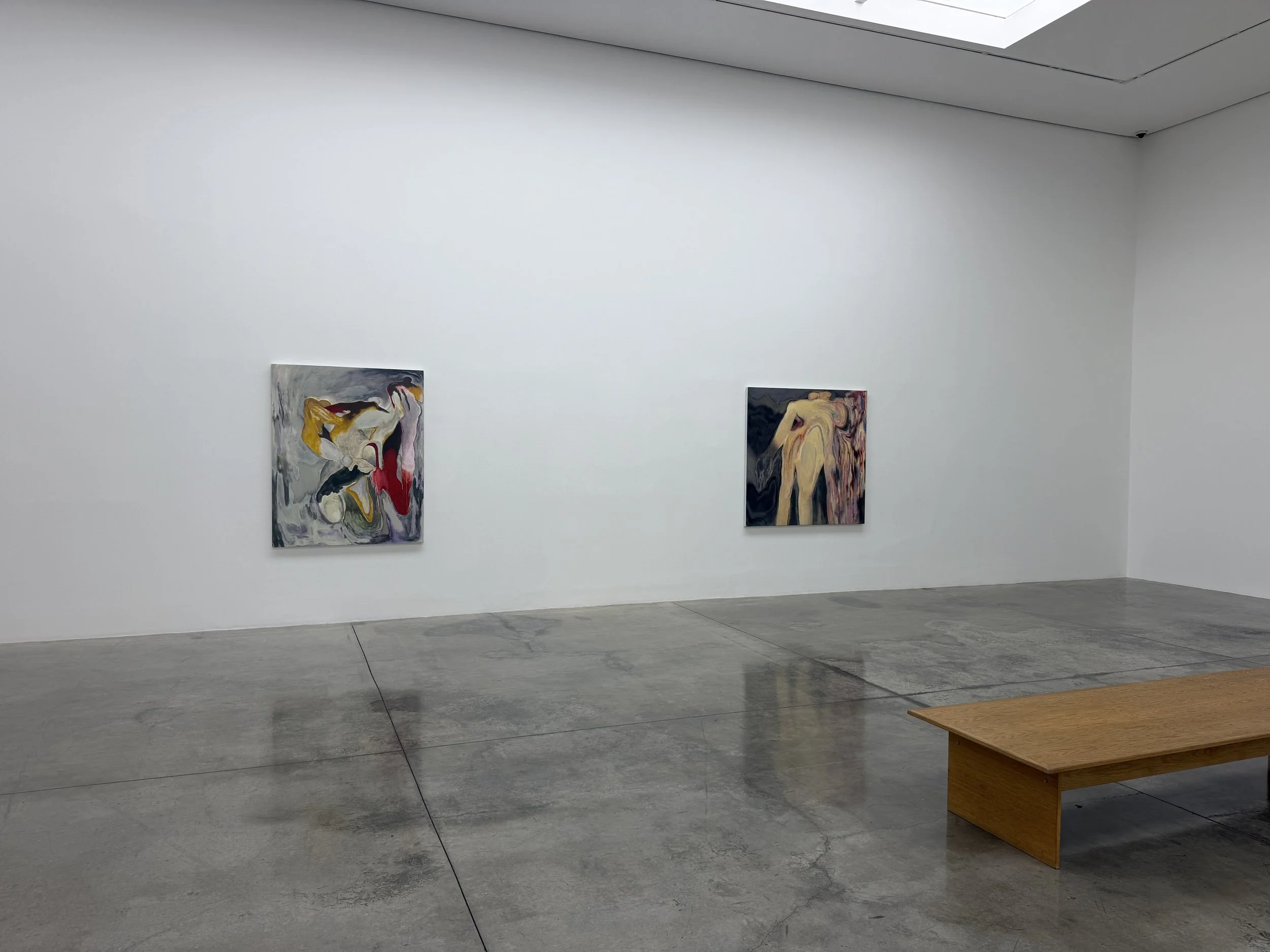
Installation view. Then by (Parentheses) Review.
I bend over, resting on one huge hand, my arm outstretched and grasping, melting down the canvas in sweeps of teal and charcoal. My palm reaches for the stability of the ground, but it is a shifting plain of ambiguity, unstable and un-graspable. My body is not mine anymore; my skeleton is vague, my limbs indefinite. Trying to grasp for stability, I’ve become an amorphous blob, rapidly swallowed by shifting sands.
I am the body inside Moonbow by Firenze Lai.
Lai’s works in North and True North render in paint the murky, formless expanses of an increasingly digital way of life. The works — made during the fraught period where AI was rapidly taking hold — unfold alongside this new reality in real time. The result is paintings that gradually descend into the otherworldly, a gradual twisting and buckling of figures that mirrors our changing group existence.
Inside Moonbow, my strange body is butter yellow, and seeps into the world around me. Most of the time I don’t feel in control of my limbs, or aware of the particulars of my physicality. It is hard to keep up with these things when my senses are constantly sucked from myself and siphoned into this bleak vista of digital ruin. I don’t know if what I see is real; I don’t know if this thought is my own, and if it’s not, I don’t know where it has come from.
Figures pile inside canvases, sometimes alone in a bleak landscape, other times huddled in groups. These figures do human-like things: they dance, reach, hunch over, recline, but in slightly disturbing ways. They often get tangled into uncomfortable forms. They mutate into the shapes of Henry Moore sculptures. They remain eerily anonymous.
Human-like features fall away, leaving deadened grey skin in The True North or desert-like swathes of skin in Metamorphosis. People are not easily defined or placed; they exist in a non-physical reality. Lai plays with the collective human psyche, and the inscrutability of a digital experience of life. To view each image is like to view a world through water, where what we see is slightly removed from reality, suffused by billowing ripples and bent or refracted. Lai’s palette, too, is a world within a world, evocative of images seen through a video camera, like the whirring replay of hazy family videos from the 1980s.
In Countercurrent figures diverge and foreshorten to become great arches of flesh. Slithers of bright, artificial colours peep out from beneath layers of bulbous flesh and paint. These colours are chromas of the unnatural. Inside Versions, a circle of figures fuse into a sculptural lump. Individuality and physicality have alluded them. No one knows where they begin or end, or how much of themselves has already been lost to the nothingness. The huddle of heads is thrust together around a deep and empty void. There is still hope — they have yet to fall in.
Lai believes in the ubiquity of images, and the reality depicted within the paintings is not limited by tongue or border. The digital conditions the work speaks to affects everybody, worldwide, living with an internet connection. If AI is bending the conditions of reality, then Lai’s warping, contorting figures might just be the new shape of the present.
North and True North is on view at White Cube, Mason’s Yard until 14 November, 2026.