In 1985, T.J. Clark devoted a chapter of his book The Painting of Modern Life to Édouard Manet’s 1882 work The Bar at the Folies-Bergère. The painting is of a barmaid standing in front of a mirrored bar in the infamous Paris nightclub, a line of bottles, glasses and a bowl of glistening oranges in front of her, and an unreadable stare in her glazed eyes.
It was Paris in the late nineteenth century; consumerism was booming, and leisure, in particular, was becoming increasingly commodified. For Clark, The Bar is not simply a painting of a somewhat bored barmaid, but rather Manet’s attempt to illustrate the tensions of this new, urban life under capitalism. It reveals, he says, the unease that simmers just below the surface of this modernity. The barmaid is a commodity for sale alongside the bottles of Bass beer that line the bar, her expressionless face unreadable. The formal instability only adds to the unease. Loose, hurried marks would come to define the painting of this period but, at this time, represented a distinct departure from the traditional Salon painting. The strange, unnerving perspective, the slightly off angle of the mirror, and the whole scene tipping forward and wait – who is that man in the corner? It is a painting of modern life, not just in subject matter but also in style.
The Bar at the Folies-Bergère now hangs in London’s Courtauld Gallery, whose latest exhibition Salman Toor: Someone Like You opened a few weeks ago. In Salman Toor’s work, the twenty-first century invades the Postimpressionist paintings for which the Courtauld is best known. Pakistan-born, now New York-based Toor has described being drawn to the ‘dignity’ of Western painting, which grants subjects a sense of presence and power, and that affinity is clear. So many of the Courtauld’s most recognisable works are reflected in Toor’s collection. There is the green tone of Toulouse-Lautrec’s absinthe coloured paintings, and the unnerving isolation felt by so many of Manet’s principle characters. Van Gogh’s thick, parallel, dart-like brushstrokes shoot across Toor’s canvases, and his influence can also be seen in Toor’s use of dark blue outlines to delineate clothing and folds in cloth. But then there are phones and chargers and laptop screens that spill pale bluish light across a darkened room.

Salman Toor, The Bar on East 13th (2019), Oil on panel, 91.4 x 121.9cm, Private Collection. © Salman Toor; Courtesy of the artist, Luhring Augustine, New York, and Thomas Dane Gallery. Photo Genevieve Hanson
Salman Toor is a painter of modern life. His paintings reflect the isolation at the heart of the immigrant experience, but also the pervasive unease that creeps in around the sides of all twenty-first-century life. Figures in Toor’s paintings move in secret and hide in shadows. In the nighttime scene Back Lawn (2021), two men lie on the shadowy ground in an intimate embrace, while, in the background, on the porch of a well-lit house, a dinner party takes place. In Man with Face Creams and Phone Plug (2019), a South Asian man stands at airport border control, his possessions splayed across a table in the foreground, inspired by Toor’s own experiences of travelling to the US in the wake of 9/11. The man is listless, but Toor affords him the dignity of a historical portrait painting.
For it is not just Postimpressionism that Toor references; The painting Lunch (2019), in which three friends sit together, heads bowed, gesturing animatedly at a phone screen, pays homage to Renaissance tondos in its round format, although the content would not feel amiss in one of Hogarth’s many paintings of raucous meals, and the lighting has a distinct touch of Caravaggio. The large painting The Bar on East 13th (2019) is a clear nod to Manet. A solo man stands behind a bar, half lemon in his hand, a martini glass eagerly waiting, completely oblivious to the thrall of revellers who dance and jostle and kiss around him. Compositionally, the reference to the Folies-Bergère is undeniable, but the similarities run deeper – the same detachment in the bartender’s gaze, the same unease that pervades the revellers – and yet, it does not feel like a parody or poor imitation. With this work, monumental in its own right, Toor is demonstrating his worthiness to be aligned with painters like Manet, not simply in style but also in the way he creates character and crafts a narrative.

Salman Toor, Three Mascots (2023), Charcoal and gouache on paper, 30.5 x 22.9cm. © Salman Toor; Courtesy of the artist, Luhring Augustine, New York, and Thomas Dane Gallery
Narrative is crucial to Toor, who likens his paintings to short stories. They function almost as fragments of a larger, unfolding story, with recurring characters who are rooted in the artist’s own memories, relationships and experiences. Subtle expressions and gestures give his characters a distinct sense of identity and inner life. Drawing is integral to this process, and a collection of his sketches is also on display in the Courtauld’s drawing gallery. It is in these works on paper that he experiments with figures, movement and expression, and really develops the personalities that populate his painted worlds. His characters have exaggerated, almost caricature-like features – elongated noses, gangly limbs and, occasionally, bright-red clown noses – humorous and unnerving in equal measure, suggesting their vulnerability and the awkwardness and performative nature of identity. Balancing comedy with melancholy, Toor creates a cast of recognisable yet enigmatic characters whose individual stories speak to wider experiences of intimacy, alienation and belonging in a modern world.
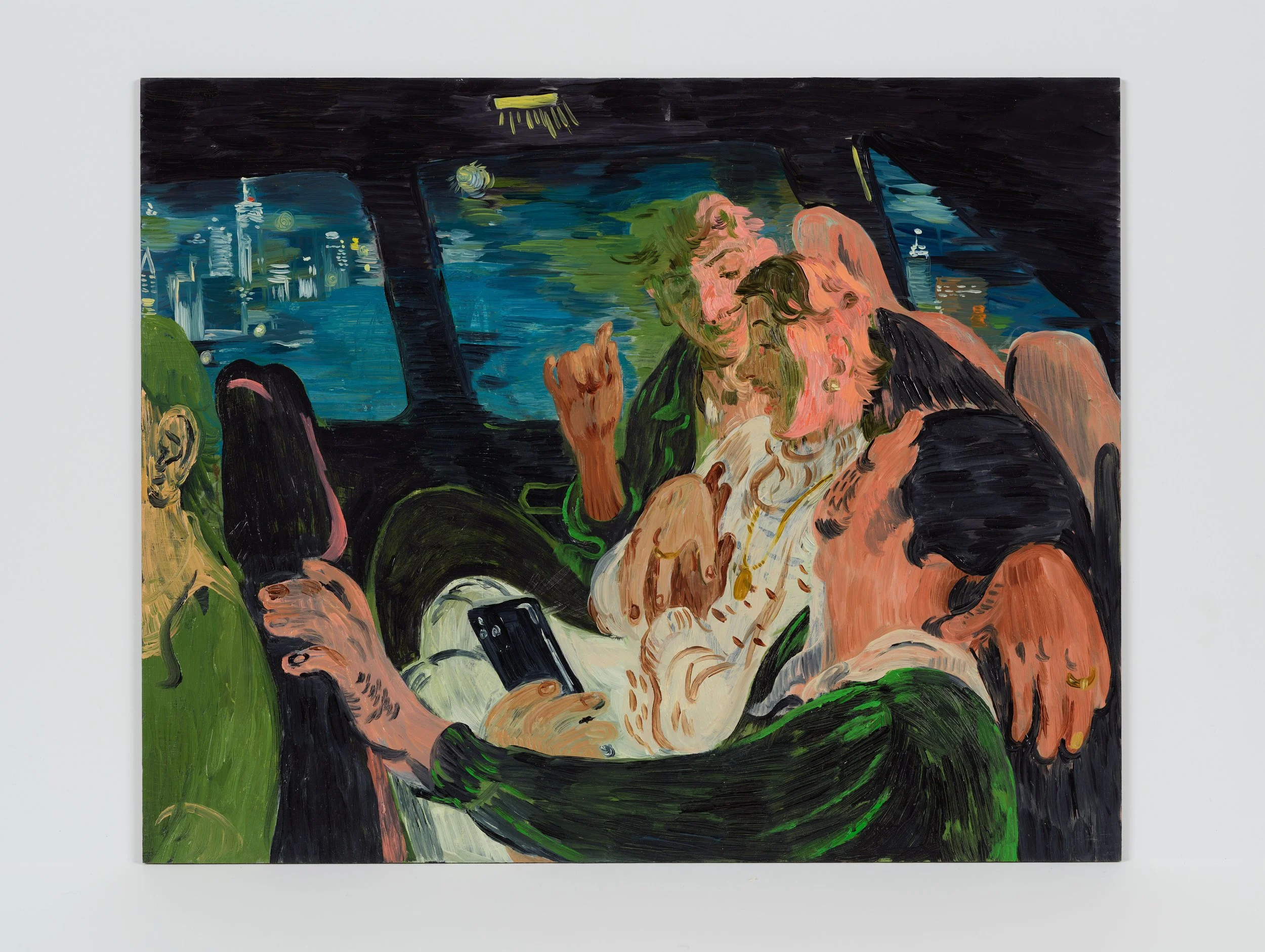
Salman Toor, Three Friends in a Cab (2021), Oil on panel, 40.6 x 50.8cm, Private Collection. © Salman Toor; Courtesy of the artist, Luhring Augustine, New York, and Thomas Dane Gallery. Photo Farzad Owrang
I marvel at the luminosity – the paint itself seems to glow. And then there are the light sources. Three Friends in a Cab (2021) shows three people laughing at a phone screen in the back of a taxi, zooming across the Williamsburg Bridge, the Manhattan skyline glowing under the yellow orb of a full moon. The painting fizzes with the sense of anticipation and excitement that precedes a night out. Bars are lit by hanging yellow fairy lights or glittering disco balls. They are little beacons of hope in an otherwise often dark world.
Because, much like with life itself, unease is not the whole story. There is also joy. These are paintings of friends and lovers, partying or eating or laughing together. In Toor’s world, life can be uncomfortable, difficult at times, but, he reminds us, life is also fun.
Cover Image: Salman Toor, Three Friends in a Cab (2021), Oil on panel, 40.6 x 50.8cm, Private Collection. © Salman Toor; Courtesy of the artist, Luhring Augustine, New York, and Thomas Dane Gallery. Photo Farzad Owrang
Someone Like You is on view at The Courtauld until 10 January 2027