This essay is an excerpt from the writer’s in-progress memoir about her father and all the things he could never talk about.
My father was resting on the sofa-bed, slightly pulled up against a pile of cushions my brother arranged last night after we got him out of the hospital so he could die at home. From where I was standing in the semi-darkness, his large frame, illuminated by morning light coming through the French windows, looked like a windowpane leaning against a wall.
His eyes were focused outside on the small yard of his London flat, possibly searching for his old friend – the squirrel. This squirrel, or maybe it was several squirrels, had visited him regularly in late winter and early spring of the previous year. Pitying the ‘little guy,’ my American father named him, or them, Abe and began leaving out generous dollops of peanut butter on a saucer every morning. Abe could often be seen sniffing the iron table in the enclosed yard, where my father drank his coffee and read the Herald Tribune or New York Times International in warm weather. But, one morning in July, my father caught Abe eating three young sunflower plants that my English aunt, when she visited, put out on the table to catch the sun. From that moment, Abe became ‘that bastard’. My father would leave no more peanut butter out for him.
I wondered if my father had forgiven the squirrel. He looked like he might be thinking kindly of his bushy-tailed friend. I would have liked to stay there in the dark, contemplating my father’s gentle expression from a distance, but I was starving and uncomfortable from the restless weight of an unborn baby in my womb. I had to pee so badly it hurt. And the least I could do would be to make him coffee, according to the strict rules he had taught me.
Coming out of the bathroom and down the three steps, which led from the hall to his dying nest, all I could think of was what I would do if he needed the toilet – a heavy man gasping for oxygen who’d never asked me to help him before. I could never support him up those three steps. It wasn’t certain when my brother would come, as he was at home helping his wife with their newborn. My father only listened to my brother. My brother was a doctor and a man. While believing he was a feminist, my father took men more seriously.
I called out to my father, like it was any other day, to say I’d make coffee, then remained a long time in his tiny kitchen eating slices of hard bread and butter; downing water from one of his chipped coffee-stained mugs while the tap kept running. Though I remembered to time the coffee for exactly four and a half minutes, I stayed hidden for longer, thinking how it was unfair of him – when we were talking late the previous night – to blame my lack of faith in God solely on my dead mother. Which made me wonder if I ever believed.
***
I’m nine and a half. I’m half staggering across the road from the car to our house. I can feel the heat through my sandals, and it hurts a little when the ends of my toes brush the tarmac. My mother has her arm hooked under mine to support me. In the car, she told me why my older half-brother died. Joe. My brother from my dad’s first wife. My brother – the grown up who comes to stay with us, who smells of America and cigarette smoke. My stuffed penguin that I love sincerely is from my brother. He knows I like penguins. I had known he died but I didn’t know why. Mum said he died because of drugs. Drugs are bad. The idea of drugs my brother didn’t need to take ending him; it could just as easily not have happened. I will never be seeing him again because he did something on purpose that made it happen. My body’s gone shivery and my eyes and throat are burning. My mother lets this be.
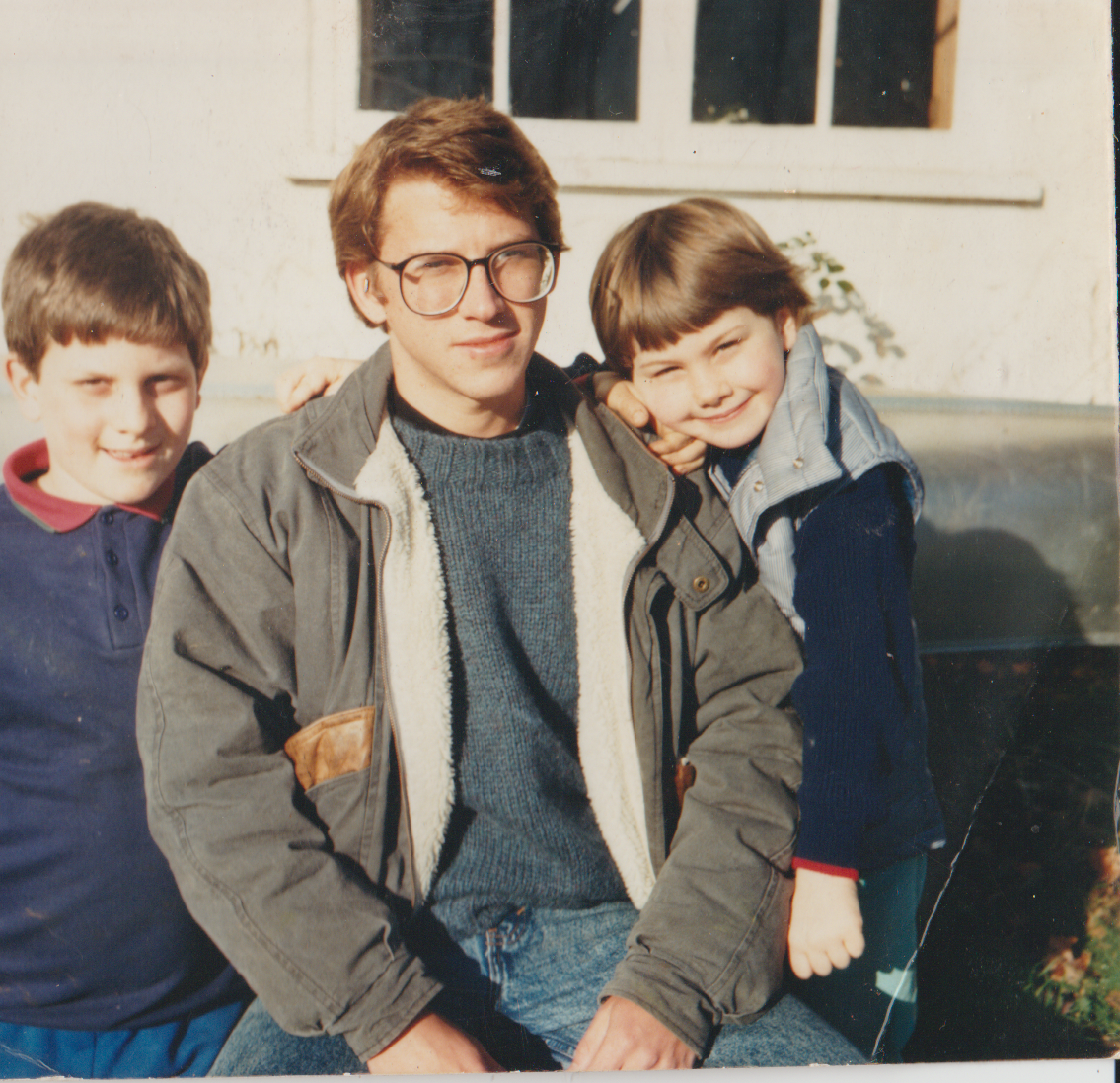
My brother and I, with our older half-brother, Joe, around three years before Joe’s death from a heroin overdose.
We climb the stone steps to our house, many steps because the front door is on the first floor. As I climb, I feel my body lightening. Tears want to come but won’t anymore when my foot touches the second to last step. My eyes squeeze shut because they sting. I don’t like the sudden coldness of my face in the breeze. My legs feel like they can hold me up fine now, so my mum’s arm in my armpit is pointless. I try to shake her off.
My father is opening the door, scowling over my head at my mother.
‘What’s the matter?’
‘I explained to Hannah that Joe died from drugs.’
I don’t look up. My toes are pink and dirty. Why was I flopping like a stupid teddy? There’s nothing wrong with me. My mother’s arm lets go and she pats me on the shoulder to indicate I can go inside. I pass through the shadow of him, knocked off balance by the darkness inside compared with out. My palm brushes the smooth wall. Dust motes lit from outside spin in warmer air when the door opens. The radio is talking to itself downstairs in the kitchen about mad cow disease and how we can sell burgers to Europe now because they’re going to get sent over with certificates. I imagine cows with paper glued to them. My parents are talking quiet behind me. My father uses few words for my mother’s many. He isn’t joking and that’s not good. She’s keeping her voice careful to stay out of the way of his feelings, which we can say nothing about.
Walking down the stairs to where the food is and the TV, I wonder if it’s ok to eat the caraway seed bread left out on the side from when we had guests over in the morning, for bagels and cream cheese from Jewish bakeries that sell fresh bagels every Sunday morning in far norther London. There are no Jewish shops where we live, only a normal butcher, florist, and the old thin man who they say has been to prison who gives me shiny red apples for free in the greengrocer. I love caraway bread. I love salmon and cream cheese. It was hard to draw when the teacher asked us to draw our favourite food in our English books and colour it in. Mine looked like a pink cowpat because you can’t see the hole in the bagel when it’s covered with cream cheese and salmon. I know I’m not skinny like other girls, but bread is healthy so it’s okay just to have just one extra piece while they upstairs talk. I can hear her footsteps and Dad going into the front room, probably to sit for a while with the newspaper he was holding when he opened the door. Hearing her coming, I wonder what she will think of me that I am fine now, not crying and chewing on sweet bread when a second ago I was bent over crying like a stupid baby. But that was in the car without Dad.
I wonder what will be on the TV. Nothing on Sunday afternoon except maybe Baywatch, which I hate. No matter how much I watch it I can’t see the point – the bits where they run for ages. But it’s better than the boringness and there might be something good. Sunday afternoon films can be watchable. Unless they’re cowboy films. There are crumbs on my feet. My mother asks are you okay and I nod that I am without looking up, because I’m chewing and I am okay now and her silence won’t get anything else out of me.
***
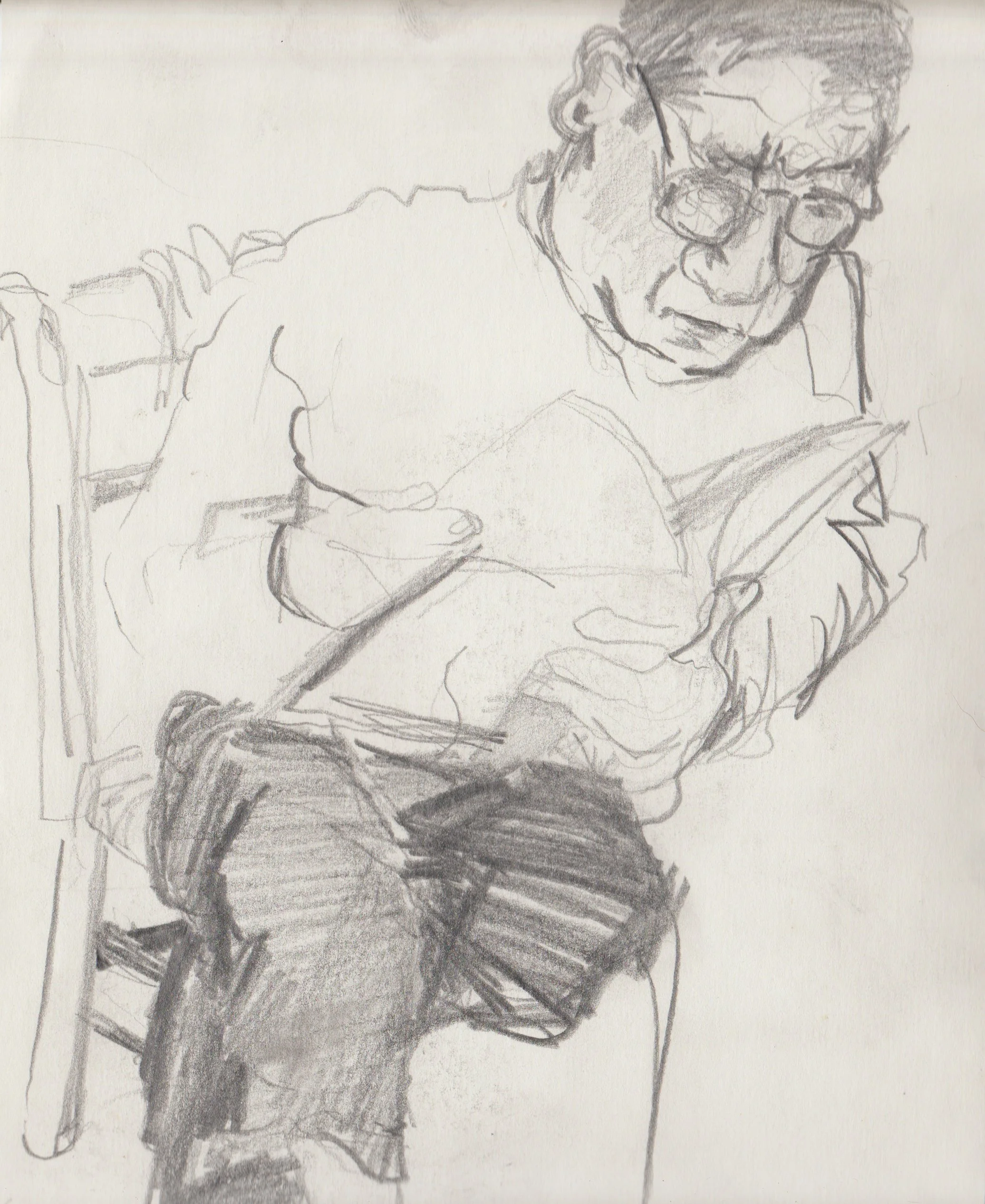
My father reading; a drawing I did, aged sixteen.
I’m ten. It must almost be Christmas, because my father has found that banana box in the attic, which contains fairy lights. He puts the box on the sofa in the front room and produces a voltmeter from his pocket – his beloved small black box with two dangling wires – and smooths the dust carefully from its clear plastic front, so he can observe the dial. The voltmeter is a Christmas tradition; I’ve been helping him measure the current in our Christmas lights with it ever since I could talk. I close my eyes and edge forwards until my nose touches the spindly trunk of our still undecorated Christmas tree, ignoring sharp needles stabbing my eyelids, inhaling pine oil. I hear my father tip out the lights and imagine him studying the tangled pile with its army of woodlice and spiders.
My father has told me that in Boston when he was a kid, some of the other Jewish families in his neighbourhood secretly carried small trees into their apartments, which they decorated and swore were not Christmas trees but Hanukkah bushes. The tone of his voice when he told this story made me understand that there was something wrong with these neighbours who couldn’t resist the sparkle enjoyed by Irish Americans in the next neighbourhood, or Anglo-Saxon Christians in movies. My father has lights, not because he wants them, but because he lives in North London where almost everyone gets a tree and, though we are atheists, we celebrate Christmas.
I turn to spy on him through the branches. He kneels before the lights, removing his thick glasses: ‘Okaaay.’ He’s speaking to the voltmeter. Glasses safely stored in the pocket of his shirt beside pens, which leave permanent black and blue circles under the pocket of every shirt he has ever worn, my father patiently extracts one string of lights from the tangle and plugs it in. I can see that shuffling about on his knees hurts him. The lights don’t work. He unplugs them and holds the first bulb close to his eyes, which appear too large without the thick lenses. He tests the bulb by placing the two metals prongs against its base and checking the dial. He tests another. ‘Look kid, I got the bastard. It’s a linear circuit, one bulb sends ‘em all out.’ Taking from his trouser pocket a packet of fresh bulbs that he apparently walked all the way to Woolworths in Kentish Town to buy, he replaces the dud. The lights shine brightly. He lays them on the sofa, peering at his voltmeter, ‘Such a great little machine!’
I’m kneeling on the floor, sweeping fallen pine needles into a pile with the side of my hand, wondering what presents I might have. If I’m lucky, a hamster. Because, now I’m ten, I’m old enough to look after one by myself.
Weeks pass, needles accumulate. The dog eats them and is sick. Presents appear. The dog sniffs those and chews up a few before we catch him.
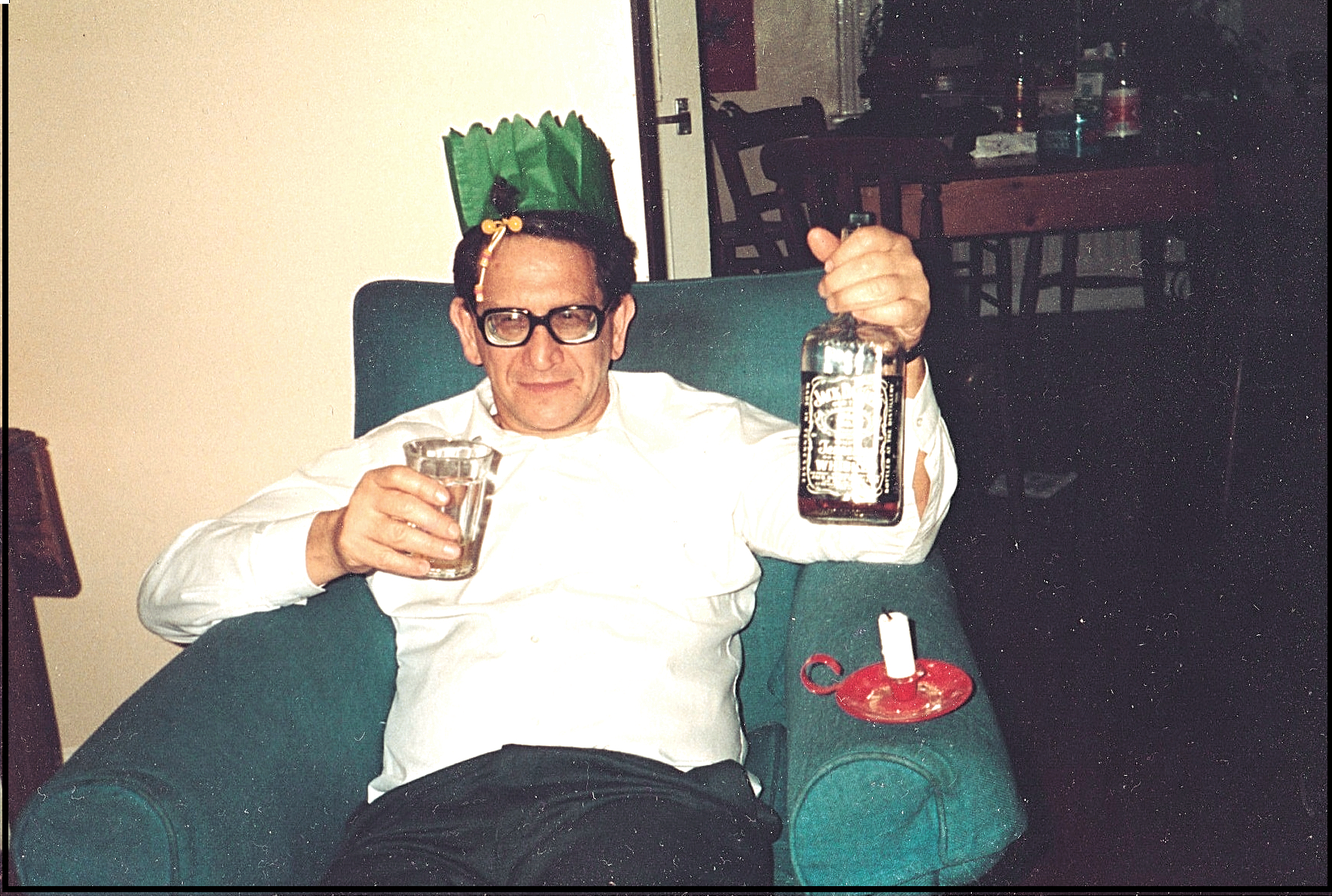
My father posing after Christmas dinner, 1992. We have decorated him with ribbons and a paper hat.
On Boxing Day, I go with my dad to the lab where he works as a professor of Neuroscience at University College. As he tells me all the time, ‘You can get so much work done when there’s nobody around.’
I spin on his spare office chair, rifling one of his drawers: looking at dusty slides with blue-stained slivers of monkey cerebellums, pens, chapsticks and keys. The air smells of chicken pot noodles. The stillness outside is spooky.
I shouldn’t’ve come but he always promises me a trip to visit the remains of Jeremy Bentham, who sits permanently in a glass-fronted case: his real bones fully clothed, a creepy smile on his wax face. When we went past earlier, the case was locked.
‘I’m bored Dad.’
‘You’re bugging me.’
I keep at it until I get what I want.
Inside the soundproof room – which they use for experiments – it’s completely white, like rooms I’ve seen in scary films where they put people in straitjackets.
My father shuts the door.
I shout ‘Aaah.’ I open the door, which is heavy and has a complicated handle that makes me thrilled and afraid I could get trapped in like a real lunatic. ‘Did you hear me?’
‘No.’ He wants to get back to his microscope. I don’t care.
‘AAAAAH.’ Open the door. ‘Did you hear that one?’
‘No.’ My father wouldn’t lie.
The silence in here is like socks stuffed inside your ears. I’m thinking about how there is no Father Christmas. Why do we still leave out a carrot for the reindeer like we’re all afraid to admit the truth?
The quiet sucks me further into myself. I’m wondering if Baby Jesus existed – the manger, wisemen, and all that. They’re always going on about it at school so why would they if it never happened? The soundproof room is a good place to think about God.
I’m thinking about Jewish families with Hanukkah bushes and how my dad never had one. Was he jealous? How different is my family from the Jewish ones with Hanukkah bushes? We’ve got a tree, and we don’t believe in anything.
The door opens. My father’s standing there smirking. ‘Was it quiet in there, kid?’ His green jumper has the faint bloom of an ink stain, soaked through from the pen in his shirt pocket.
***
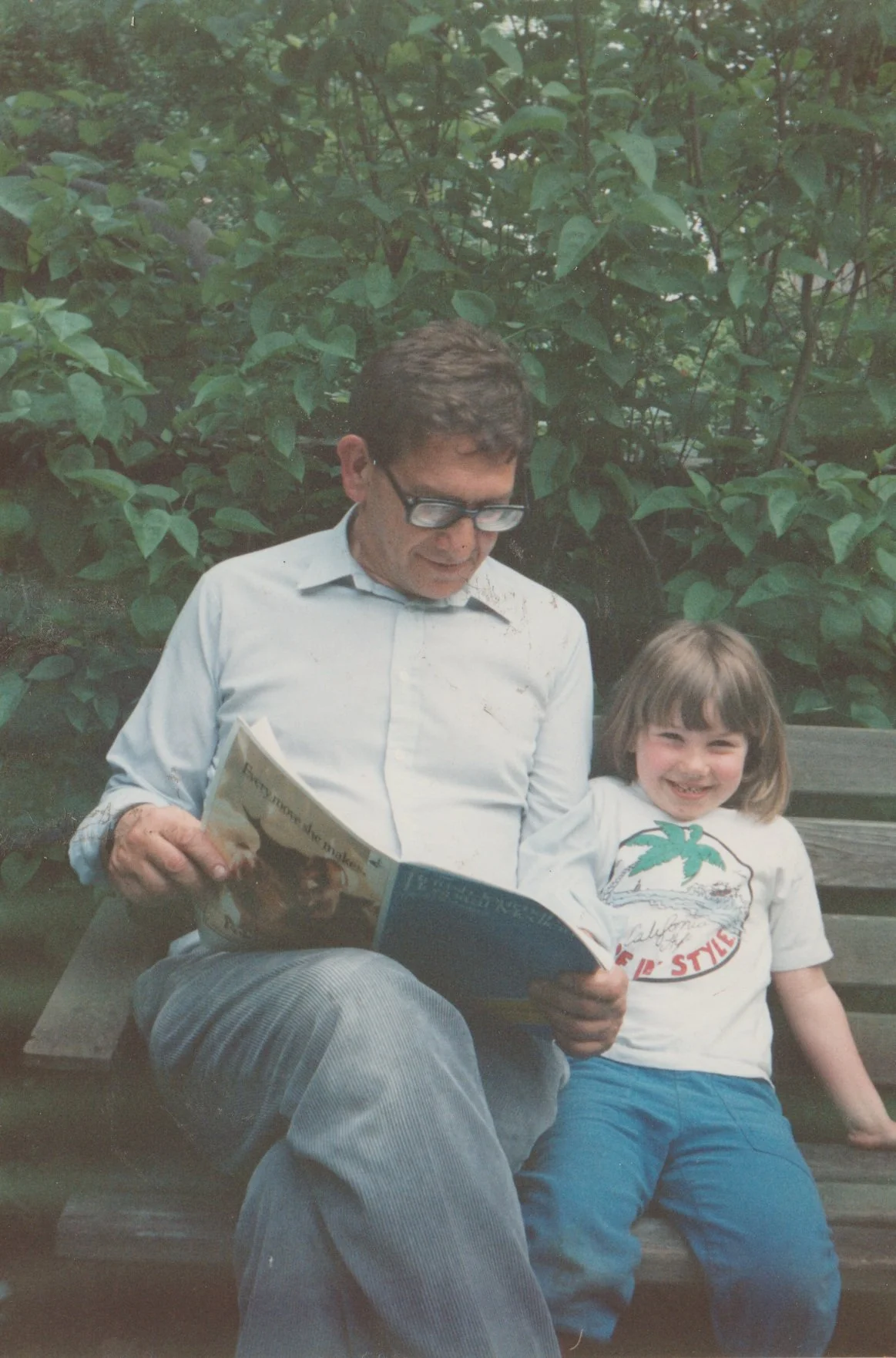
My father reading to me from a scientific journal when I was around six.
My dog has been sent away to live in the country. He kept nipping guests on the bottom. He never did anything to me. He broke the downstairs window because he wanted to get through it to chase the dog from next door. He used to run away. They said he would have a better life away from me in the country with people who could walk him. They said I could go visit him. Now the people who adopted him say a visit from me wouldn’t be good for his mental state. My mum’s going to write them a nasty letter. I could try asking God to tell them they have to give my dog back but there is no God.
***
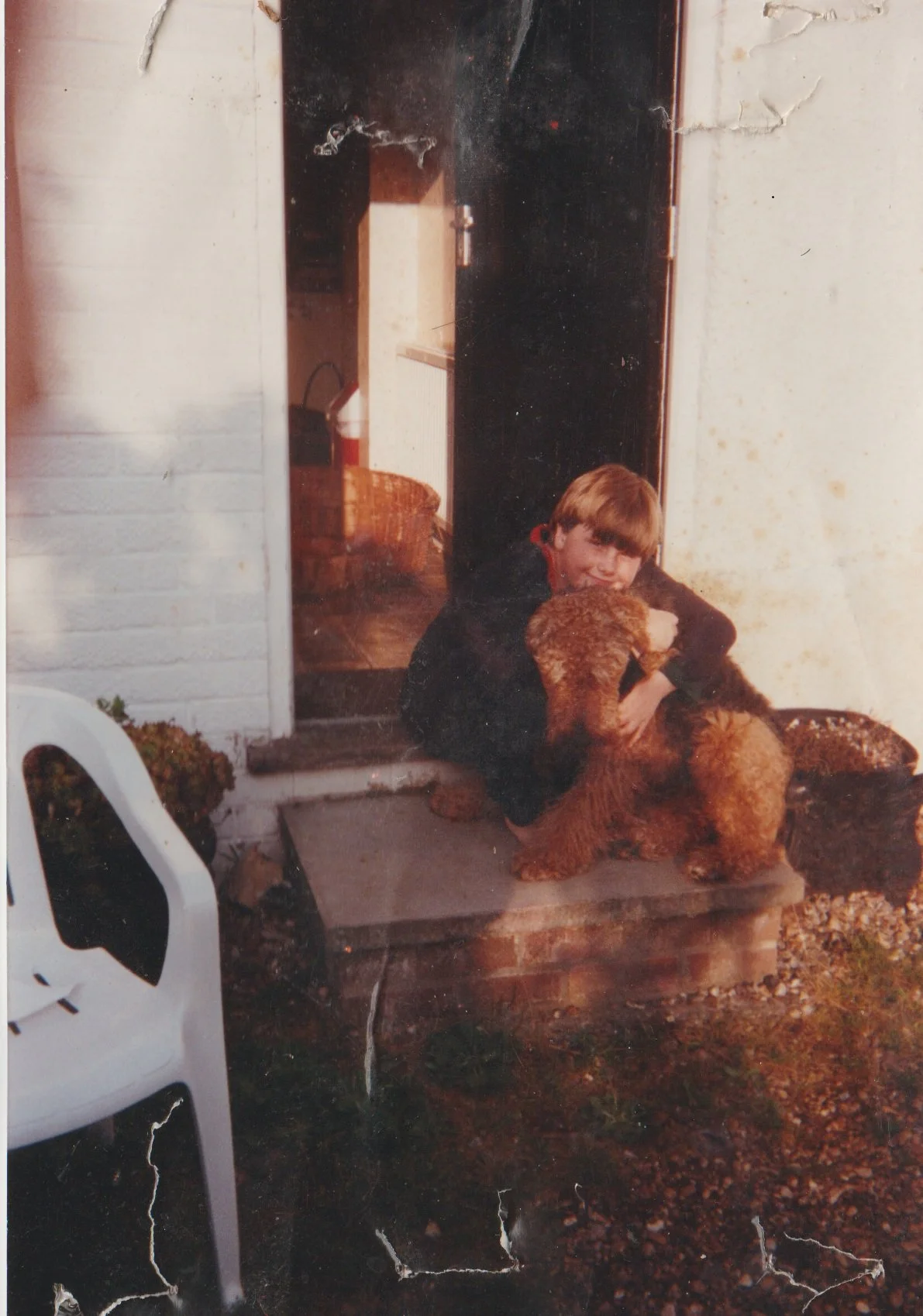
Me with my dog shortly before he was sent away to live in the country.
He drank some of the coffee I made him. I tried not to think about what would happen after it filtered through his failing kidneys.
Not long after he finished his coffee, my brother arrived.
I heard them flush the toilet. While my dad waited with his cane, my brother held him around the waist as he navigated those three steps down to the living room, which now seemed similar to a treacherous rock face.
I looked away, so I wouldn’t have to catch my father’s eye, knowing my brother had been in there with him, though my brother being a doctor gave their sudden intimacy some legitimacy. The undrunk coffee in my cup was cold, thick with granules and greasy against the ceramic. I’d forgotten how, with this pregnancy, the smell of caffeine made my stomach turn.
I looked out the French windows searching for Abe, trying not to hear the noises of pain and effort that my father couldn’t help making as he lowered his leg to the floor from the final step. I noticed a wet ballpoint pen outside on the iron table that my father must have abandoned the last time he worked on a crossword in the sun. Someday soon, someone would throw it away because the ink wouldn’t flow properly. I thought about how I loved the old man and how badly his silence had hurt me over the years. I wanted to ask him about the past, I wanted to know more about my dead brother whom he had hardly spoken of since his death. I wanted to understand how Joe got to the point of overdosing on heroin alone in his bedroom. But it felt wrong to ask anything that would cause him pain. I knew that soon, my father’s voice would congeal like the ink inside his pen before disappearing forever.
Cover image: The writer and her brother, Ben, with their father.
All photographs are from the writer’s personal archive.