Trigger Warning: discussion of sexual abuse
‘You have to ground first and find a space to come back to,’ says the psychologist I am seeing.
‘Where is safety for you?’
‘The river, back home.’
‘Good, now visualise it and where you are exactly; what do you feel and hear?’
‘In the river’
Fresh, pulsing water against my ankles and the whisper of the surrounding trees, of their leaves caressing each other.
My two feet in the river like I never dared to do – where I never dared to be.
En son sein. In her centre.
That was the only session of Eye Movement Desensitisation and Reprocessing (EMDR) I managed to do. Not the processing kind, only the grounding. Any other attempts to follow my psychologist's finger with my eyes would send my body to collapse.
The river was my only door.
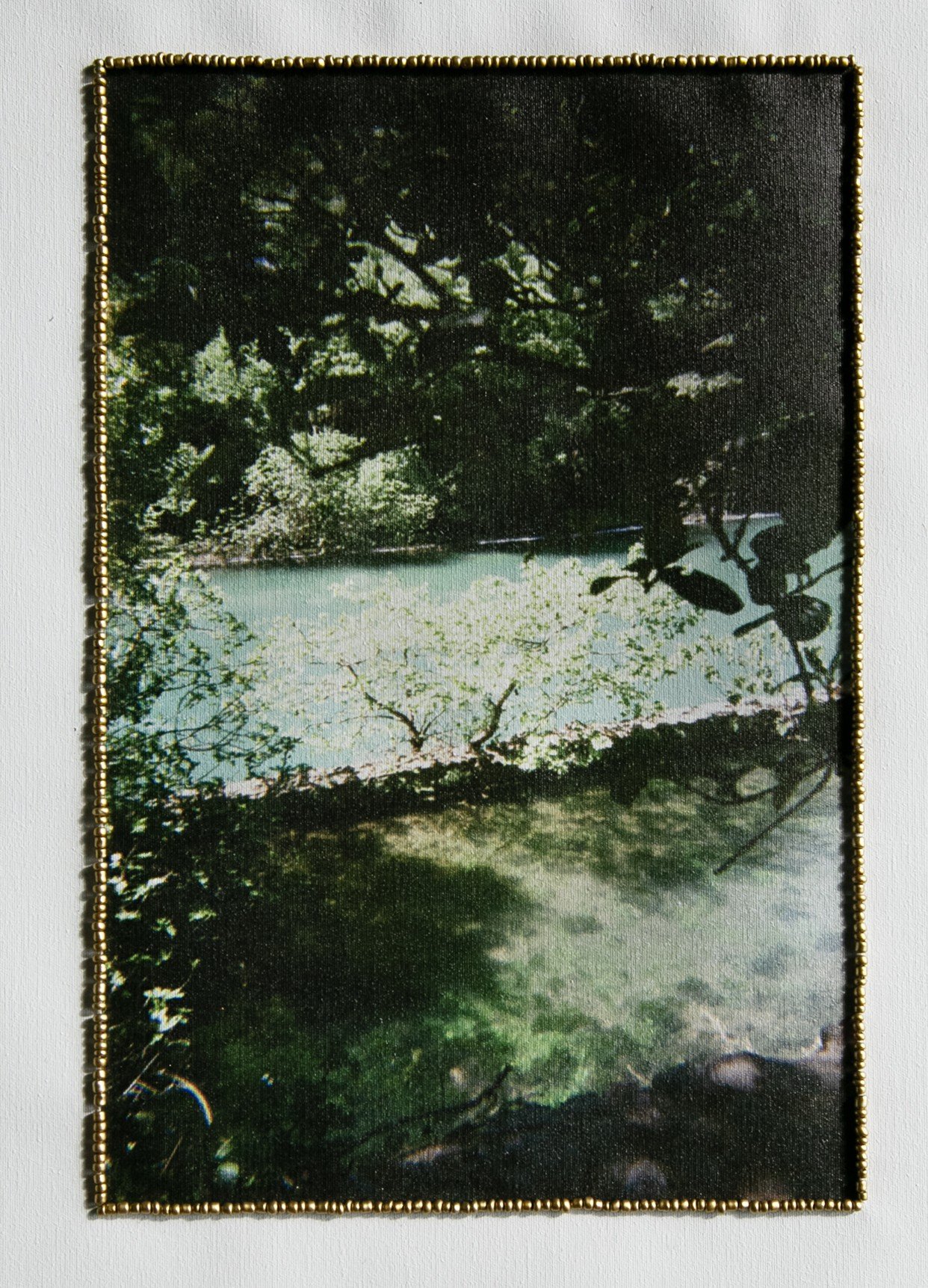
Stay Longer Fontaine Du Vaucluse. Courtesy of the writer, from her series Stay Longer. Photograph printed on canvas then hand-beaded. The photograph was taken in the Luberon region where her brother lives.
In his book Is A River Alive, Robert Macfarlane says that ‘Our fate flows with that of rivers and always has,’ which brings me to think: does our healing flow with the river too? And if so, what happens when the fate of the river is uncertain?
It’s June 2026 when I start reading Macfarlane’s book; the second heatwave is hitting globally. Normandy, where I am from, has been placed in the Orange zone – common for a lot of other places in France, but not there. My whole life, Normandy has been one of the coldest and rainiest parts of France on the weather map. But recently, for a day, it gets hotter than in Provence, South of France, where drought and wildfires are a common part of summer.
I’m scared to find out how the river that flows at the border of my parents' garden is coping.
‘Who are your rivers?’
Asks Robert Macfarlane to Willow Defebaugh in the Atmos podcast, The Nature Of.
I cannot remember my river’s name which is odd considering how much space she has occupied in my life and that of my family’s, and still does. Some families have a dog, we have a river. Although we do not “have” her. We are just lucky enough for her to flow through the back of our garden, offering all of her wonders to us.
She passes through the field behind the house, curving left and right like a ribbon flowing in the air. Sometimes in winter she pours onto the grass, enlarging her bed, and singing louder. As a child I spent years building a treehouse by her side with my best friend, Simon. Summer after summer trying relentlessly to make even just a wooden bench in the air next to her. There were countless other places, with flat terrain that would have been easier to build on, but the river was the centre of our lives.
Her form is very large just after the little bridge; she arrives in our garden like a basin, round shaped with a current coming from her passage on the stones under the bridge. A bridge that Simon and I as children used to look at like it was a passage to another world, even though we went to the other side everyday above on the road not through the river. This river passage felt mystical; one that you do not cross.
We lost Simon a few years ago. Maybe he has now seen the other side of the river.
Further down, a tree stands where her shape changes from a basin to a stream that runs down by the side of the garden I planted when I was younger. She continues around the bamboo that one of my older brothers planted. Finally she keeps going in between stones, with beautiful shades of green through her crystalline water created by the plants that live in her bed – dans son lit in French.
My mother sleeps by the river in summer sometimes with my nieces and nephews. The oldest always wants to sleep as close to the water as possible. I realise how much comfort and relief the river has been giving to all of us, given how many times my mother is reading by the river when I call her. She says the aliveness of the river makes her whole. That same brother who planted the bamboo found calm only by the river as a child. He couldn’t sit still until he was next to her and then the world could do whatever as long as he was busy being a la rivière.
After my brothers and I moved out, we continue to keep a relationship with the river in our own way – my brothers by transmitting their love for the river to their children, and me by frequently inquiring about her. This is a habit that takes root from my dad’s upbringing as a son of farmers. In rural areas you ask the people you love how they are doing through the land. My grandpa used to always ask me if it was raining before asking how I was. My mother does it visually by documenting the level of the river and sending us pictures when she fluctuates.
But then what’s the river’s name?
La rivière De La Douve. The Douve River
Of course.
I remember now, but why did that name never stick?
At the beginning of Is A River Alive Macfarlane tells us more about the names of rivers like ‘The Danube’ and what their ancient names were. ‘In this age, rivers are seen and named plainly as god: Dana (later the Danube)’ he writes in his prologue.
So river, what is your real name?
After a bit of research, I find it - Unva.
Her name seeps in my body and memories.
Now it sticks, and completes the connection. Maybe Unva is like a grandmother or a godmother.
Unva is like someone’s name, one that you can call, scream or whisper. There is no intimacy in Riviere De La Douve. As Macfarlane says, ‘Words make worlds, in English we “it” rivers (…) to reduce them to the status of stuff resources.’
Over centuries letters have been added, others removed. It wasn’t like a god’s name anymore that you whisper. Prepositions and pronouns stripped Unva of her aliveness and of our intimacy with her.
A wave of sadness washes over me with the realisation of such disconnection. It’s almost like I am deprived of something. It lingers and echoes another realisation. One that brings me back to my psychologist’s room during our second session. I can still feel the light fabric she had over her half sofa.
During that session she asked me to place each of my hands on my opposite shoulder, like a hug. She tells me it's called the butterfly hug. A beautiful name evoking lightness, the opposite of what that hug created. My body rejected it, I couldn’t keep my hands on my shoulders, I could barely touch them. Instead I suffocated, bursting into uncontrollable tears. The ones I had when I lost people I loved.
Apparently the trauma disconnected me. ‘A part of you is in exile’, my psychologist says. This is what abuse and rape did to me. It disconnected me from my body. I wasn’t whole anymore. Unva was disconnected to us by words when her name was changed into a noun. I realised that words also played a part in my “exile” years of mental abuse by reinforcing a domination over my body apart from the sexual violence. The body in French is called le corps. An expression faire corps extends from le corps to mean becoming one with something or someone. When I couldn’t be one anymore with my body, the English language facilitated the process of my body becoming ‘it’.
I can still feel how lost and vulnerable I felt when I stepped out of her office, in the streets of North London. I was disorientated and felt like there was a huge weight on me that stopped me from moving. This weight was realising the vastness of what several men had managed to take and destroy, each in their own way.
In the podcast The Nature Of, Willow Defenbaugh says that we are in a deep ecological dissociation and so many people are afraid of facing that grief of disconnection with themselves, or with the world.
For so many years I kept telling myself, ‘Don’t let them take more than they already did, what they did to you doesn’t define you.’ What I didn’t know was that the more I kept pushing away what happened to me physically, the more my body became a stranger.
In English, as we ‘it’ the river, I ‘it’ my body too.
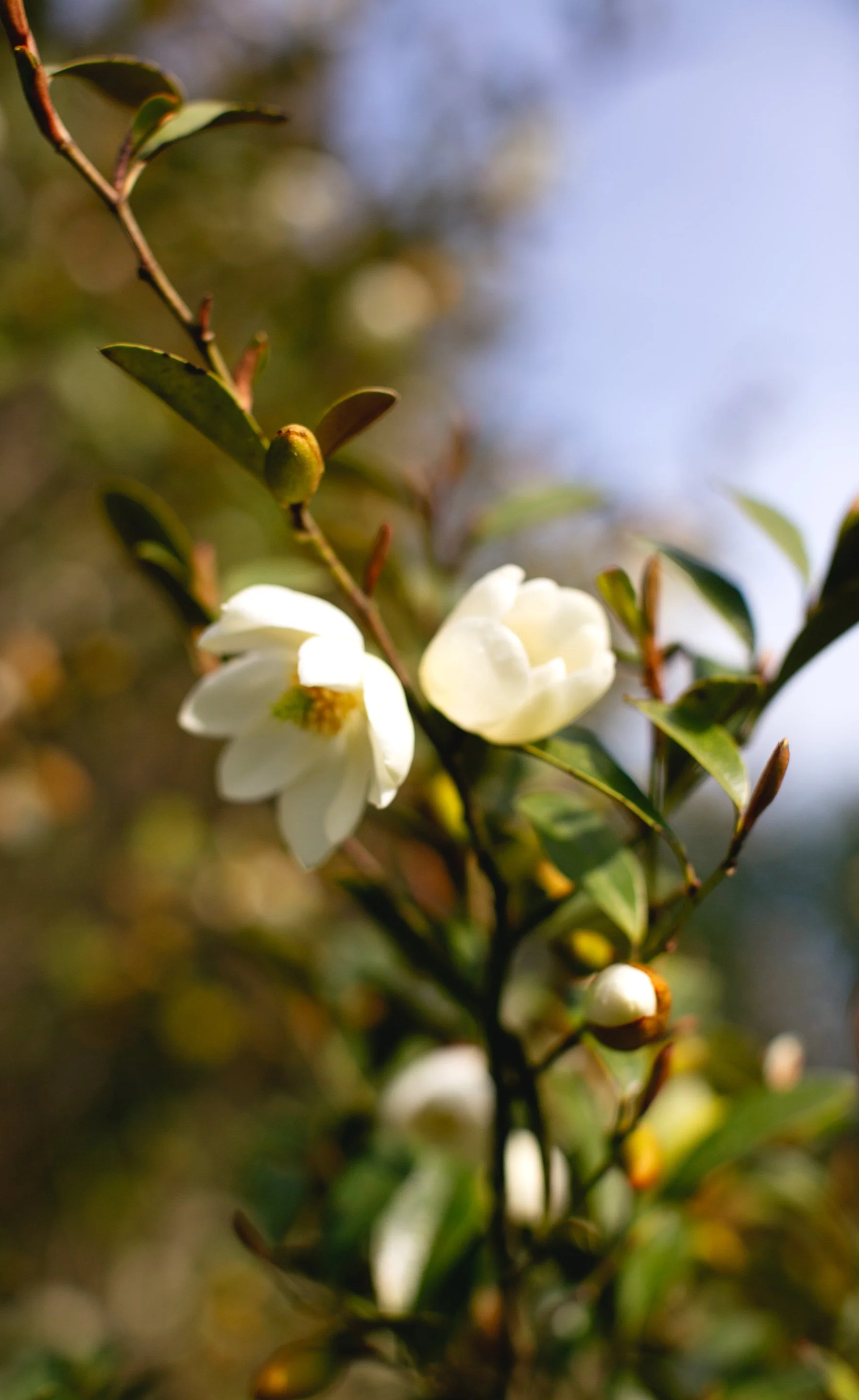
Flowers From Home. Courtesy of the writer, from her series Flowers From Home. Photographs taken in her parents' garden in Normandy, especially by the river.
The only EMDR I did brought me to what nature and the land meant for me. I grew up smelling and caressing every flower I would see and learning their names, recognising the song of my mother’s favourite bird, La Mesange Bleue. But then I moved to places with less flowers and where the Mesange Bleue didn’t have space to sing.
The first abuse happened the year I left, and then more over the years. Through that decade I grew away from my body and every return to my parents’ garden became a source of anxiety. Even the river couldn’t manage to relieve it. Now that I put the pieces together, the aliveness – le vivant as my mother said – of Unva was showing me how it wasn’t flowing in me anymore.
Disconnecting ourselves from ourselves and the land – isn’t that what patriarchy does to us?
Having in my mind the feet in the river as a first grounding technique felt like a fight back as much as coming home.
A song I’ve listened to a lot comes to my mind. River by the French duo Ibeyi:
Let me baptise my soul with the help of your waters
Sink my pains and complains
Let the river take them, river drown them.
Feet in the water, I am begging Unva to ground me again. And like in the song, I ask her to drown the violence that lives in my body but isn’t mine.
Unva, let me feel and listen to the rhythm of your waters to reeducate my body's flow.
I began to understand how much the feeling of eco-anxiety was affecting my relationship with the land. The way starting therapy and ridding of temporary coping mechanisms felt impossible for years due to the fear of having to face what happened, I realised that facing the feeling of eco-anxiety meant facing the feeling of grief.
After almost a year of therapy, my psychologist came to the conclusion that my body isn’t secure enough to undertake this type of work, because the point of EMDR is to process the traumatic events and memories in the body. In order to do that, it needed to be safe enough for the body to access these memories. While it felt like I couldn’t look at what happened to me, I came to realise that I did do enough work to build more resilience and tools to make things that once felt impossible now possible. I am now able to look at the video of the river my mother sent me in the middle of the heatwave. She said, ‘I’m so worried about the river; she has never been so low I need to show you.’
I opened the video on my phone with dread, I was scared of how less alive Unva would look, and how less alive she felt.
Watching the video I am able to see rocks and tree roots I had never seen before. They used to be part of Unva’s world, underwater in her flow. The exposed roots and rocks feel so vulnerable, similar to seeing a photo of my grandmother at the hospital with her veins and bones more visible than they should be. Everything about her is quieter. The difference is people die but rivers are supposed to outlive us. I have never in my life considered that Unva could die. Drought and dying rivers was a thing that happened in the south of the country, not here in Normandy, where the weather was commonly wet.
Macfarlane in his book questions, ‘Who are your rivers’ that comes from a Maori tradition where one might greet someone new by asking, ‘Ko wai koe?’ which translates to ‘Who are your waters?’ He explains that it is like asking ‘Who are your people?’ It names the intimacy we can have with the land that we grew up on, live in. This intimacy, this connection is what we need to start naming in order to protect our land.
Imagining where I grew up without the river is like chopping up a quarter of my childhood, and her level lowering is sinking my heart. But, what can be done?
My partner’s first reaction was – can we add water to her? Of course he knew that was silly, but that’s somewhat besides the point. We feel so powerless and lost because we aren’t the ones directly harming the river, the same way people didn’t know what to say or how to sit with the information of the abuse and rape I went through.
The French environmental activist and poet Cyril Dion who spoke publicly about his abuse from his grandfather as a child speaks about the similarities of that discomfort when putting words to the climate crisis – it is naming something that people would rather stay in denial for a little longer. There is a discomfort coming from something that seems too harrowing and at the same time requires to burst the bubble of denial. As a survivor of sexual abuse I am going through traumatic amnesia, my brain keeping some details of the different assaults locked away as self protection. However for both, naming and voicing it is the only way to start a repair process as well as a protection one. ‘Words make worlds.’
You cannot protect what you cannot name. In the first part of Is A River Alive Macfarlene relates his journey to the Los Cedros cloud forest in Ecuador, home to the River of the Cedars. Los Cedros forest was the first forest to be granted governmental protection and be recognised as a living entity with legal rights which was the beginning of the ‘Right To Nature’ movement. ‘Right To Nature’ names a world in which the land has rights and in which each human being has to reevaluate whether they have been in respect of these rights; a world in which we cannot just be in an extraction relationship to nature. Reports show that mining operations ceased shortly after the court order. Being granted legal rights has protected the forest from mining which would have been devastating for its ecosystem.
The word ‘extraction’ echoes within me what perpetrators of rape do to our bodies, like mining does to the forest. These men took what they wanted from my body for their own good without a care in the world of what it would do to my ecosystem.
‘Consent’ is not a word I grew up with and it’s a crucial one. The word consent gave weight and textures of what it meant to not respect it. On 29 October 2025, in France, they adopted the consent-definition of rape in the law. It shifts the definition from any form of sexual penetration committed with the use of violence, coercion, threat or surprise, to a law that says that all sexual acts done to another without consent is rape. Having this word helped me understand and identify how many times it hasn’t been respected and what it meant for intimacy to actually be consensual.
I didn’t press charges any time that I was raped and assaulted. I cannot say that if this law was adopted earlier, I would have. While by no means this consent-based definition is the end goal, to me, both these laws in discussion are part of the collective imaginary. They put words to how we relate with each other and the land. With the ‘Right to Nature’ bill it repositions us within nature and in a way, confronts us to our emotional connection to the land. It reconnects. The new rape definition in the law does the same with our bodies. It’s not only about proving the violence of the act anymore but that the victim did not consent. By doing so it’s also asking a whole society – what is it to consent to sex? Without any external pressure, when is a choice fully mine? To respond, it asks us to connect to our bodies, listen to the physical signs and understand them.
Thinking about these laws in tandem, a specific memory comes back to mind. People – men – would come to fish in the river through my parents’ garden; some asked, some didn’t. Sometimes we would find trash left behind which would enrage me. As a child I remembered it as a violation of the river. Men came, took, and damaged.
Maybe one day Unva will be protected and recognised before she gets stripped of her aliveness. Hopefully, soon we’ll live in a world in which victims of abuse are protected and supported enough that they don’t have to live outside their body for decades, like I did. In the meantime, I long to be back and sit next to Unva. To whisper her name and thank her for flowing through me again, reminding me to caress the flowers and helping my hands reach my shoulders, and stay there.
Cover image: Stay Longer Fontaine Du Vaucluse. Courtesy of the writer, from her series Stay Longer. Photograph printed on canvas then hand-beaded. The photograph was taken in the Luberon region where her brother lives.