Carceral Forms, Peripheral Zones
In our months of conversation, artist Tarik Ahlip and I kept returning to the idea of imprisonment. In Sri Lanka, where I write from, Bogambara, a maximum-security prison established in 1876 by the British administration, was closed in 2014, with the explicit aim of developing it into a “Cultural Park”. In February 2026, I visited the prison with the hopes of seeing it in its original reputation of stone walls of colonial architecture—it was also recommended to the public as a site of “sightseeing”.
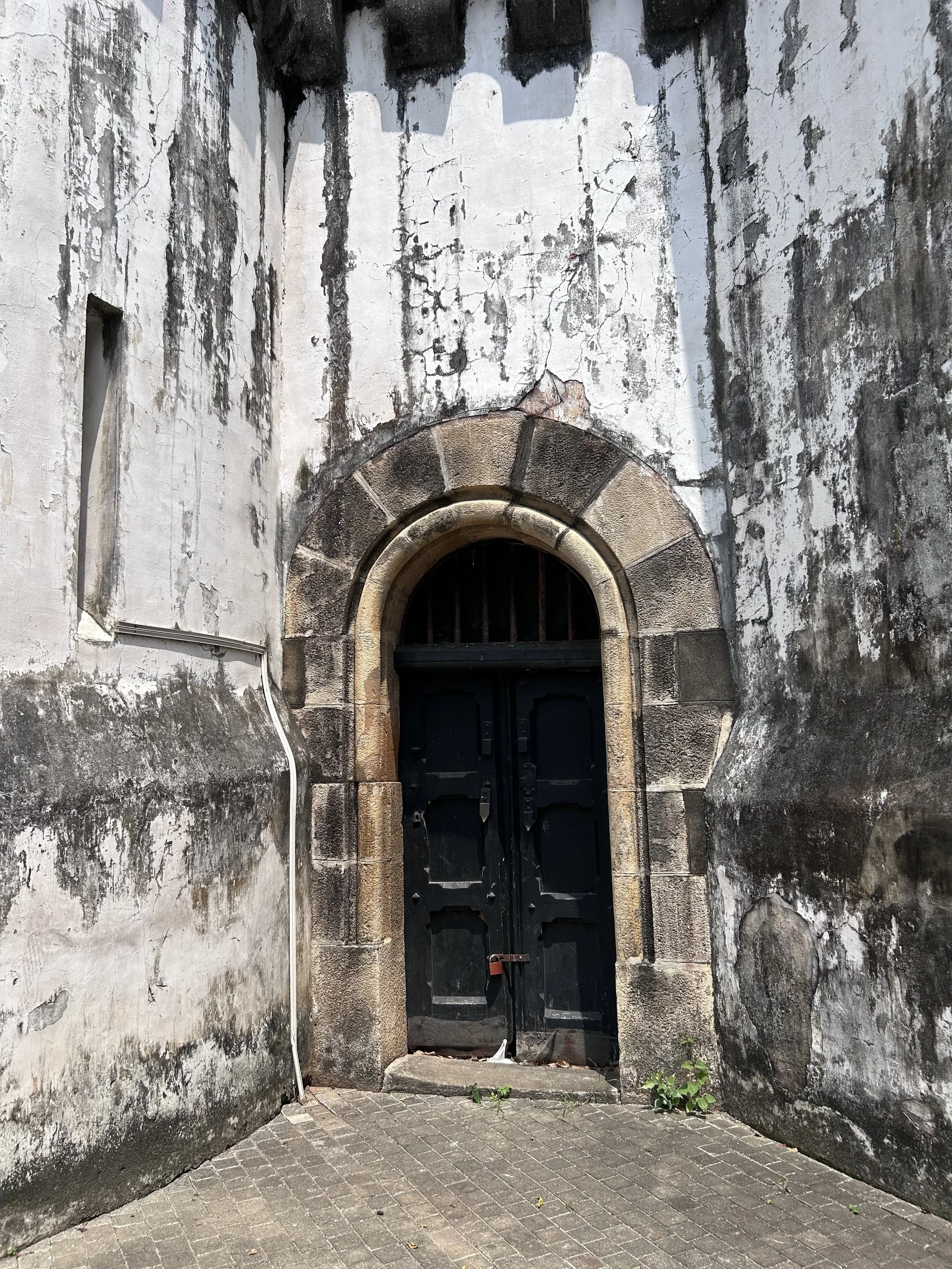
Bogambara Prison in its state of transformation. February 2026. Photography by Pramodha Weerasekera. Courtesy of Pramodha Weerasekera.
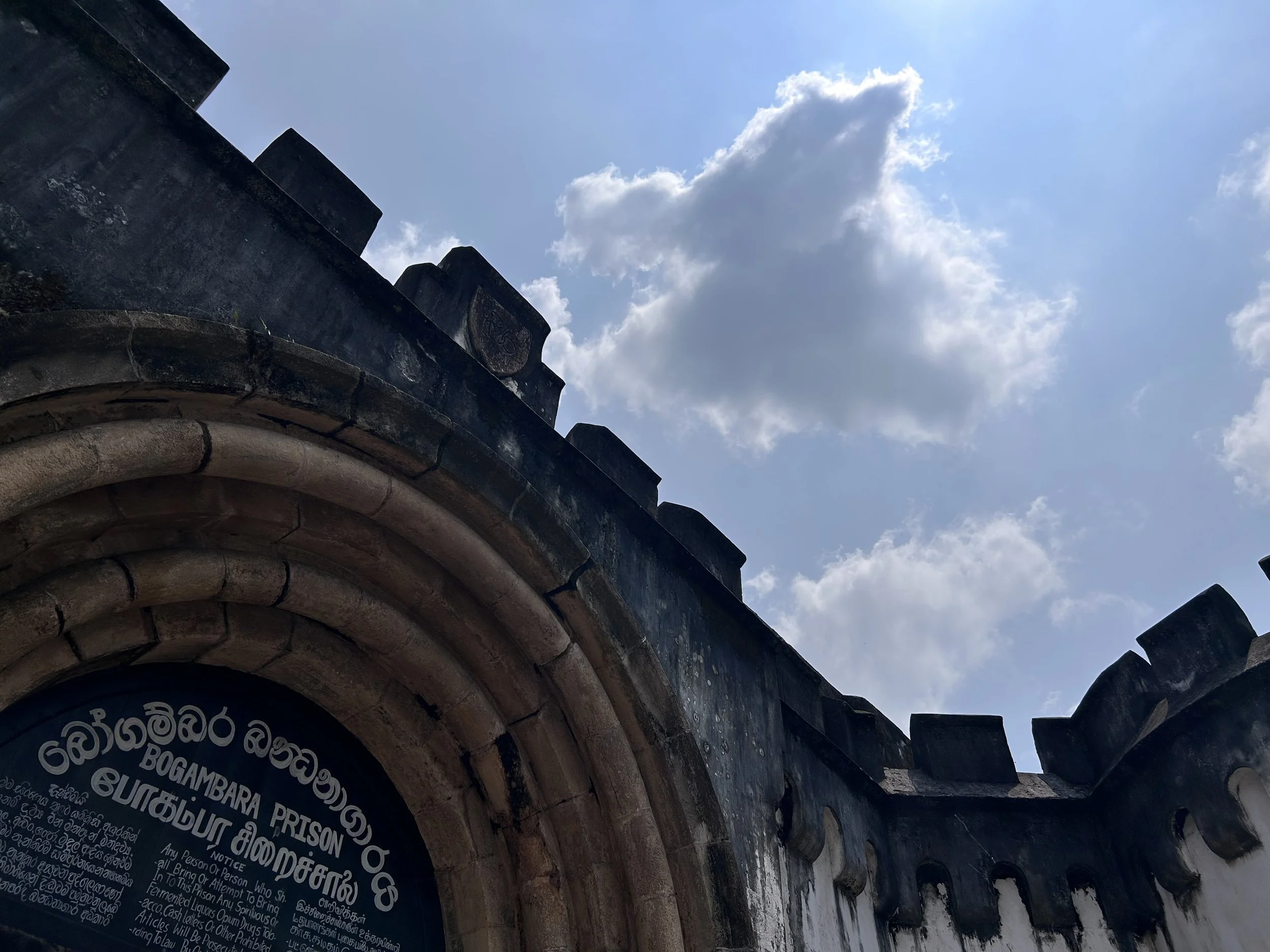
Bogambara Prison in its state of transformation. February 2026. Photography by Pramodha Weerasekera. Courtesy of Pramodha Weerasekera.
This “Cultural Park” is being imagined by the Sri Lankan government and Board of Investments as a ‘four or five-star hotel,’ with coworking spaces, boutique accommodation, and recreational activities after initial discussions about a “world class museum” and a waning heritage space. This proposed transformation was circling my mind, particularly due to indirect capitalistic, tourist-economy related motivations embedded within the state’s intervention to a heritage building. On 9 July 2026, the Bogambara Prison was declared a prison again, halting the process of redevelopment and investment, as inmates got into a brawl, opening gunfire, at the Negombo Prison, 100 kilometres south of Bogambara. Thirty-one inmates and prison officials have died as of writing (15 July 2026), and over 100 are hospitalised.[1]Immediately after the most serious case of unrest at a prison in Sri Lanka in a justice system established primarily by the British colonial administration, the story of the Bogambara Prison asks questions about imperial remains, justice, incarceration, and control—especially in countries, like Sri Lanka, which belong to the global periphery.
I became acquainted with Ahlip’s practice during a studio visit to Gertrude Studios in Naarm, Australia, where he works. In addition to shared, yet vastly different, roots in Sri Lanka[2] we found ourselves conversing about imprisonment and the larger political structures that encourage—and even demand—it in today’s sociopolitical and economic chaos. Ahlip’s sculptural thinking and filmmaking revolve around global economics, politics, and hope for a “sovereign civic project”, as he refers to it. A unique mixture of encaustic and plaster relief works accompanies a series of documentary essays which follow recent activist research and work about Lebanon, Iraq, and Turkey. As an architect and artist venturing into documentary film, buildings are central to Ahlip’s practice, as structures that humans inhabit. These structures are also affective economies, where feelings of love, disgust, grief, fear, and pain coexist. They are spaces where the individual and the collective merge. Architectural structures, beyond their function of human inhabitation, are atmospheres where “bodily space” binds with “social space”, becoming vessels of affect.[3]
Imprisonment is synonymous with control, immobility, hierarchy, removal from society, lack of access to normalcy, execution, and rehabilitation. For me, the Bogambara prison building’s architecture is a marker of these ideas: sitting in the city centre of Kandy, it has tall walls, heavy metal doors with large padlocks, and no windows, a compound. The psychology of a prisoner is moulded within this structure, which they enter with hopes of leaving. Ahlip recalls Italian artist Giovanni Battista Piranesi (1720–1778), whose series Carceri d'invenzione (Imaginary Prisons) (ca. 1749–50), depicts a prison of suffocation with distorted visuals of lengthy staircases that disappear into thin air, isolated arches, and overwhelming curios of pulleys, wheels, cables, and engines. Piranesi’s etchings are “imaginary” yet unwavering in their depiction of the psychology of humans who are imprisoned by local and international state structures.
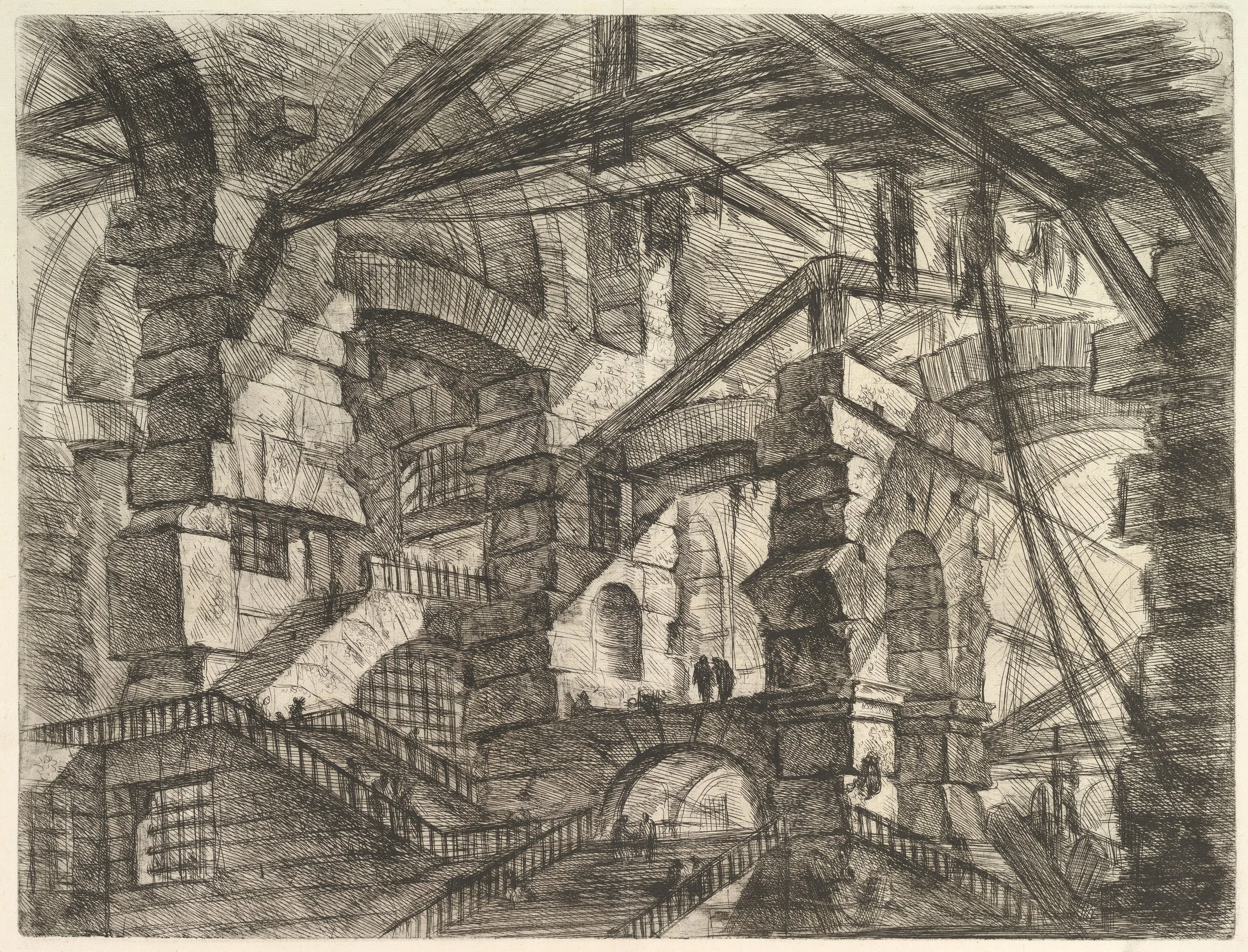
Giovanni Battista Piranesi (born Mogliano Veneto), ‘XIV: The Gothic Arch’, from Carceri d'invenzione (Imaginary Prisons), ca. 1749–50, etching, engraving, sulphur tint or open bite, burnishing; first state of four (Robison), 63 x 49.5 cm, Courtesy of the Metropolitan Museum of Art, New York. Open Source image.
Ahlip’s abbreviated architectural forms about incarceration arrive almost four centuries after Piranesi, with ambiguous temporality and place, as he tries to engage with a framework for understanding global systems and modern conflict.
Through his work, Ahlip reminds us that imperialism in its contemporary form, particularly in how political economist Samir Amin describes it, has enabled a centre and a periphery, discarding the very real impact on humanity and society. Amin speaks of social justice and the sovereign civic project as an inherently anti-imperialist, decolonial, democratic, anti-capitalist, and collaborative project that must be undertaken with care by the working class.[7] In his sculptural work On Her Return (Facial Burns and a Garland of Flowers) (2024–25), made of plaster, pigment, and sand, Ahlip captures the problems in the periphery, particularly in the context of the violence and genocide in Gaza, as it tries to recover but continuously fail in terms of a sovereign civic project.
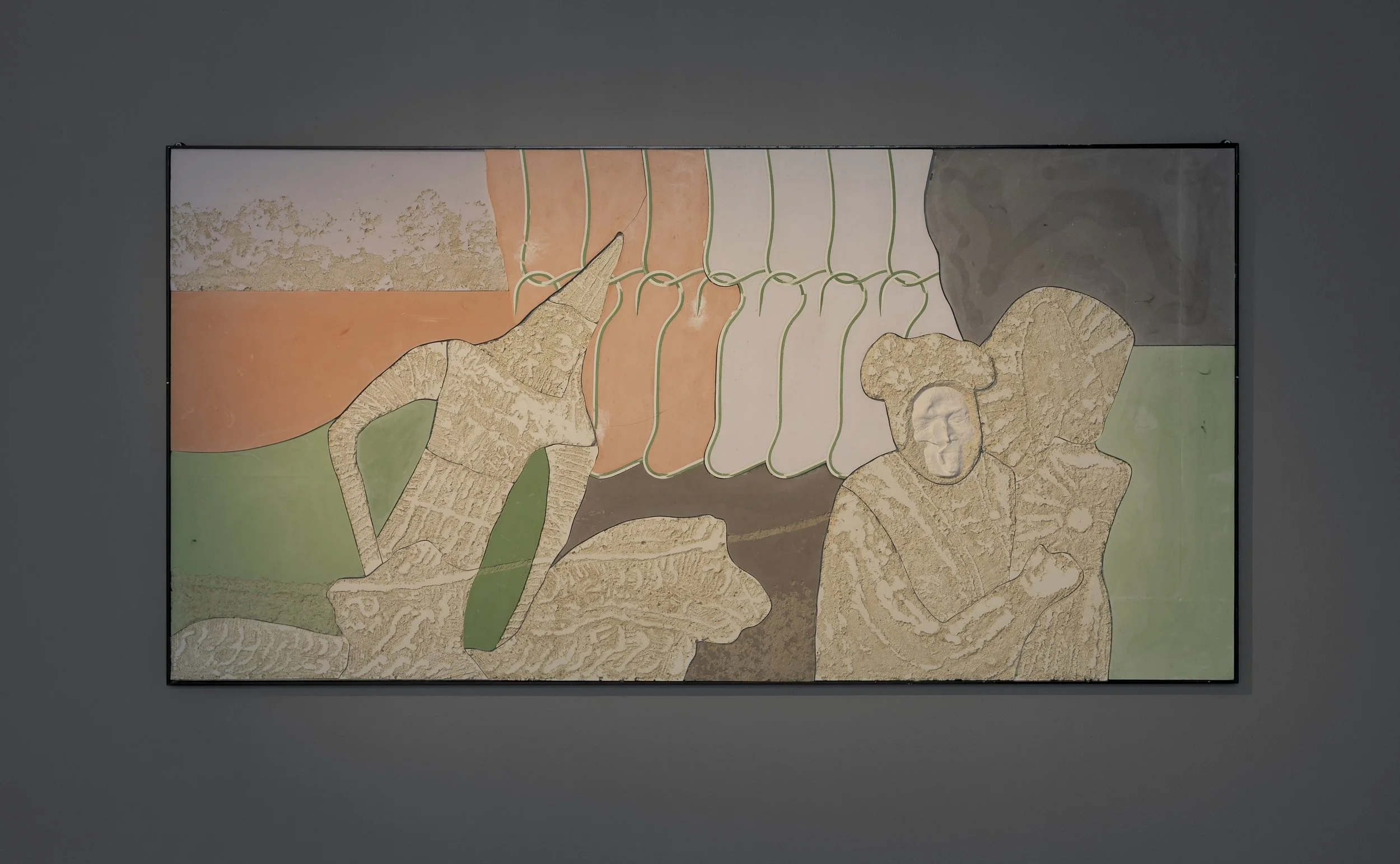
Tarik Ahlip, ‘On Her Return (Facial Burns and a Garland of Flowers)’, 2025. Plaster, pigment and sand. 120 x 240 x 4 cm. Installation view at Various Small Fires, 2025, curated by Brigid Moriarty at Gertrude Contemporary. Awarded the 69th Blake Prize, 2026. Photography by Christian Capurro. Courtesy of the artist and Gertrude Contemporary.
Combining Ottoman style imagery of horsemen with a person’s burnt, disfigured face, Ahlip refers to the case of Isra Jaabis, a Palestinian woman who underwent an 11-year prison sentence in an Israeli prison for allegedly detonating a car bomb in Jerusalem. Jaabis suffered severe facial burns during the fire, and returned home to Palestine in 2023, merely months before the genocide in the region escalated. The burnt face of the figure is depicted with smooth plaster devoid of pigment against the likenesses of Ottoman horsemen who are constructed of coarse sand with a grey texture. The tactility of the sand exerts a visceral response of fear in terms of control, rule, and all-encompassing denials of justice for humanity. The judges’ statement from the 69th Blake Prize (a biannual Australian art and poetry competition), which was awarded to Ahlip for this work, commends it for its ‘textured surfaces, scorched tonalities, and the interplay of plaster, pigment, and sand’ which ‘create the sense of an object both excavated and constructed.’ He skillfully renders the temporality of the incident ambiguous within what appears to be “religious art”, simultaneously making one wonder if politically motivated incarceration and aggression based on ostentatious and exaggerated evidence and have been acts of social injustice dating back to the Ottoman Empire’s voyages of discovery and conquests.
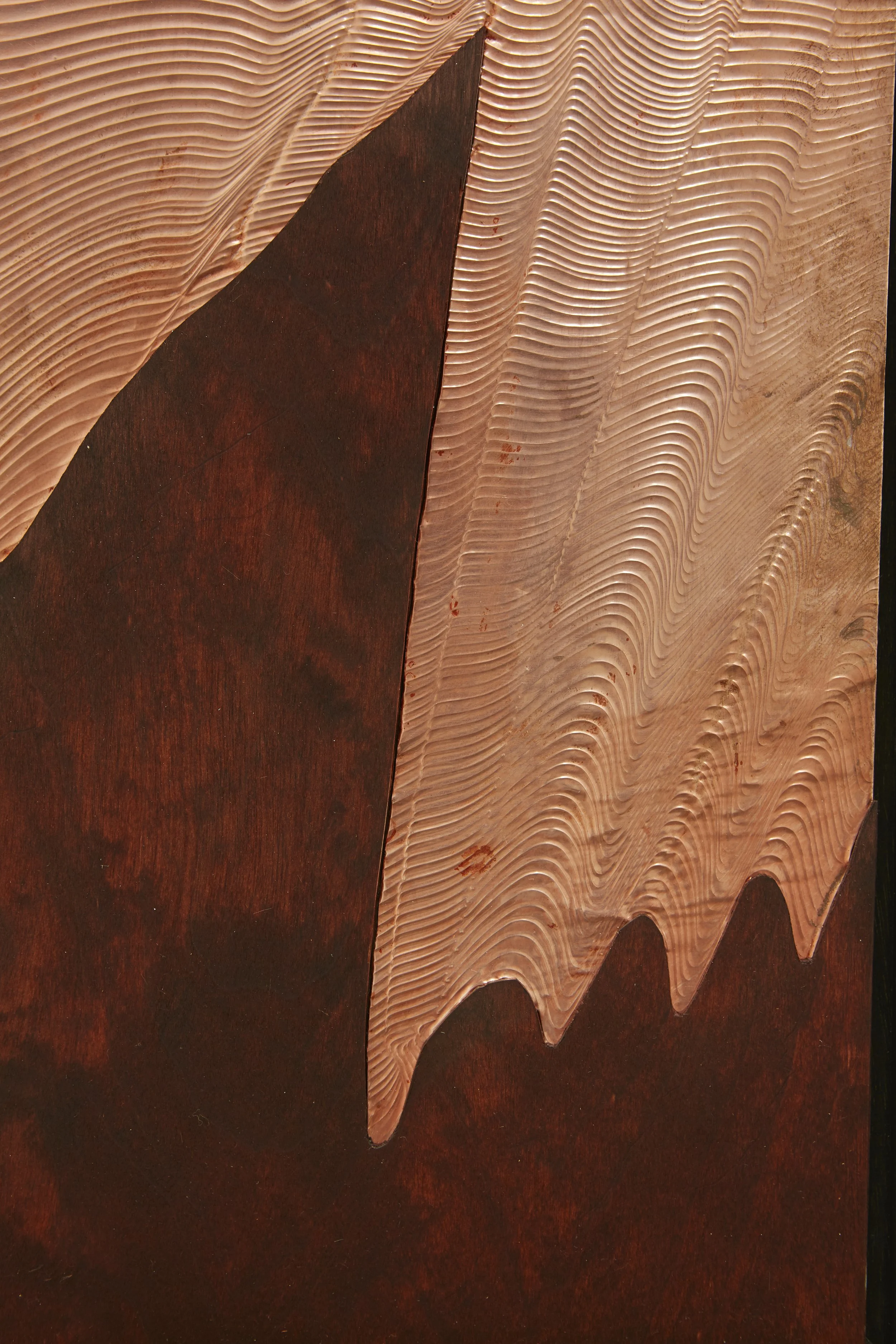
Tarik Ahlip, ‘Female Amplifier’, 2018. Copper and marine ply. 60 × 60 × 3 cm. Detail. Photography by Charles Dennington. Courtesy of the artist and Alaska Project.
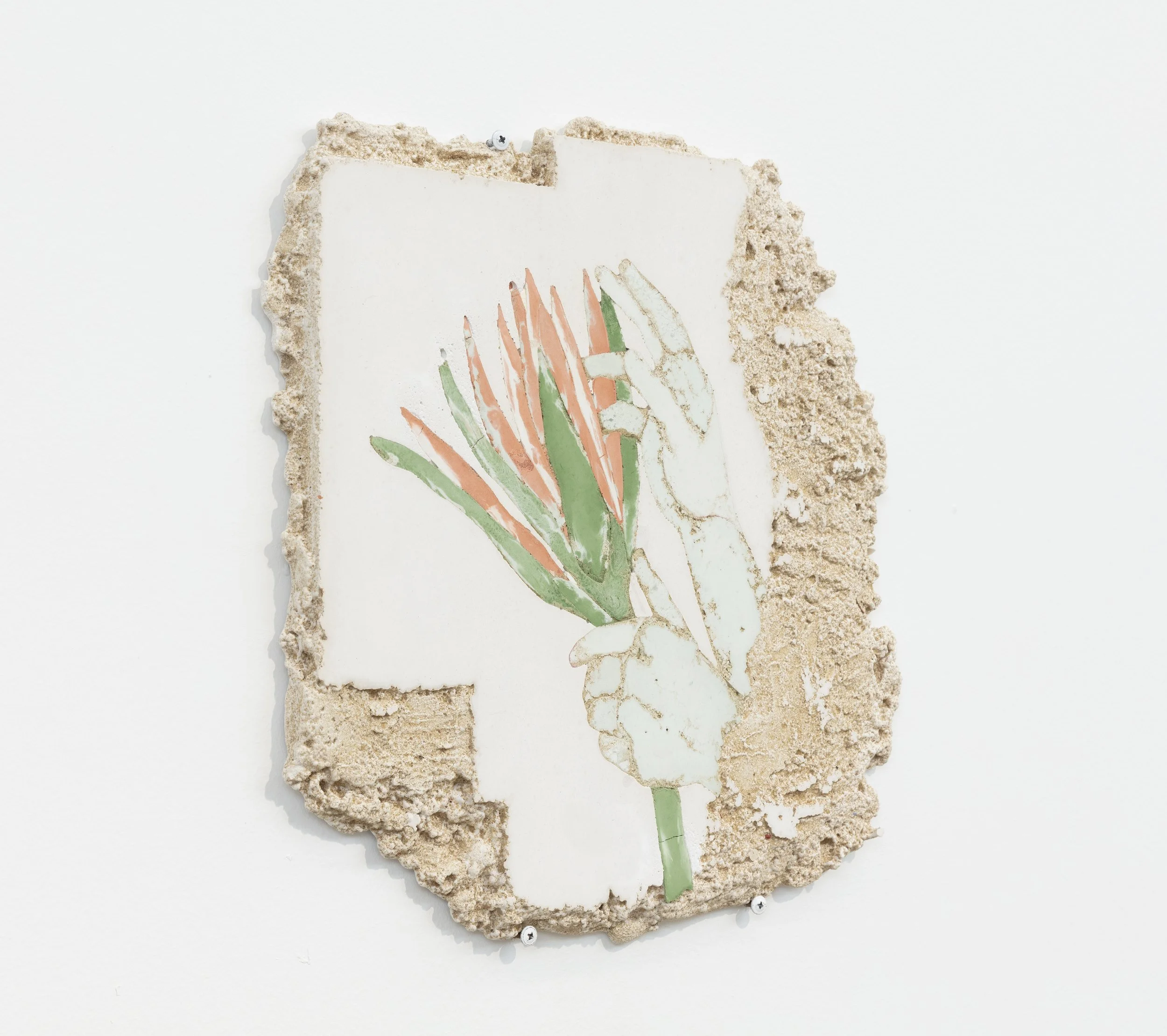
Tarik Ahlip, ‘Feast’ (diptych), 2026. Plaster, pigment and sand. 45 x 45 x 2 cm. Installation view at Infinite Gesture, curated by Mikala Tai at Ames Yavuz, Sydney. Photography by Simon Hewson. Courtesy of the artist and Ames Yavuz.
His recent diptych Feast (2026) takes a similar approach of mixing granulated, discordant sand with almost pastel-like soft toned plaster. In one piece, an almost-robotic hand separates the petals of a flower—reminiscent of gestures and poses in murals from the Ajanta Caves in India and the Sigiriya frescoes in Sri Lanka. The accompanying piece depicts a decapitated person’s torso in medieval armour, reinforcing notions of control and violence in visual form. The Ajanta Caves hold Buddhist art, and have for thousands of years served as a site of respite for pilgrims, monks, and merchants traveling through India. Sigiriya, on the other hand, was built by King Kashyapa (CE 477–495) of Sri Lanka as a rock fortress of solitude and protection as he ruled the country after seizing the throne from his brother after a coup.[4] Ahlip returns to his excavatory technique in Feast, and the concept appears more cemented in a discourse of democracy that criticises the extreme control of capitalistic and imperialistic systems of governance. It is clear that the aesthetics of Ahlip’s practice are embedded in the visuals themselves, if one dared to look beyond their obvious beauty—which sadly seems to be a difficult ask from audiences of contemporary art who are subjected to the art market’s chaos and are enamoured with the low attention spans of a digital age funded increasingly by invisible capitalistic machinery.
While incrementally conceptualising and developing such sculptural works, Ahlip has been engrossed in documentary film, as a medium of both observation and storytelling about moments of incarceration, both of daily and political significance. In 31.05.2010 (2024), he documents recollections of the 2010 Mavi Marmara disaster as told by Jasmin Redjepi, a journalist and activist who was on the ship. The Mavi Marmara flotilla took Turkish civilians to international waters (contested by Israeli occupation) with aid of 10,000 tonnes of groceries, food items, school supplies, and electricity generators for those affected in Palestine. Ten civilians were killed by the Israeli military for crossing what they deemed to be their seas, escalating the unrest in Gaza beyond its locale. Redjepi’s recollections are powerfully layered with archival television footage of the actual event—not in an attempt to make the narrative neutral but to use the backdrop of the documentary medium’s constant plight about truth.
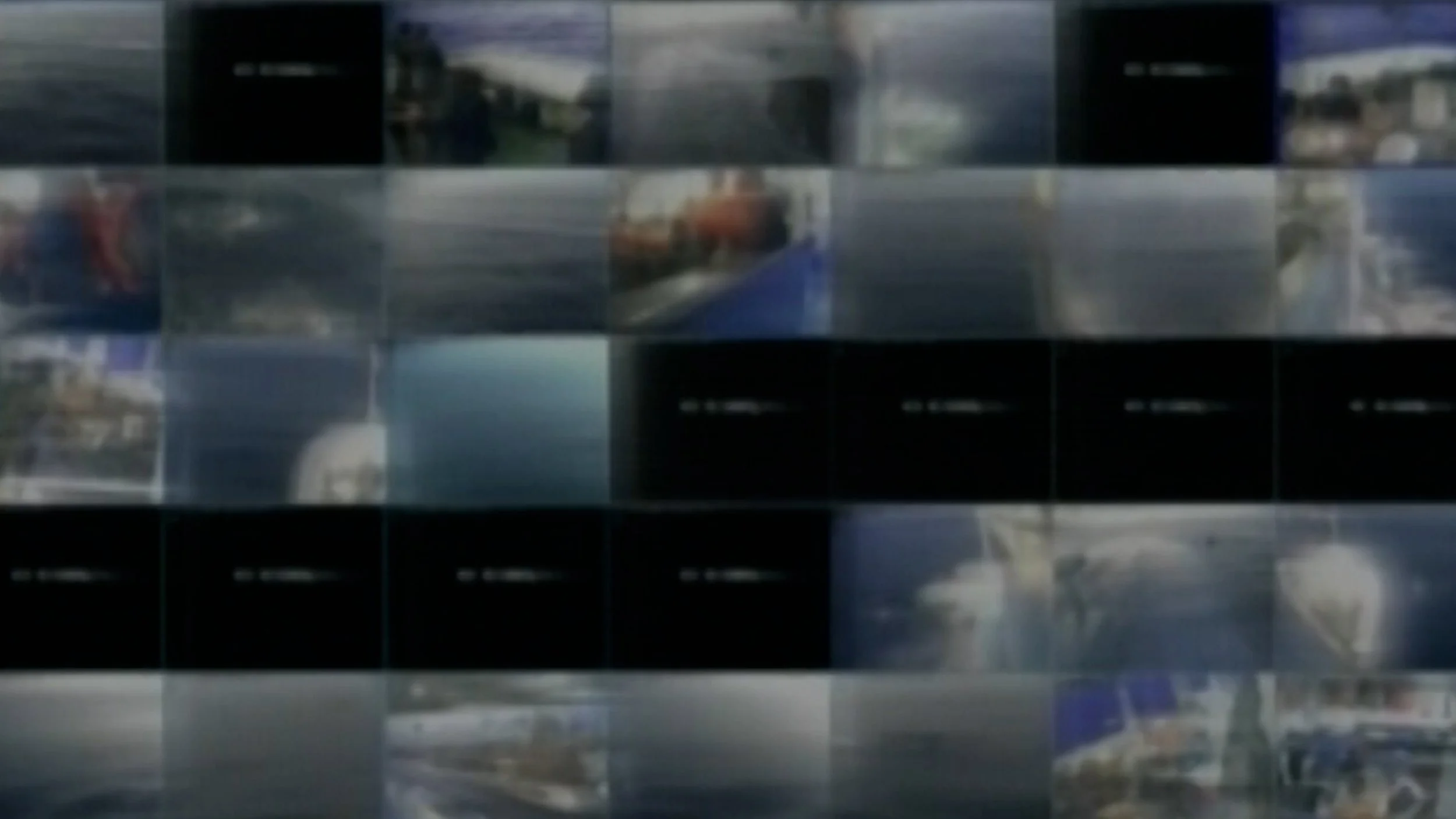
Tarik Ahlip, 31.05.2010, 2024. Single-channel video with sound, 10:56 mins. Video still. Courtesy of the artist.
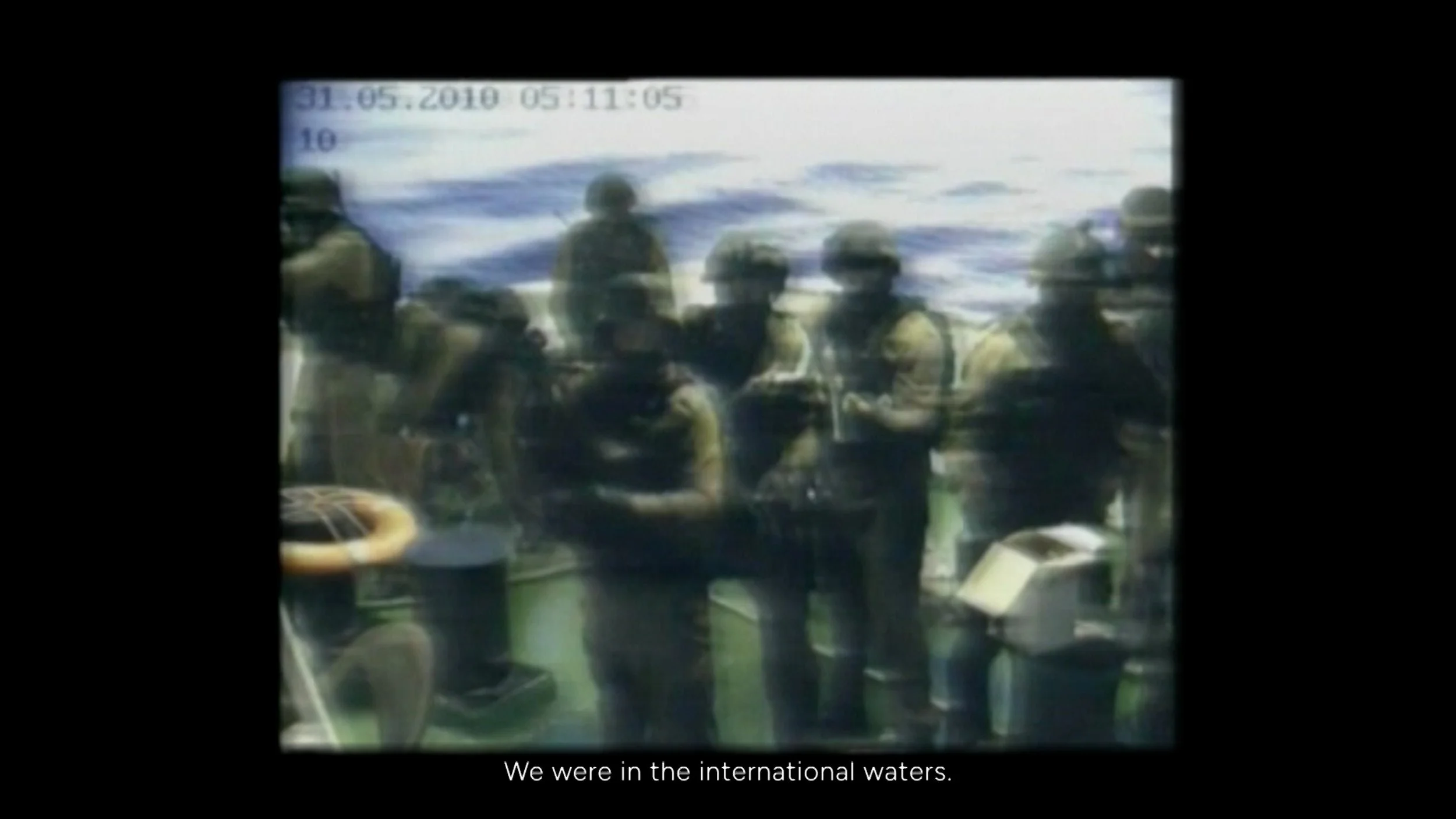
Tarik Ahlip, 31.05.2010, 2024. Single-channel video with sound, 10:56 mins. Video still. Courtesy of the artist.
While we listen to Redjepi’s personal story of anxiety and determination to deliver aid in the face of death, we see the aftermath of the flotilla through fast-paced, blurry, almost-undecipherable footage of protests, riots, and press conferences filled with the unease of political turmoil among neighbouring nations turning into losses of civilian lives. The bodily reactions I experience when watching Ahlip’s film are a sped-up heartbeat and tears, while my mind attempts to make sense of the chaos that surrounds me in Sri Lanka and Ahlip in Australia, due to the decisions and actions of the larger-than-life political forces that perpetuate violence and social injustice. The humane is rendered unnecessary when confronted by greed for power, control, and furtherance of ethno-nationalist and ethno-religious states. The Mavi Marmara is thus no longer a mere vessel that contains aid; it becomes a prison where civilians are held in fear of survival—a prison. This affect is potent in 31.05.2010, a moment where an attempt was made to break the siege of Israeli military forces.
In the film Paradise (2022), Ahlip approaches the concept of imprisonment through religious strictures around halal slaughter. While Halal slaughter of animals is prescribed by the religion as an act of sustenance (qurbani), its moral grounding is a subject of controversy. The film shows footage from a mosque in Canberra with a voiceover by Ahlip. No worshippers ever appear as the camera cuts to and from architectural elements of a mosque, with Ahlip questioning his diasporic memories of qurbani, a process he has witnessed as a child. Anna Emina El Samad writes about Ahlip’s approach in this work as ‘the language of the diaspora is being invoked, the sound of previous homelands being rediscovered and remembered.’[5] In diasporic memories, much remains to be detangled as one grows up. The architecture of the mosque allows Ahlip to detangle this psychological prism and prison as a methodology of critique of faith, religion, and orthodoxy from a distance. For him, the mosque is empty, as he tries to reconcile multiple ethnic, religious, and national identities he is subject to as a second-generation diaspora member with roots both in South Asia and West Asia.

Tarik Ahlip, Paradise, 2022. Single-channel video, 16:42 mins. Video still. Commissioned by West Space. Courtesy of the artist and West Space.
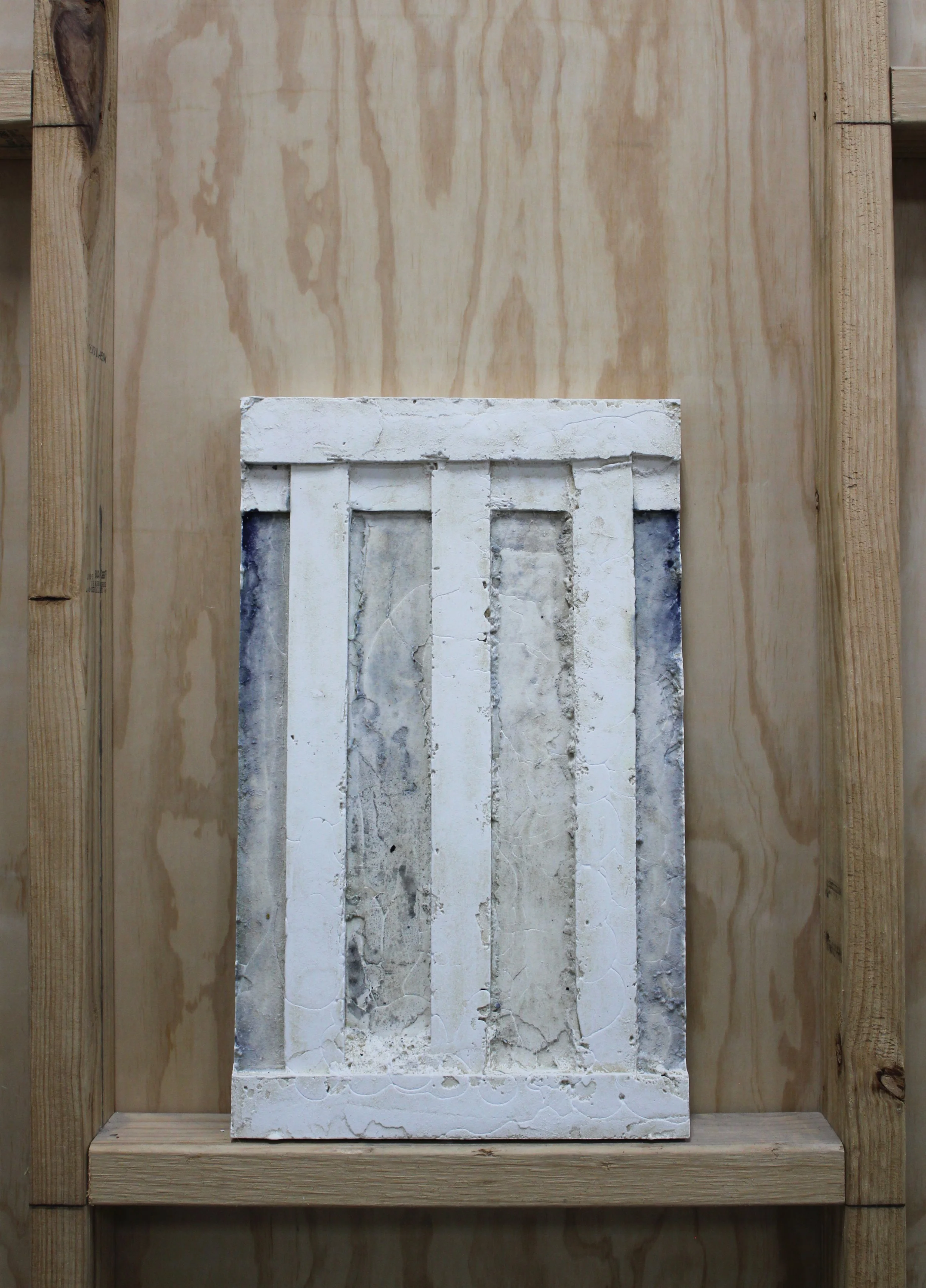
Tarik Ahlip, Untitled, From a series of plaster studies incorporating photographic solvent transfer and cyanotypes, 2026. 40 x 50 x 3 cm. Photography by the artist. Courtesy of the artist and The Renshaws.
When I met Ahlip in Naarm, he had just completed a series of works and had shipped them to Brisbane for a solo-exhibition. I never saw these works, except in photographs.. These works appear similar to the doors of the Bogambara Prison, in smaller encaustic forms. These flattened surfaces made of white plaster speak to the potency of the doorway as an architectural form that is both an entrance and a blockage. One may enter only if they are allowed in.
Footnotes and References
[1] The figures related to prisons as released by the Ministry of Justice specified that when the unrest occurred, approximately 41,000 prisoners were in the system, when the prison complexes only have capacity for 11,000. See more: The Examiner. “No Negombo Jailers Killed; Welikada SWAT Team Beaten to Death, Prisoners Shot,” July 10, 2026. https://www.examiner.media/no-negombo-jailers-killed-welikada-swat-team-beaten-to-death-prisoners-shot/.
[2] Ahlip belongs to a family of Sri Lankan Malays, who migrated to Sri Lanka starting in 200 B.C, later increasing when both the Malay Peninsula and Sri Lanka were Dutch colonies (c. 1700–1950). I am Sinhalese, the ethnic group Sri Lanka likes to call its ‘majority’ and its ‘original’ settlers.
[3] I draw this idea of affective economies from the work of Sara Ahmed, whose writing focuses on how affect can transfer from the individual to the collective. Ahmed, Sara. "Affective Economies." Social Text 22, no. 2 (2004): 117-139.
[4] Bandaranayake, Senake. Sigiriya: City, Palace, Gardens, Monasteries, Paintings. Issue 338 of Publication Series. Colombo: Central Cultural Fund of Sri Lanka, 2006.
[5] El Samad, Anna Emina. “Inherited Memory.” West Space, 2022. https://westspace.org.au/offsite/work/inherited-memory/.