We’ll Always be Connected
—————Corpus: Story—————
Main Order 1: Return Home with Lou
I wake up to the warmth of Lou’s hand on my face. I open my eyes and see Lou reaching out her hands, smiling. She seems to be in a good mood. I softly plant a kiss on her forehead, then stand up with her strapped to my chest.
See the sun set,
the day is ending
I look ahead — the mountainous terrain stretches out in front of me, with the open sky sitting behind.
'Okay. Time to head home.' My gaze centres on a spot in the distance. Return home with Lou, 1190m. My shelter is the destination, at least for now.
Let that yawn out,
there's no pretending.
I begin to make my way down the steep and rocky ridge, with both my hands gripping the strap on my chest to keep Lou secure. Crossing difficult terrains is something I’ve gotten used to by now; I used to be a porter after all. But everything has changed since I’ve put that life behind me. I’m no longer on missions or hustling to make a delivery. I’m just making my way home with my daughter.
I will hold you,
and protect you.
I tread down the ridge, slowly and steadily, avoiding the slippery slopes indicated by my scanner. Then the mountain leads me onto another hill, where I’ll have to keep going straight until I can make my way down again. I take a moment to scan my surroundings and pick out a longer but safer route. The scanner shows a trail of blue digital footprints on the ground, which means someone has probably taken this route before.
As soon as I decide on a route, my scanner detects a potential gate quake — an earthquake caused by the wormholes that started forming between continents ever since I started connecting places to the chiral network. I tighten my grip on the straps, centring my balance as I feel the mountain beneath me begin to tremble. A gate quake measuring 4 on the G-scale has occurred. Looking ahead, I see rocks tumbling down a slope in front of me. I feel stronger quakes beneath me, the ground shuddering more violently and intensely. Despite trying my best to steady myself, I lost my balance and fell to the ground — luckily, I didn’t fall off the slope. Lou definitely did not like that. I think to myself and immediately hear her crying.
My gaze fixates on the ground, watching jagged rocks fall off the ridge. Both my palms are pressed against the surface of the mountain, keeping my body steady. As the ground beneath me begins to calm, I straighten myself up to check on Lou.
I unstrap her and hold her up in my hands. Her eyes closed as she continued to cry. 'You’re alright...' I say to her while trying to soothe her by gently bouncing her up and down. Even back when Lou was still in a BB pod, any time I’d trip or fall, or when Timefall finds us, I’d always gently rock her to calm her down. This has never changed.
So, let love warm you
'til the morning.
The crying gradually subsides, and Lou opens her eyes to look back at me. I strap her back onto my chest and check our destination again: Return home with Lou, 850m.
As I continue on the path, I feel raindrops gently falling on my face. The hood of my suit lifted over my head automatically as it detected rain.
It’s within my instincts to run when the rain starts to pour. At some point, any rain begins to feel like Timefall. I hear the splatters my steps are making, and my vision is blurred by raindrops.
I just want to be home with Lou. As quickly as possible.
And I won’t wake before you go.
And I still hear your heartbeat.
—————Corpus: Databank—————
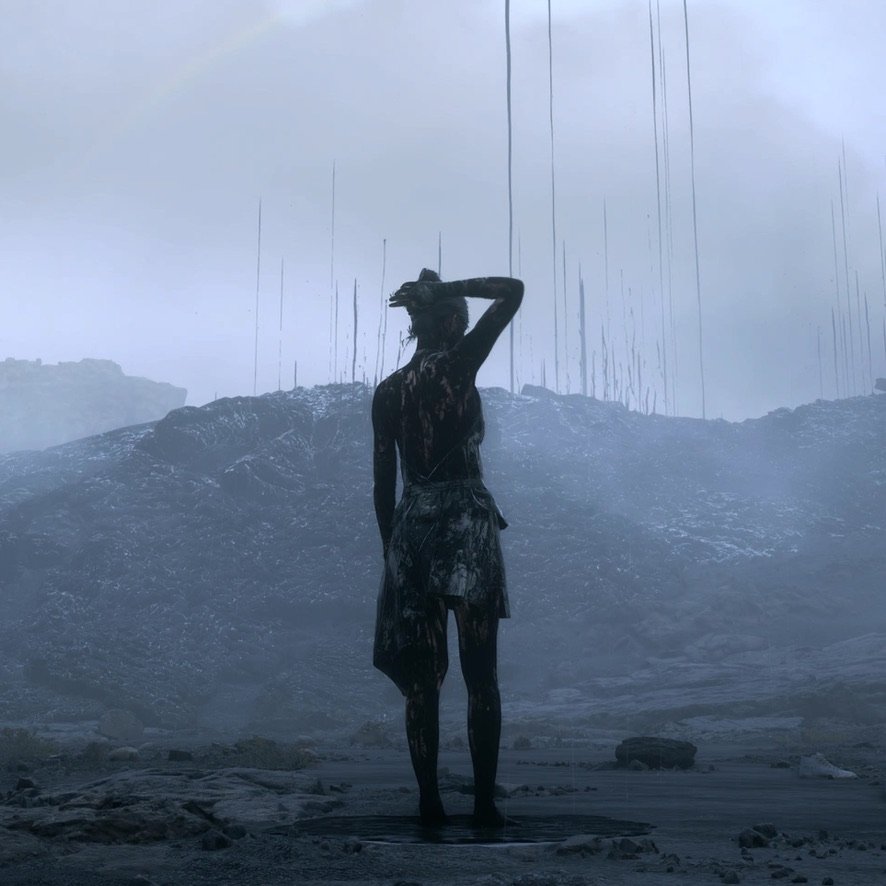
Tomorrow from Death Stranding stands on her “Beach” surrounded by tar. Image provided by writer.
Set 11 months after its predecessor, Death Stranding 2: On the Beach, is a 2025 video game developed by Kojima Productions. Sam Porter Bridges — the protagonist of Death Stranding 2, played by Norman Reedus, is the character whom I control throughout the game. Sam is a former porter, or a courier, who worked for an organisation called Bridges. By the end of the first game, he has successfully connected the entirety of the United States to the chiral network, a data network which allows for communication and connection in this post-apocalyptic setting where everyone lives in secluded shelters. By the beginning of the second game, Sam has retired and is residing in his safe house with his daughter, Louise. The game opens with a recap of its predecessor in text form, then moves to a montage of the post-apocalyptic United States, which has been destroyed by an event known as the Death Stranding. As a result of this cataclysmic event, the world of the living and the Beach(or the world of the dead) began to intertwine, mesh, with each other, causing creatures known as Beached Things (BT) to appear.
For the very first mission of the game, I travel across mountains to return home with Lou, while the song BB’s Theme plays in the background. I travel the landscape of ruined terrains, the gate quake, and the rain. In Death Stranding, the land tells the story, because what happens to my environment happens to me. Like the Timefalls — rain that accelerates time and decays everything it comes in contact with. The physics are engineered to make me feel every jagged rock through the subtle vibration of my controller as I walk the surface; the wet and slippery landscape after rainfall is shown through droplets splattered across my screen; walking on snow-covered terrain restricts my control, thus slowing me down. Nature is not only where the story unfolds, but also how it unfolds. Sam is the lone traveller, positioned within and against the landscape of endless chains of mountains, of snowy hills, of ragged grounds covered in rain, of nights dimly lit by streetlights along the highway.
Everything I do in this world leaves a mark, from something as small as a footprint, to something as big as building a road — and these are all things that can affect other players. It’s important to connect for convenience. So, in Death Stranding 2, I’ll first have to travel to shelters or facilities on foot to connect them to the chiral network; only then can I utilise the fast travel option, for example. In addition to the single-player experience, the game has an online system called Social Strand, which allows players to interact with each other, offering the experience of gaming alone, but not being lonely. I can leave signs for other players, build infrastructures and upgrade infrastructures built by others, or leave behind me a trail of footprints, all visible to randomly selected players who are connected online. I find traces of other players as well. Each player has their own Social Strand profile, and we can send each other likes, for things like the infrastructures we’ve built or the tools we’ve left behind for others to use. Like the in-game feature that allows Sam to call out to other porters, we, too, are constantly looking for and engaging with signs of fellow wanderers.
German psychologist Erich Fromm first coined the term biophilia in the 1970s, where he described it as a 'passionate love of life and of all that is alive' in his book The Anatomy of Human Destructiveness. This concept of the biophilia hypothesis was later popularised by American biologist Edward O. Wilson in the 1980s; in his book Biophilia, he argues that humans have 'the innate tendency to focus on life and life-like processes', whether that be other people or nature. The Death Stranding games demonstrate our, very human, desire to be connected to one another. Whatever the cost, or however difficult. The Social Strand is identical to the chiral network which connects the characters in-game. All players are tied together by the same landscape, but all of us see a slightly different view. I feel an urge to be a part of a community. I want my Social Strand platform to be filled with likes and proof of the journeys I’ve made. I want to build infrastructures to make other people’s gameplay easier. I want to help deliver lost cargoes that another player had left on the ground. I want to feel less alone by making others feel accompanied.
Sam — and in a way, the player — is meant to be the lone hero, or the cliched “chosen one”, who saves the world by connecting places to the chiral network. The question of connection is posed to all players: what it means to connect and how we connect. In trailers of Death Stranding 2, the slogan ‘Should We Have Connected?’ appears. There is a price to pay for connection in this divided world. By the end of the first game, Sam has established a connection with his BB pod, or Bridge Baby, a device used to detect BTs created by Bridges, which is a foetus extracted from a brain-dead mother, then kept in a pod that simulates the environment of a womb. Sam was asked to dispose of his BB because it was no longer fulfilling its purpose, which is to connect the world of the living with the Beach. Instead, he removed the foetus from the pod in the hopes that the child would survive, which it did and is later revealed to be Sam’s biological daughter, Louise. Sam later embarks on a journey to connect Mexico to the chiral network, after being requested by his ally Fragile (played by Léa Seydoux), and upon his return discovers that Lou has been killed when her shelter was attacked.
Through the prominent presence of consequences in its gameplay, Death Stranding demonstrates what it means to connect, and asks me to consider what I leave behind — for myself and for others — when I commit an act. Travelling with too many cargoes will mean Sam might get too tired or lose balance; taking on a more dangerous route may mean damaged goods, resulting in a lower rating for my mission; killing a wild animal on the way will subtract likes which I’ve received from other porters; a quicker route may mean encountering enemies… and when I do come in contact with enemies, battle isn’t always the solution. Corpses need to be disposed of within 48 in-game hours at designated locations, before it necrotises and turns into a BT, causing a voidout, or an explosion, in the area. If a voidout happens, then an area on my map will remain a large crater for a period of time. Disposing of corpses will mean more travelling, with a ticking time bomb on my back.
I am no more than the traces I leave behind. I scatter fragments of myself in other players’ worlds, and find pieces of others in my world, whether that be a sign warning me of BTs, a weapon left somewhere on the map, or a trail of footsteps indicating a route that’s been taken before. Discretely and quietly, all players are building each other’s worlds, bit by bit, and begin to exist in each other’s landscapes. I don’t have the power to change how the story goes: there’s always Sam, there’s always Lou, and there’s always Fragile, who will be asking Sam to embark on yet another journey. Though I’m given the option to refuse Fragile, every time I choose to do so, it will trigger a time loop, which takes me back to the beginning of the sequence. I’m forced to live the scripted story, but I do have the power to make choices elsewhere: I can make other people’s worlds a better one. Death Stranding asks its players to consider possibilities, inviting them to think what it may be like to be walking in someone else’s shoes (in a rather literal way as well, since I can actually craft shoes and put them in lockers to share with others).
I often think about other players who might be playing at the exact moment I am. How are they seeing this world? Have they crossed a bridge I’ve built? Did my upgrade on a generator help anyone? I think about how my contributions have affected others, how I’ve quietly affiliated myself with them. I started to build more infrastructure, craft equipment to put in shared lockers, or leave more signs, in the hope my contributions may randomly appear on someone’s map and make me a part of their world, that someone, somewhere is looking out for them
When rain falls, in real life, I put on Death Stranding’s soundtrack, immersing myself once again in a world that is as dangerous as it is beautiful. I imagine myself as Sam, treading across the wet grounds, witnessing flowers bloom and die in the same instant as Timefall hits, and trying to make my way home with the ones I love. I like to think, somewhere else, there is another person, doing the same, thinking the same.
—————Corpus: Story—————
Main Order 49: Return Home with Lou
I still remember the moment I saw the wide-open doors; I knew that something must have gone wrong. I ran downstairs to find a rummaged room, flashing red lights — no signs of Fragile or Lou. When I made my way out of my shelter, the Odradek scanner showed me a trail of footprints on the ground that belonged to Fragile. I followed it to find a bike tipped over on the ground, and next to it lay Fragile.
I rushed towards her, picked her up, her body covered in wounds and stains. 'What the hell happened?' I lifted her up from the ground. 'Lou…Lou…' She mumbled, her eyes still closed. She told me later that someone had attacked them. 'I couldn’t protect Lou.' She said to me, 'I’m so sorry…'
It wasn’t until now that I found out Fragile had sent you to Neil Vana’s beach. I wonder what it was like for you. I know time works differently there, but did you feel all those years go by?
I spent all this time thinking that you were gone. Or that you somehow became a BT in the BB pod. I kept seeing you in the pod; I’d hear your laughter when I went on rides, and I’d hear your cry when Timefall came.
We’ve missed out on many years. On time we could have spent together. I didn’t get to watch you grow up. I couldn’t even recognise you when I saw you on the beach, when I brought you back, and when Fragile named you Tomorrow.
'I’m your Louise.' You say to me. How strange — I still remember you as the Lou who smeared her dinner all across her face.
We’ll make up for the time lost, as long as we have each other.
Tomorrow is in your hands.
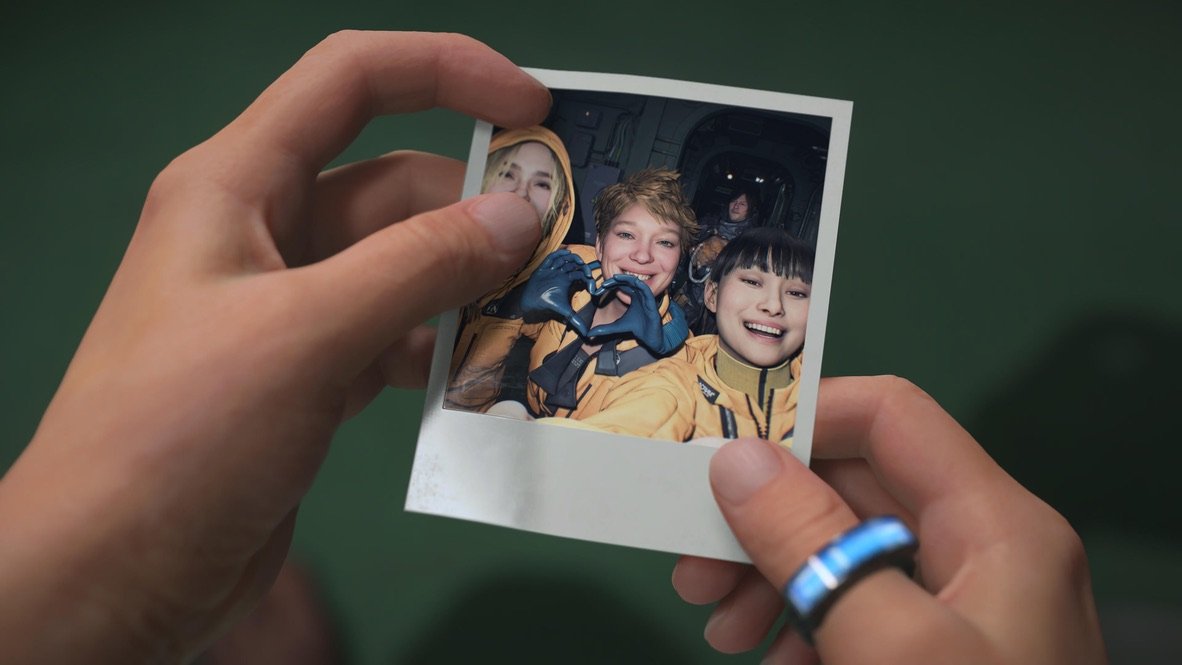
A Polaroid photograph from Death Stranding 2 featuring characters Fragile (Léa Seydoux), Tomorrow/Lou (Elle Fanning), and another crew member. Image sourced from YouTube.
Cover image: A Polaroid photograph from Death Stranding 2 featuring characters Fragile (Léa Seydoux), Tomorrow/Lou (Elle Fanning), and another crew member. Image sourced from YouTube.