This Must Be the Place: on Gaining Ground, Landscape and the Divided Woman in the Canadian Canon
‘My name is Abra. My name is Abra. I had almost forgotten that; the naming of things lost its importance here, with no one to hear them named.’ So begins Gaining Ground, the newly reissued novel by Canadian writer Joan Barfoot. Gaining Ground was initially published as Abra in Canada in 1978 and it is being reissued by Faber in the United Kingdom this month. When the book came out it won the Books in Canada First Novel Award and received critical acclaim. Its reissue almost fifty years later points not just to the enduring relevancy of its themes but also to the ways the novel transmogrifies, how all these years later it reveals something in itself that is uniquely contemporary. Gaining Ground also occupies a unique position in a tradition of Canadian bush-literature, that settler Susanna Moodie, critic Northrop Frye and writer Margaret Atwood have all confronted in their work.
Gaining Ground is about a woman named Abra, a wife and mother of two, who (with the help of an inheritance from a deceased grandmother) runs away from her life to a cabin in the backwoods. When Abra sees an advertisement for a ‘Winterized cabin on seventy acres, stream and bush, suitable for vacation or hunting lodge’ something within her stirs. ‘I saw it and felt a yearning, not even a verbal thought, just a sensation as if a thin string were pulling me toward – what?’ – Gaining Ground is an exploration of that what, that longing, the tug of a thread that calls one to somewhere, elsewhere, anywhere but here.
With remarkable subtlety and nuance, Barfoot charts Abra’s escape from the constraints of maternal care, wifely duties, depression and tedium. Abra organises her departure in such a way that ensures she will be almost impossible to find, paying for the cabin in cash and covering up her trail so skilfully that she is not tracked down for many years. She successfully lives her almost traceless life, learns to live off the land, learns to live with and of the land until she is found, first by her husband and then later by her daughter.
These are some of the key beats of Gaining Ground, but it is about so much more than one woman deciding to walk out of her life. It is a novel about the ways in which quotidian tedium can, like bricks made of lead, pile up, and eventually obliterate a person. Abra doesn’t walk away from her children, or her husband, she walks away from a version of life where time accumulates without meaning or mercy. What Abra unbraids herself from is a life that has expectations of her, expectations which slowly kill her as she attempts to meet them. ‘Was it escape I saw? I did not think so. Or if it was, it was not so much escape from this life, although I was dead in it, as an escape from something.’ What the cabin, the remote woods and the anonymity of this new existence offer Abra is the hard pearl of possibility, the opportunity to be something other than a supporting beam in the architecture of someone else’s life.What Abra does is not so much remove herself from life but remove herself from a version of life that is insupportable to her: she refuses to perpetuate a way of living where her existence is made manifest only by the ways in which it is useful to or serves others. This is significant, at the time of original publication, and today, because Abra is a woman, more importantly a mother. There is no subtle or elegant way to say that society hates bad mothers. The worst crime a woman can commit is to refuse her roles, and if she does refuse, then she must pay with guilt. What is radical about Gaining Ground, is that Abra rejects not just motherhood and wifehood, but she eschews guilt: ‘It seemed to me that when I had been with them, in that other life, that I had lived against myself … Now I lived with myself. I had done something to them, but I could not feel guilt.’ So where does this leave Abra? It leaves her with the capacity for joy, distilled and uncontaminated: ‘I kept feeling spasms of joy, instants of realising, and it happened when I saw the bowl and the saucepan to be washed, all there was of my meal, just my own, from now on.’
That perfect happiness can only be achieved for Abra when she accepts a life in service to her own desires, is, was, and will continue to be revolutionary. In the afterword to the Faber edition Barfoot writes that she was trying to identify ‘what might a person’s own real nature be, and could it ever be possible to locate it and then tuck it into a life that was true to it?’. Through Abra, she does locate it, and she tucks her into a cabin in the woods. Barfoot formulates an economics of escape where wilderness serves to release her protagonist from the burdens of time and the inherently gendered way it has dominated her life. In the woods, Abra’s only real interlocuter is nature: ‘I see that what it had was a total reality, a complete sense of being where I was, doing what I was doing, with nothing between myself and the experience, no thoughtful mediator saying, “now I shall do this,” and “that looks alright, now let’s go on to this”.’ Abra is free because there is no one mediating her life and time (she does occasionally go to the small town for supplies but bar this she is isolated). As the sole witness to her own happiness, Abra can live truthfully.
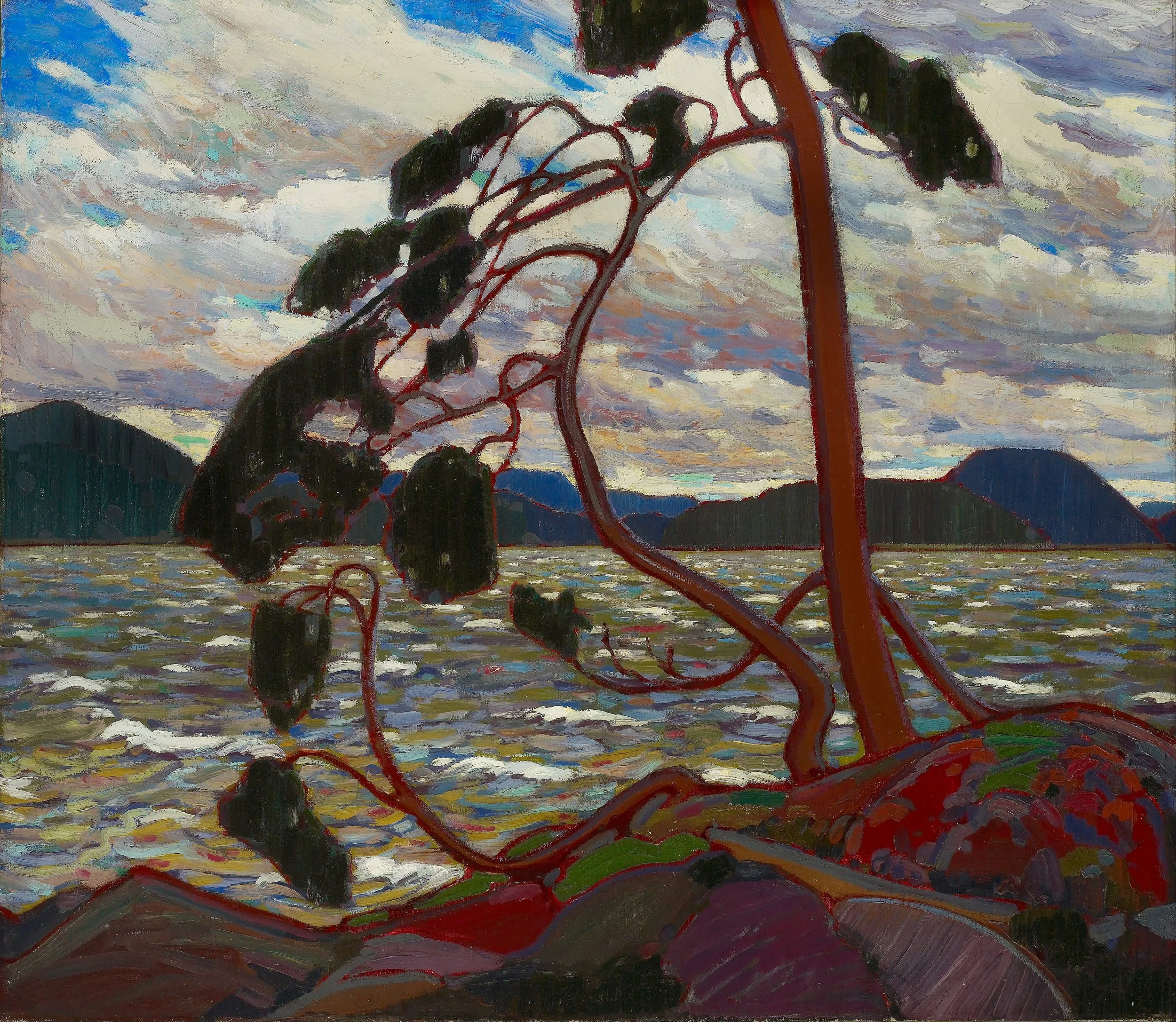
The West Wind, Tom Thomson, Oil on canvas, 1917. Sourced from Wikiart.
At one point, Abra rescues a squirrel she finds dying in the woods. In her attempt to rehabilitate him enough for re-release into the wild, she sees how ‘almost imperceptibly, he became a responsibility’. However, she also finds pleasure in caring for him and comfort in his presence. Quickly she identifies ‘the danger of the false comfort’ and when she puts him back outside, healed, she runs away without turning back and cries as she does it. Abra comes to an understanding, alone in the woods, that ‘if something can survive on its own, then I have no right. Then it is necessary to let it be’. This is also, essentially her parenting philosophy; in the afterword Barfoot writes about Abra’s ‘Larkinish contention that, with or without her, her children would inevitably both suffer and thrive. They might do so in different ways if Abra had stayed but suffer and thrive they would be bound to do.’
Abra’s refusal to turn back and look at the squirrel echoes an earlier episode in the book, the moment where she leaves the city and her family for good and refuses to look through the rear-view mirror. Though in this earlier section her preparation for her departure is tearless ‘I was trying to make myself feel what I thought I ought to, what I thought was normal, instead of accepting that I could not feel any sadness at all’. There is a mythological weight in her refusal to look back, perhaps she knows that if she does turn her gaze backward, that her plans to move forward on a path alone will disintegrate, that something will slip in, catch her, and keep her stuck.
Through Abra’s reunion with her daughter Katie, the reader gets to witness her parenting philosophy in action. When Katie finds Abra at her cabin in the woods their meeting is initially fraught. Katie decides to stay in the local village and spend some time getting to know her mother. Their friction and their rhythm are captured with astonishing emotional depth. At one point Katie says, ‘up here with you I feel like I’m being me, and I don’t care because I trust you not to hate me whatever I do … That’s weird, isn’t it? I know so many people, and I guess I don’t trust any of them.’ Despite having failed her daughter by leaving, she has also in another sense given Katie the gift of absolute approval by nature of her absence. In this, there is inherently trust. Katie says to her mother, ‘I wonder how come you’re the one I trust? Of all people, you’re the one I should trust least.’
Katie’s emotional force is eventually directed towards trying to bring Abra back into the city with her. In one final heartbreaking scene, Abra is in Katie’s car and feels immediately suffocated by the unfamiliar seatbelt:
I need her help. She has put the strap on, she can let me out of it, she must know how, I am suffocating in it. I beg. "Katie let me out of here, get me out," and I am crying with so much fear. Her face disappears and then she is beside me, saying "calm down, Mother, it's all right, it's just the seatbelt, you're supposed to wear it but if it bothers you, you can leave it off, it's not serious, and she is crying too.
Freed from the hold of the seatbelt, Abra runs towards the cabin. Of course, she cannot return to the city, to her old life, to the role of mother. She tells Katie, ‘I’m sorry you’ve had to suffer because of me’. I see Larkin here of course (‘They fuck you up, your mum and dad. / They may not mean to, but they do’) but I am also reminded of D.W. Winnicott, who writes: ‘I would rather be the child of a mother who has all the inner conflicts of the human being than be mothered by someone for whom all is easy and smooth, who knows all the answers, and is a stranger to doubt.’ Abra doesn’t do easy and smooth, she most certainly does not know all the answers and she is doubt’s bosom friend. Her doubt trickles steadily throughout the book, but within the doubt, within ‘the two lines running along the same person’ Abra understands that there is space for her ‘to move around inside the discussion’ of these clashing identities. She makes a home for herself in the very crack between her two selves: ‘a little light could enter and there was a space where I could burrow into it’. And so she burrows. And we have to trust that Katie will be alright, as well as Abra’s other child, and her ex-husband. We have to trust that they can suffer, survive, and hopefully, thrive on their own.
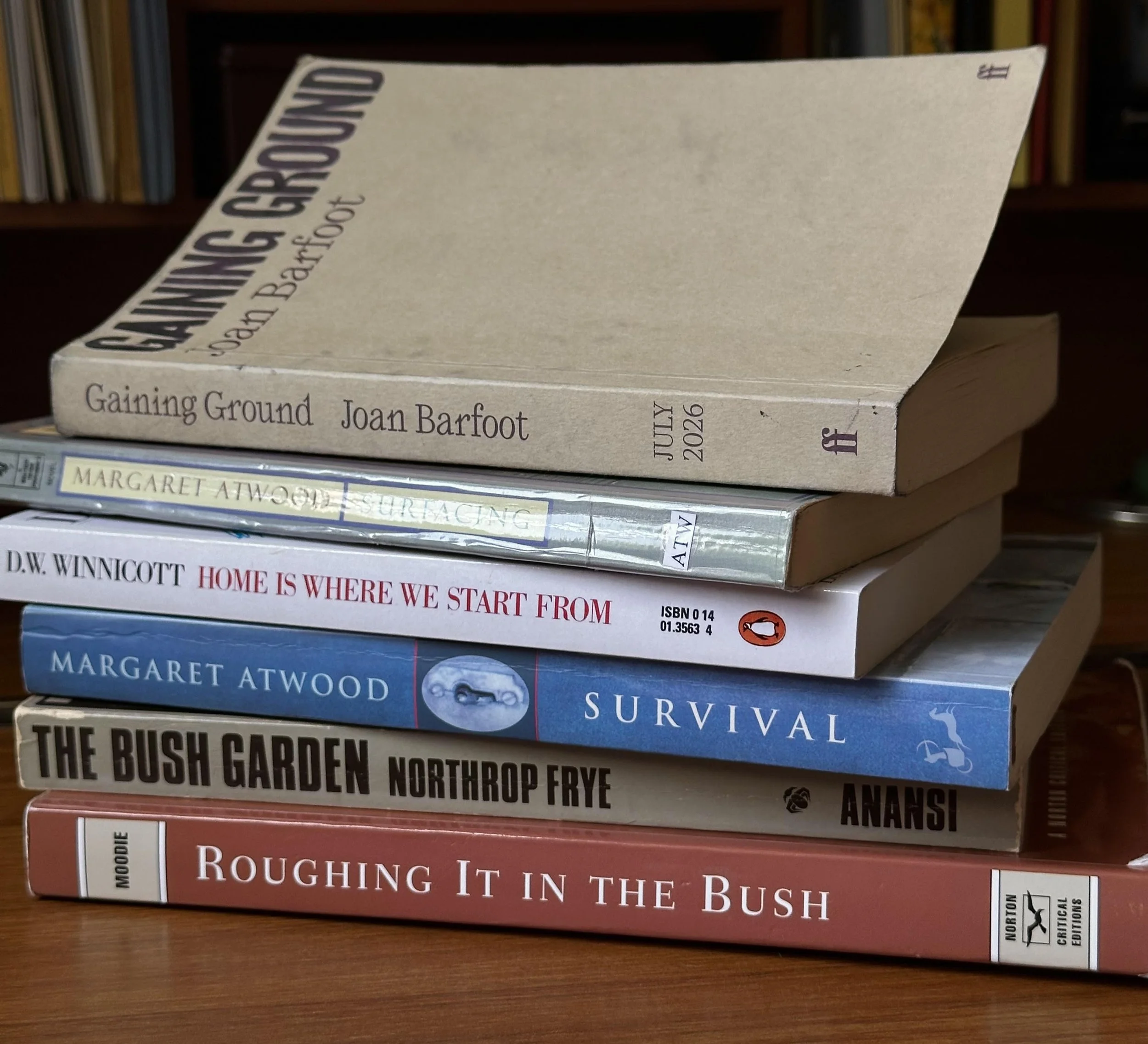
Books consulted for this essay. Image taken by writer.
A few years before Barfoot published Gaining Ground, Margaret Atwood published her 1972 novel Surfacing. Atwood’s novel is also in many ways about a kind of inheritance, the baggage we inherit from our parents, our genders, our national identities. In Surfacing, a nameless female protagonist goes out into the wilderness to search for her missing father with her boyfriend Joe, and another couple. The trip into the woods becomes a trip into the past, to the annals of memory but also evolves into a stark confrontation with identity. In the protagonist’s search for her answers and her father, both she and the past start to break down, dissolve at the edges. She becomes deliciously feral, ‘I am not an animal or a tree, I am the thing in which the trees and animals move and grow, I am a place.’ However, despite the protagonist’s eventual reckoning and her declaration to ‘refuse to be a victim. Unless I can do that I can do nothing’ – there is a frustrating backward step into civilisation at the end of the novel. Rather than stay wild, she walks out of the woods and back into the hands of Joe (who, it should be noted, she does not even like very much), re-inserting herself into gendered social mores, capitalism – the stale architecture of modern life. As a contemporary reader of the book, I got to the end and wanted her to stay in the woods forever. And perhaps, Barfoot herself might have felt this if and when she read it, because she refuses to let Abra fall back in step with the civilisation she had her escape from. Abra becomes the wilderness unto herself that Atwood denies her protagonist.
A contemporary British readership may not be aware of the tradition of Canadian bush-literature that Barfoot’s book fits into. Gaining Ground comes a few years after Surfacing, and both owe a debt to British-born Canadian settler Susanna Moodie’s 1852 autobiographical book Roughing It in the Bush, a canonical text in the Canadian literary tradition.The book charts Moodie’s 1832 move to Upper Canada (also known as the Canadian ‘bush’ or backwoods) with her husband and child.For Moodie, the escape is one of necessity, a colonial attempt to improve their financial prospects and start anew.
It is worthwhile to note that Moodie crossed the Atlantic with her family to settle in the Canadian backwoods a few years before Henry David Thoreau went to the (not so far from town) woods to ‘front only the essential facts of life’. Thoreau wanted to go to the wilderness to learn from it but also more precisely to ensure that when he came to the end of his life he would not ‘discover that [he] had not lived’. Both Thoreau and Moodie wrote books about their experiences of ‘survival’ though Thoreau’s is far better known (outside of Canada) than the other; maybe because Susanna was Canadian, or maybe because she was a woman. Canadians, however, are very familiar with Susanna Moodie. There is even the slightest nudge to it in Gaining Ground, when Abra declares ‘I do not have an interest in “roughing it” I am accustomed to comfort’. Atwood published a book of poetry about Susanna Moodie in 1970, called The Journals of Susanna Moodie. In her afterword to the collection Atwood writes, ‘Mrs Moodie is divided down the middle: she praises the Canadian landscape but accuses it of destroying her’. This dichotomy parallels the split identity of the nameless protagonist in Surfacing and also Barfoot’s Abra. For Atwood, Moodie’s split self is the key to understanding her, ‘on a remote bush farm, she can neither hold on to her English past nor renounce it for a belief in her Canadian future’.
Both Roughing It and Gaining Ground deal with a woman grappling with her circumstances, attempting to survive in the elements and learning how to move through the extremes of each season. For Abra, the bush represents freedom, for Susanna it represented a terrifying force that contrasted with her genteel upbringing. Susanna writes that initially her ‘love for Canada was a feeling very nearly allied to that which the condemned criminal entertains for his cell’. Both Abra and Moodie attempt to decipher the extremities of the Canadian climate. While Abra reflects on her first winters from a position of learned empowerment, ‘I should not have been afraid of winter; I should have understood that not even its toughness could hurt me here’ Moodie looks back and sees only her shameful vulnerability, ‘The rigour of the climate subdued my proud, independent English spirit, and I actually shamed my womanhood, and cried with the cold’. The reality of Canada, its backwoods and its cities, is that the climate is indifferent to the whims and foibles of any one individual, this is precisely what makes texts set within the extreme vastness and cosmic apathy of the landscape so very rich.
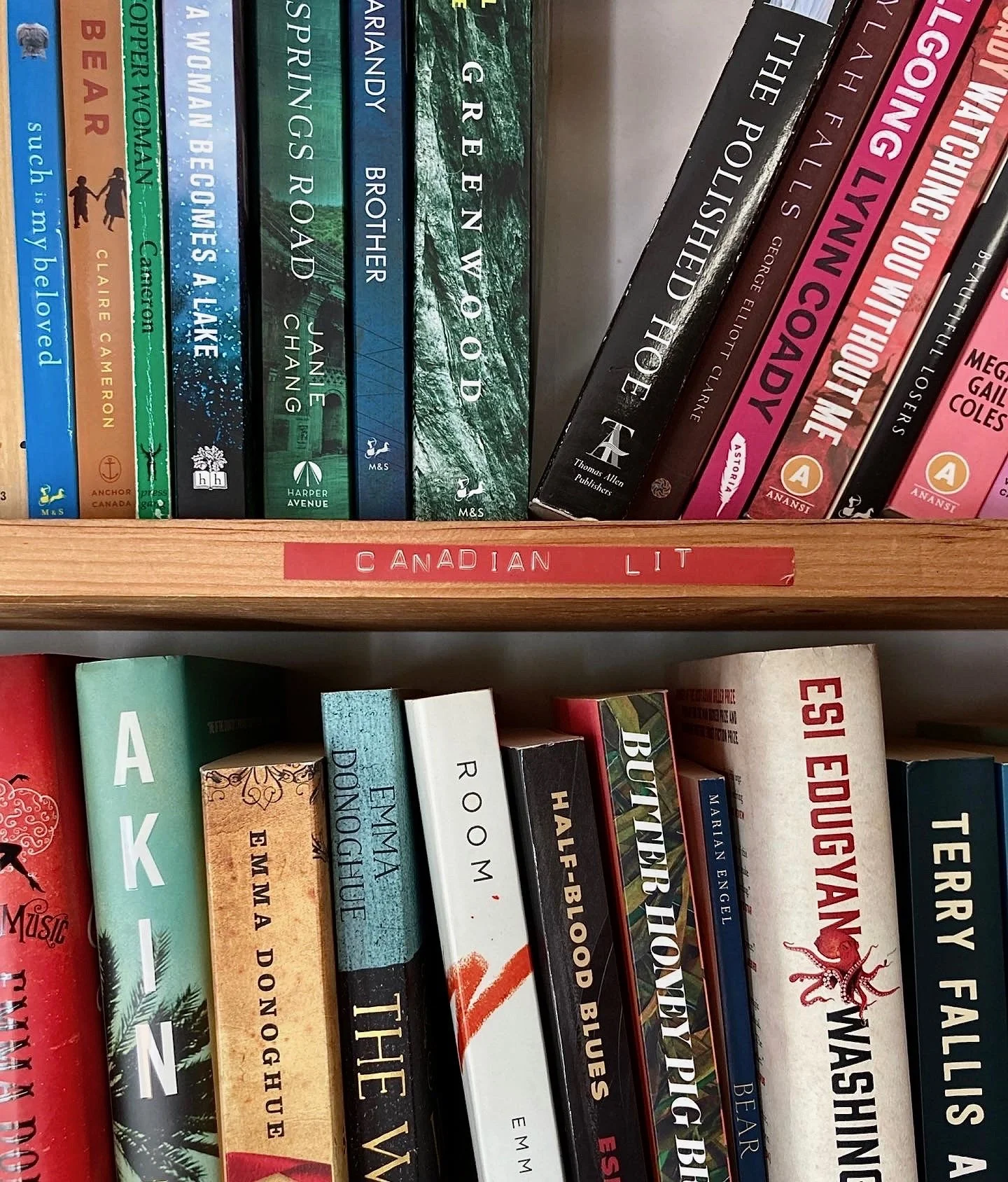
Shelf of ‘Canadian Lit.’ Image taken by writer.
I have admittedly spent more time reading about the Canadian wilderness than in it. When I was an undergraduate student at the University of Toronto, I initially took only the mandatory CanLit course but enjoyed it so much that in subsequent years I filled my schedule with as much of it as possible, including a yearlong independent research project on Susanna Moodie. I have been to the national archives in Ottawa and held a lock of Moodie’s hair in my hands and marvelled at her detailed drawings of flowers. I have driven two hours out of the city to visit her grave at Belleville Cemetery, where the statue of a winged woman presides over MOODIE carved into stone in large block letters. I have also been for many sunny swims in Thoreau’s Walden Pond in Concord, Massachusetts. But from my mooring in suburban Toronto, my relationship to the wilderness was primarily literary. Perhaps because I moved to Canada from Paris, France when I was a child there always existed a veil that swayed between me and the wilderness rendering it gauzy, romantic and not totally real. This is not to say that I haven’t camped or canoed or slept on a forest floor or treaded water in a cold lake or snowshoed across plains of snow – I have – but more than any of this I have read books in my room and studied in libraries and sat in lecture halls.
What I liked so much about Susanna is that she came from a landscape and a vocabulary that was wholly incompatible with what she encountered in Canada. I loved and still love that you can see her struggle against language: this was no land of babbling brooks but of forests so dense that nothing could pass through and a cold that could kill. In Canada what she encountered was in many ways a narrative problem. She had one framework through which to understand her surroundings, which led to a dissonance in her writing that has proved eternally fascinating. Perhaps there was something in this incongruity that I identified with as an outsider myself. Now, many years later and living in London as a different kind of outsider, one thing I have often found myself trying to get across is the scale of Canada, and precisely how small the population is in relation to that scale. It is hard to explain one’s relationship to vastness, but Canadians have a sense of it inherently. I think it does something to a people and to their literature to exist in constant relation to a mass of indifferent land, we are always aware of how small and how fragile we are.
In the Northrop Frye’s 1971 collection The Bush Garden: Essays on the Canadian Imagination he writes:
When all the intelligence, morality, reverence and simian cunning of man confronts a sphinx-like riddle of the indefinite like the Canadian winter, the man seems as helpless as a trapped mink and as lonely as a loon. His thrifty little heaps of civilized values look pitiful beside nature's apparently meaningless power to waste and destroy on a superhuman scale, and such a nature suggests an equally ruthless and subconscious God, or else no God.
Frye recognises the inconsequence of our values in the face of the indefinite, be that Canadian winter yes, but also we can extend this to motherhood and furthermore, identity. Perhaps, what Abra and Moodie teach us is that we split ourselves from ourselves and from time, in order to progress. One must irreparably fracture themself to know themselves fully. So a woman separates herself from her family, or her country – from every fragment that spells woman as she knows it, and in this rupture, growth. To face head-on all the inner conflicts of the human being, to spend evenings lonely as a loon, to be cold in an indifferent climate, to be broken – is also to discover that one is living. And like snowfall in the middle of a forest, or a motherless child in a city, these realities will keep occurring. Survival is a perpetual state. Abra shows us that a thread pulling you away from something can also loop you backward to yourself. You can stage a quiet revolution in being the only witness to your suffering, to your happiness. We are destined to keep happening, alone, together, snow on top of snow on top of snow. ‘I was beginning to understand there would be many things I would have to do to survive that I might not enjoy’ Abra tells us, here too a path…
Cover image: The West Wind, Tom Thomson, Oil on canvas, 1917. Sourced from Wikiart.