August in Cologne
Galerie Karsten Greve
1
On a long walk, I wander into a solo show of the artist Pierette Bloch.
The main room has a long wall text that I mostly skim ... something about the repetition and rhythm within her practice resembling time within music.
2
Across the room, I see a piece covered in short marks of rich black ink.
The artist's strokes do not appear methodical or hurried. They have a sort of voluptuous brevity—as if someone had covered their knuckles in ink and brushed them against the page.
3
Each catalogue description includes the type of paper Bloch used—Canson, Arches, Kraft, Vinci.
As I walk from one piece to another, I notice variations in the colour and texture of each. Some have yellowed over time. They are not necessarily less beautiful.
4
The silence of the rooms and the silence of the untouched paper changing slowly under glass affect me as much as the markings of the artist.
Maybe it's because I sense, but do not yet fully believe, decisions I have not made will soon affect me as much as the ones I have.
My body is not heavy and no longer young. I have scraped away everything except its potential, and perhaps unknowingly, I scraped that away too.
5
At home in Santa Fe, snippets of conversation often distract me from my own thoughts. Here in Köln, because I do not speak German, I take in long sequences of sounds without meaning.
I walk for hours listening to these sounds.
I call my boyfriend and try to describe the different effects of the papers in Pierette Bloch’s paintings. He wonders if Bloch knew her work would last. Maybe doubt affects the materials you choose, maybe doubt is not a bad thing to allow people to see.
6
Later, I copied a description of a Pierette Bloch composition in horsehair.
"The extremely fine, fragile yet tenacious, material conveys both precision and arbitrariness, as the hair from mane or tail would always slightly fray."
Museum of East Asian Art
1
I linger by Tanaka Ryōhei's etchings.
2
Roots take up nearly half of Trees No. 2. The trunk and lower branches are also visible but less prominently so.
Like a window, the frame focuses and restricts my gaze. The artist only includes what he values. There are no upper branches.
3
I love how little care Ryōhei gives to the "whole" picture.
In Collapsing Roof No. 5, beams stick out of broken thatch. He pays painstaking tribute to the holes in this roof. However, he doesn't show any structure beneath.
4
I think of the opening paragraph of Marguerite Duras's The Lover.
"One day, I was already old, in the entrance of a public place a man came up to me. He introduced himself and said,'I've known you for years. Everyone says you were beautiful when you were young,
but I want to tell you. I think you're more beautiful now than then. Rather than your face as a young woman, I prefer your face now. Ravaged."
I've always wondered why she gave that encounter such prominence—is it so rare to believe that time creates more beauty than it destroys?
The Ludwig Museum
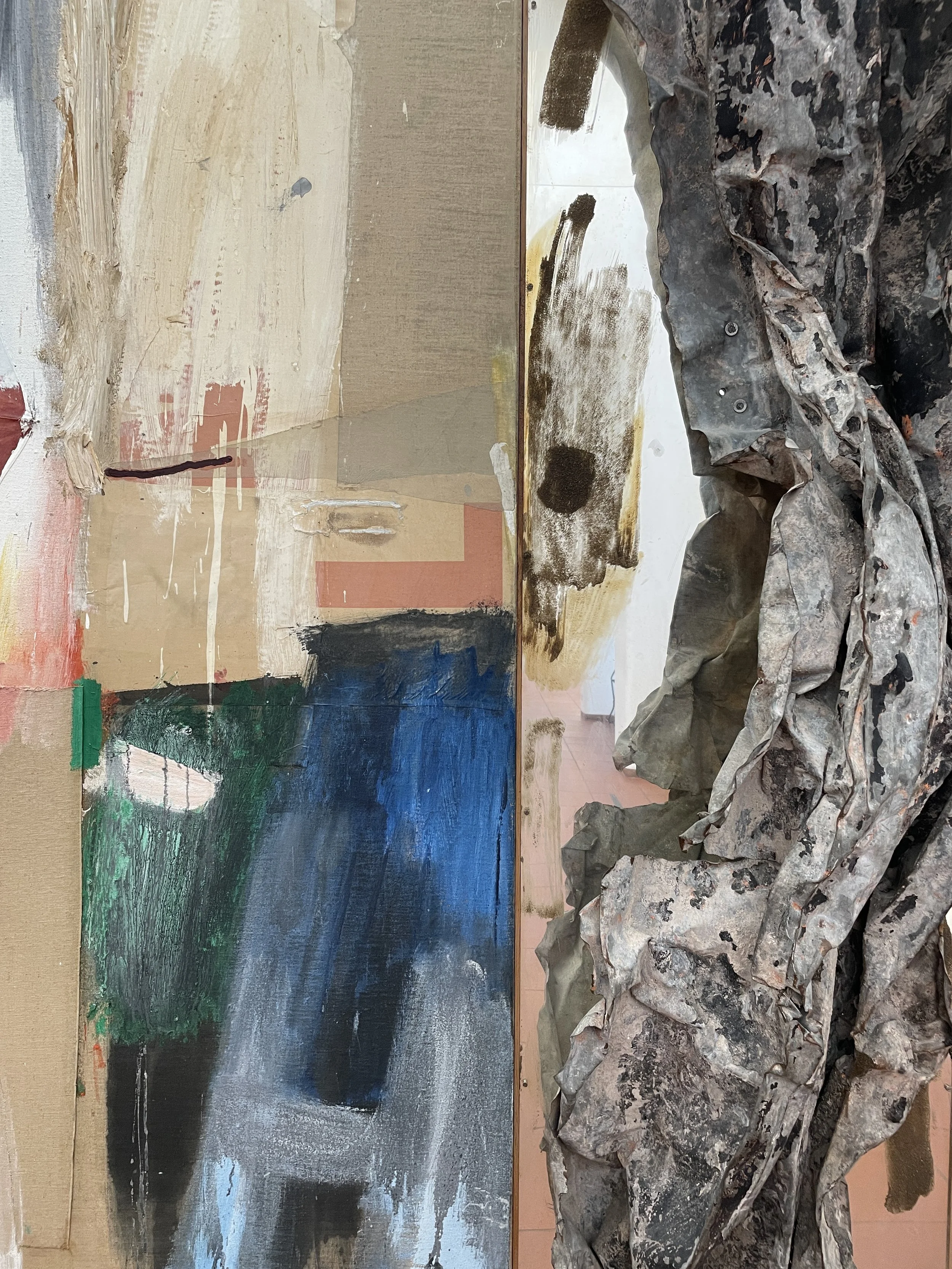
Allegory, Robert Rauschenberg, Combine: oil, paper, fabric, printed paper, wood, and umbrella on canvas and metal, sand, and glue on mirrored panel. 1959-60. Detail. Image taken by writer.
1
I begin on the top floor. By the time I reach the lower floor, I've almost stopped looking. I reluctantly walk through several rooms, which seem a wash of red, until I turn a corner and find myself facing Robert Rauschenberg's Allegory 1959-1960.
2
As I look, I simultaneously think of being in a crowd of people speaking loudly and of the absolute absorption that comes, occasionally, from being alone with a person you chose.
Allegory 1959-1960 is one of Rauschenberg's self-described "combines", a work that bridges sculpture and painting. This particular one is made of oil, fabric, printed paper, wood, an umbrella, canvas, metal, sand, and glue on a mirrored panel.
3
Several people walk into the room and I back away, so they have a turn in front. Each time I reproach the combine, I see something different.
The umbrella is broken, black canvas extends beyond the frame, paint fans out, then abruptly stops. Textures do not blend. There are so many edges.
4
I imagine the artist arranging and rearranging the brokenness that surrounds the mirror, the chances taken and withheld, the persistent hope that by placing all the pieces in the right order, he would make them beautiful.
As Rauschenberg told ArtNews:
"I realized that the details should not be taken in at one glance, that you should be able to look from place to place without feeling the bigger image. I had to make a surface which invited a constant change of focus and an examination of detail. Listening happens in time. Looking also had to happen in time.”
Cover image: Allegory, Robert Rauschenberg, Combine: oil, paper, fabric, printed paper, wood, and umbrella on canvas and metal, sand, and glue on mirrored panel. 1959-60. Detail. Image taken by writer.