I Am Worm
In the block next door to me lives a man with scars running up from either side of his mouth, a violently extended smile. His top-floor flat was once home to a pack of black and white cats he got as kittens, or perhaps bred, but once the cats became old or bold enough, they escaped from their balcony, down to freedom in the concrete streets of East London below.
The cats have become strays, that spray the alleys of our neighbourhood with acrid ownership and mewl, fight and copulate throughout the night, multiplying season by season.
Despite their emancipation, the man goes out once a day and feeds the cats raw chicken legs which he buys from Lidl in a jumbo family-pack, chucking them at the cats from a few meters away, the closest anyone can get to them. The lean and slinking felines squabble over the pale, dimpled limbs as they slap onto the tarmac. Despite calling various authorities and charities to intervene, the organisations tell us that since he is feeding them, and no cruelty appears to be taking place, there is nothing they can do. The pack proliferates.
I think of this man and these cats, of their defiant escape and their current faux-feral existence as I read Morgan Day’s debut novel, The Oldest Bitch Alive.
The book by fiction and architecture writer Day follows the life of Gelsomina, an ailing French Bulldog, who contracts terminal parasitic worms and, with them, a new clarity and perspective over her life. The novel navigates her fraught and solemn reflections on her existence thus far. The dog’s philosophising is interwoven with narrative interludes concerning her architect owners along with chapters told from the perspective of the worms infecting Gelsomina. These worms in turn are reckoning with their new home, and what it means to live in Gelsomina’s old and failing stomach.
Gelsomina is pampered by her owners John and Wendy, who spend their days attempting to care for her: halting her attempts to gain freedom to the surrounding countryside; restraining her from licking her paw into a raw open wound; offering her liver flavoured CBD gummies for her perceived anxiety and cleaning up the messes she deposits across the couple’s tasteful and exacting glass house.
My local stray cats and their escape from the confines of their cramped flat into the city below feel like a foil to Gelsomina’s apparently cushy situation. No fourth-storey brick slip flat or pot-holed back streets for Gelsomina. Instead she sits on her sofa, in her glass house staring wistfully at the forest just beyond her reach.
The house Gelsomina and her owners live in is wholly unsuitable for life. With Sisyphean patience, John and Wendy wipe down the snuffle marks left by their two French bulldogs to keep the glass’s illusion of a seamless connection with nature outside. So committed are they to this illusion that birds continually injure themselves by colliding with the house’s glass walls. Even the human occupiers, despite lauding this purported connection to the outdoors, admit that the house makes them feel exposed and intruded on by curious delivery drivers.
Onto this imperfect vessel, the human inhabitants project a set of ideals – minimalism, cleanliness, taste – which they believe will sustain the lives it contains. It’s a theme echoed in Gelsomina’s own body, an imperfect home for the pair of parasitic worms. Inside Gelsomina, the worms grapple with the choice to assimilate to her dying body or exit to try and find a better, brighter, but by no means guaranteed, alternative.
Thus, the glass building is a container for the dog, the dog a container for the worms. The house is badly designed, just as the French Bulldog is a badly designed breed, with an excessively short snout that affects its respiration and eyes that dangerously protrude from their overly wrinkled face. Not only can the domesticated Gelsomina not survive on her own outside, her breed itself cannot survive without constant monitoring and medication. Gelsomina is dimly aware that her contrived fashionable breeding casts her as more thing than being: "her primary concern was that she is a burden. Gelsomina occupies a similar role as the glass house in her old age – a thing that requires maintenance. Or perhaps she is closer to a piece of weathered furniture, one that is not used but passed down for sentimental reasons.” The couple’s pursuit of idealised living has led to a house that breaks the necks of birds and a dog who can’t breathe.
A moth lands on the page in front of me. It strikes me as an inconvenient animal, a pest, like Gelsomina’s worms or Gelsomina herself as she moves through the house incurring infractions to the owner’s annoyance, such as humping her plush ball or defecating inside. I wonder whether to squash the moth which is most likely eating my clothes. But it is such a small fleeting life, who am I to decide to snuff it out, slammed between the leaves of a debut novel?
While I’m reading The Oldest Bitch Alive I’m feeding my baby. She rests warm in my arms late at night, growing plump, drinking life from my body. Over her short existence so far, she has refused to drink any of my carefully harvested milk, which sits in little jars in the freezer in the hope she will one day be sustained by a bottle and not solely from me. But this synthetic delivery of milk, this most primary stuff of life, through a pliable plastic teat, disgusts and frustrates her. Instead we remain physically, geographically, emotionally tethered to one another. Entangled.
Gelsomina never gets the chance to be a mother, something she cogitates in her final days. She reflects tragically on her experience of being neutered and her post-surgery phantom pregnancy. “I did not give birth but young appeared. It was following a blackout and my return in agony”. Even after her phantom pregnancy, she harbours a residual attachment to various squeaky toys in her life. Her lack of young feels like a telling reflection of her own surrogate parents, who have “not reproduced, either, to her knowledge. It is as though the glass house has its own set of laws. The structure insinuates sterility.”
As soon as she ingests the worms, Gelsomina becomes conscious of their presence in her body, gaining a kind of existential omniscience. Along with the uncomfortable fizzing in her gut, she also becomes aware of the state of her life up until this point. The worms inside Gelsomina’s body imbue her with a new found sense of responsibility. Despite the fact that, like her neutering, she has no choice over their residence in her body, she thinks of their presence as a responsibility. She must in some way nurture them, give birth to them, disregarding that they are digesting life from her. Gelsomina’s incubation of the worms is an unsatisfactory surrogacy, with the possibility of an inverted rectal birth. “Before giving into sleep, her only remaining option is to end her life and reincarnate as a worm.”
Only the worms in the novel reproduce sexually, taking advantage of the embracing warmth of Gelsomina’s stomach. The worms continually ponder and act on their need to reproduce, either making clones of themselves or copulating with one another. I’m most like the worms, I think to myself. I have replicated. What hurtling life force drove me to do it? The same questions that swirl around the worm’s mind settle in my own. Was it my choice or a basic animal desire? Though the worms have been able to reproduce they are not more content than any of the other characters in the novel. To reproduce may be a compulsion, but it is not a solution.
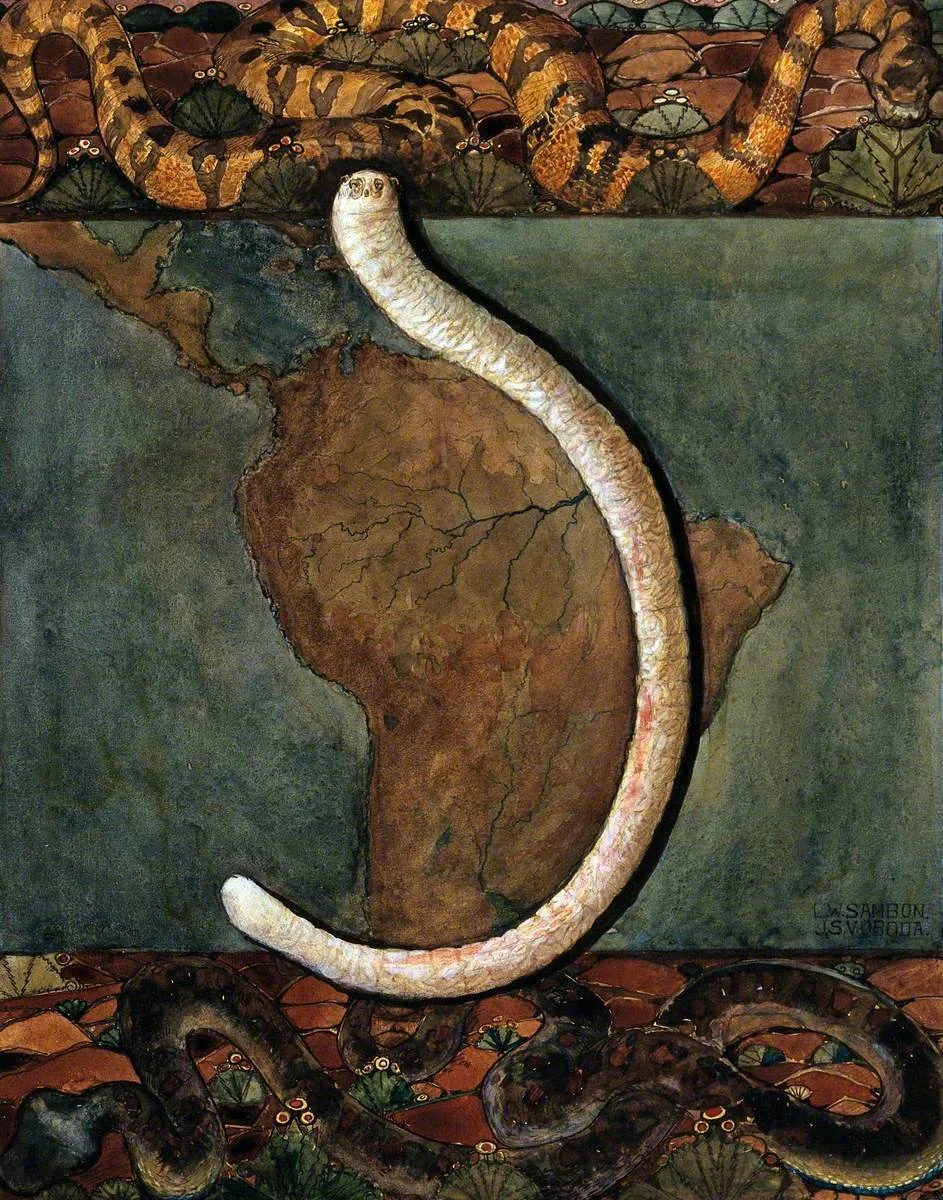
Parasites: A Parasitical Worm, Shown Much Enlarged, with Its Hosts (after Louis Westerna Sambon), J. Svoboda. Wellcome Collection
In the past few years, the proliferation of ticks where my great aunt and uncle live has increased. Warmer summers year on year have accelerated their breeding. My aunt and uncle fret about the tiny external parasites that bite and cling onto their dogs, and in turn onto them, transferring bacterial phyla into their bloodstreams. They both fear infection and lyme disease and have had to take courses of antibiotics after nasty reactions. I think about how we invite some animals to live with us and not others. My aunt and uncle welcome the dogs into their home, but not the ticks they bring. An impossible ask. Every time I log onto Instagram, I am greeted by a host of videos by ‘mothers who regret motherhood’. Mothers who are bitterly resentful of their choice to reproduce, who feel their body ails and withers at the behest of another being. And more sinisterly, benefit from the virality of the content they make. They are caught in a bizarre cycle, lamenting their parasitic offspring while financially feeding off the content their babies allow them to make. I don’t identify with the videos – I feel nothing like the women in them – yet their clickbait content spreads invasively across my algorithm, which draws me in and throws up more and more videos in their wake. Do I somehow unconsciously sympathise with these women? What do I know of my own reactions, of what my held attention reveals?
Despite suffering from an illness that incurs equal parts shame and disgust, Gelsomina deports herself with a nobility throughout. Gelsomina’s illnesses, the problems with defecation and her sexualised incursions are handled with a formality of language that gives her a great sense of dignity. ‘The unwatched release I have never had. Always under the eye,’ Gelsomina reflects on her first shit alone in the woods. The humour in the novel is laced with irony, such as John and Wendy’s tendency to ‘often say they envy their dogs’ lives’ whilst petting the suffering Gelsomina. The humour is bitter, ironic, sometimes whimsical, but never scatological.
The book is also horribly tragic-comic or sometimes simply tragic. Despite the fact that their continual attempts to pet and pamper Gelsomina always fall short, I can’t help but feel for the owners as they come to terms with her impending death. The peculiar tragedy of putting down a pet which, despite John and Wendy’s infuriating obliviousness to her proper care, you understand they feel painfully. It’s a double tragedy which comes out as our misplaced capacity to care, to love, to grieve.
Sitting in the park situated between city skyscrapers, my baby and I watch a pigeon coo its way towards us. The birds’ long evolution of living alongside humans means we pose no threat. The tower blocks of London have become their cliff edges to roost on, our rubbish, the berries and seeds they might have foraged in rural habitats. There’s a white plastic tag around its ankle and it’s missing two toes on its other foot; all that remains are some rough calloused stumps. I used to think this was because of a peculiar kind of pigeon leprosy that ran rampant through London’s estimated population of three million pigeons. I’ve since learned that city pigeons typically lose their feet because of urban debris – specifically human hair – that gets wound round their toes, cutting off circulation and slowly causing their toes to wither and fall off.
Despite their demands on her body, the worms feel no ill will towards Gelsomina; in fact, they are only partially aware that their presence is hurting her. Extrapolated outwards, it’s with the same obliviousness that we as humans continue to live on the planet, a vague or not so vague awareness we are sucking our host dry, but without any real power to change it. We feel sad for our host planet and continue to take from it regardless.
My own baby has no choice but to exist in this world through me; because of me. Most of the time, I see it as a hopeful gesture, a motivation to make the earth a better place for her, but at others I can be wracked with pangs of guilt. Perhaps I’m just as misguided as Wendy and John, as they well-meaningly squirt medicine into Gelsomina’s eyes; or the worms who wish to exit the dog’s body in the implausible hope that a better host might exist.
The fourth trimester, the first twelve weeks after a baby is born, is the time when the caregiver helps the infant transition from the previous safe, warm life of the womb to the stark outside world. People quip that your baby thinks they are still literally part of your body; that they have no sense of self. It explains their need to be held often and closely, unwilling to leave the safety of their host body, a body they feel is also theirs.
To give birth is to remind oneself of our basic animal nature. In Metamorphoses, philosopher Emanuele Coccia argues that all living and non-living beings are in a constant state of transformation, borrowing and recycling life’s matter into further lives. An interconnectedness that applies to humans just as much as trees in the forest or the flies hovering round a rubbish bin. To Coccia, birth takes on a much wider meaning than its biological definition. In order to live, he sets out, one has to take from the body of someone who has already lived and transform it. What does birth mean? It means in order to exist a newly living body must steal from a living body, so that this piece of matter lives on in a different form. From this perspective, the distinction between sexual reproduction and parasitic reproduction falls away. It is all simply recycling from other bodies. Our bodies are set up simply to give another body a life. It’s a rejuvenation, something that we seemingly race towards, just as Gelsomina breaks out on her own into the wilderness during the climactic finale of the novel. Despite her looming death the French Bulldog has found purpose, clarity, and a yearning to be in control of her life for the very first time.
Day’s book conjures up a series of associations and diversions that tickle and sway one like the thousands of villi lining Gelsomina’s stomach. The book skips lightly from character reveries to essayistic asides to cosmic manifestos voiced by Gelsomina or her worms. It trips my mind onto any number of tangential subjects: climate change, motherhood, strays, more-than-human design, domesticity, objects and the objectified. Perhaps that’s the right reaction to a book grappling with the unwieldy questions of how we are to determine meaning in our lives and how our lives relate to others.
It’s this latter point that stays with me. Day’s book is not just about exploring the meaning of life, our guiding motivations, or our degree of control over how we live. It is also about the meaning of a life lived with others, about coexistence and the tensions that arise within it. It is about living with other animals, other humans, other species and the inevitable failure of the attempt. The absurdity of trying to know and understand another life. Where and how we make our homes within unsatisfactory limits, how much these shape us and shape our homes, our vessels. Or perhaps not, perhaps that’s my own reaction, having so recently been a vessel for life. They call the period after birth, in which the person who has given birth becomes a parent, matrescence, which is analogous to adolescence. A rewiring of the brain. Perhaps that’s why I can’t interpret Day’s book as simply about the meaning of life. My brain has been rewired, rebirthed into one that can only frame life as it relates to others.
Moments in the book such as Gelsomina trying to nurse a plush strawberry during her phantom pregnancy fills me with a yawning sadness that only motherhood could have given me insight to. Much like the questions the book posits, I don’t think that by reproducing I have found my life’s meaning, and yet it fills me with a meaning that is profound and immediate. Can I really see beyond the animal me to the intellectual one? Would that be honest or even possible? In this way, I find myself doubting my own reactions to the book. Are they mine? Or has the reshaping of my brain, a demand of caregiving supercharged by hormones and a pregnancy-induced reduction in my brain’s grey matter, clouded my ability to react objectively? Am I simply reacting as I’ve been designed to, my pursuit of life and self dictated purely by biology?
As I finish this piece, I realise I haven’t seen the pack of strays nor the man with the Glasgow smile around recently. I wonder what has happened to them. Have the cats moved further afield, each one with a new territory, their own alleyway kingdom? Have they died horribly through lack of regular veterinary intervention? Perhaps, who knows, of worms? Or have they been caught, neutered and rehomed, and are now lounging around on Ikea cat trees looking through glass windows and vigorously kicking up litter tray gravel across linoleum floors? Reading Day’s book, I leave with a sense that freedom, at whatever costs, is harder but more noble fate. That these stray cats have an agency over their lives feels preferable to a comfortable captivity. That, however well-meaning, sharing our lives with other animals, other lives, is always, somehow, going to fall short. Our inability to understand one another and what we mean to each other is the ultimate tragedy.
Cover image: Parasites: A Parasitical Worm, Shown Much Enlarged, with Its Hosts (after Louis Westerna Sambon), J. Svoboda. Wellcome Collection