Silver Dagger: How Songs Wait for Us - Queer Listening and Memory
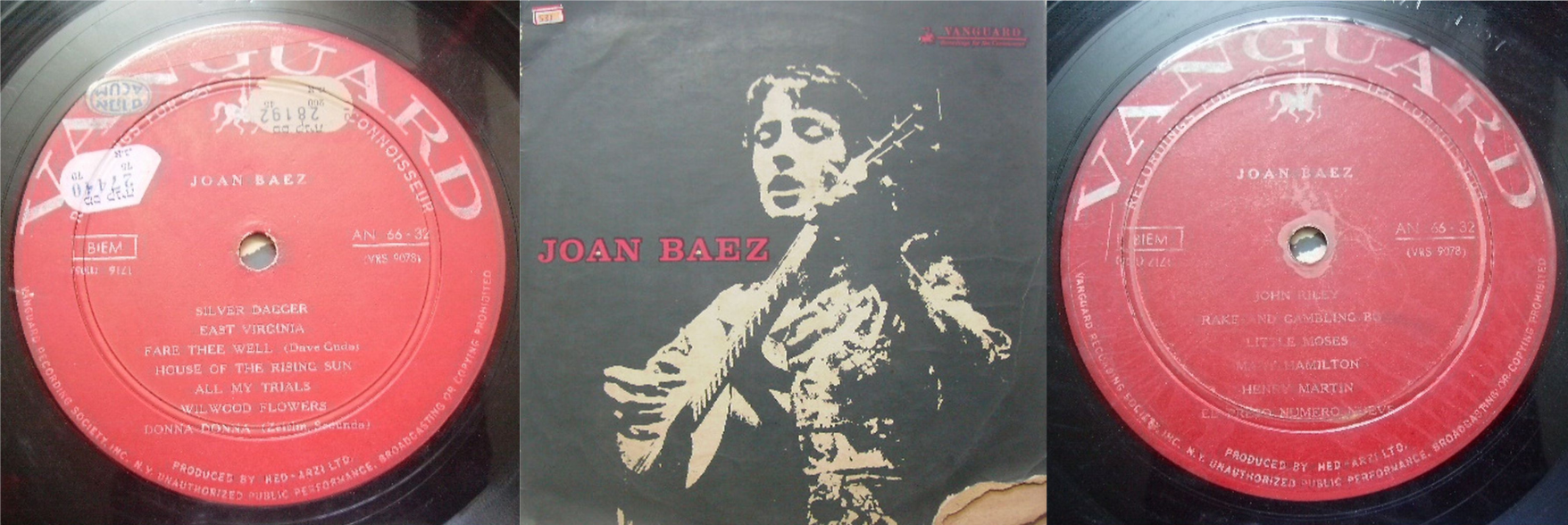
Cover and sides A and B of Joan Baez’s self-titled record, 1960. (Manhattan Towers Hotel Ballroom). Images sourced from an eBay listing.
When I was 12, or 13 or 14 I had a Joan Baez record. I had about 20-30 records then in my collection. Some were given to me, from my grandfather, and maybe my cousin, who I considered an expert of music at that time (she was a Beatles fan), and some I bought with my own money, earned from dog sitting, baby sitting and handing out flyers for a nearby second hand store, that paid me too little to stand for hours in the street, making it appealing by also suggesting a 20% discount on the store’s clothes and items.
My small room had once been a balcony. The room barely fit a bed-and-a-half, a compact desk and shelves. One wall was entirely windows and blinds, making it too warm most of the year and freezing in winter, but always flooded with beautiful light. I listened to these records there day and night. I don’t remember if the Joan Baez record had a title – if it was even ‘an album’ or just a kind of cheap reissue one often found in the local second-hand music stores where I grew up, but I remember clearly which songs featured. I listened to that record on repeat, lifting the needle again and again onto the songs I wanted to hear most. I probably damaged the arm, the needle, and the already cheaply made vinyl surface. Two songs were scratched. The interruptions altered the listening experience, yet never deterred me from playing them loudly over and over again.
Joan Baez is one of the most beloved and successful folk singers within the largely white Anglo-American canon. Yet her voice can also be overwhelming: the high pitch, the intense vibrato, the emotional outpouring of the songs she chose to sing and the way she sang them. I think my partner, Jade, wouldn’t listen to more than a few songs in a row by Baez, not because she doesn’t like her, but because it is an intense sonic experience. I sang along with Joan, loudly, to "Silver Dagger" - the first song on side one - and the Spanish song "El Preso Numero Nueve" - the last song on side two - though I never paid much attention to the lyrics of the first, and didn't understand those of the second.
Years later, my collection grew significantly, and my taste expanded into different genres and periods, drifting away from the 1960s folk, hippie, reggae records that dominated it then. I eventually sold most of that early collection to the record store next door to the café where I worked. I visited the shop almost daily and spent most of my salary there after rent and bills. I ate at work and treated my mother’s fridge as my grocery store. The person working there, warned me with each record he examined that I’m going to regret selling them. It took another decade for me to realise that he was right, as I gradually bought these records again. Anyway, I forgot all about Joan Baez.
My love and memory of Joan Baez and the understanding of listening to these two songs returned unexpectedly through cinema. I watched two films with Jade: A Complete Unknown,where Baez appears as a secondary figure, and The History of Sound where she is absent altogether.
The History of Sound (2025) contains what felt to me like one of the most intimate portrayals of queer people falling in love in the history of cinema, reverberating with emotional climax and fragility through the performance of “Silver Dagger.”
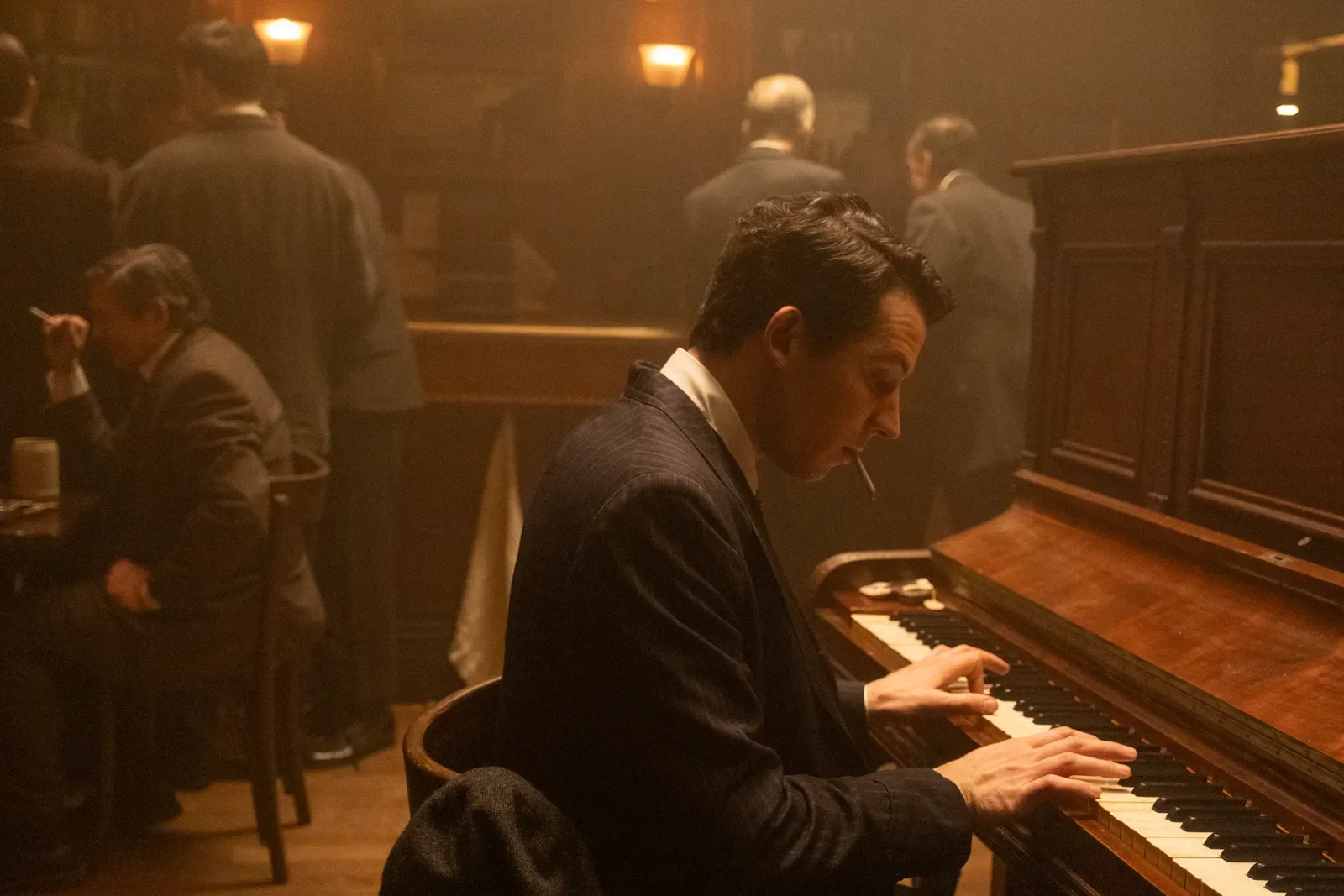
Still from History of Sound, 2025, Dir. Oliver Hermanus. (Mubi, Universal Pictures, and Focus Features). Sourced from The Knockturnal.
1917. A crowded dark room, one with the atmosphere of a social club. Men seated around tables, drinking, smoking, conversing, laughing. Faint piano notes emerge, a hum, followed by a dim voice
Across the Rocky Mountain…
I walked
For miles and miles
With each repeated verse, both voice and piano grow louder. The sound captures one of the men – Lionel – and carries him elsewhere, into another place and time. With every phrase and note, he drifts in mind and presence, then physically, away from his table and toward the source of the sound.“I’m sorry, I know that song from home”
We, alongside Lionel, see only the back of the man at the piano. Did he feel the approaching presence? The soft, yet curious gaze toward him? A growing, yet unknown desire?
on her I cast my eyes
Only then is his face revealed: eyes closed, voice delicately shaping each word:
She was most tall and handsome
Blue eyes and curly hair
There’s no other girl
In the wild world
With her I could compare
David — knowledgeable, outwardly arrogant — is a collector of songs. He learned “Across the Rocky Mountains” somewhere in a forest in England. Lionel knows it from home in rural Kentucky, having learned it from his father, who likely learned it from his own elders. Something about Lionel’s intimacy with the music — music David had until then approached aesthetically, as collection and preservation — unsettles him. It intrigues him. Maybe, in that moment, something in him cracks open: a softness, unfamiliar to him until then.
“I didn’t think people around here knew songs like that.”
“They don’t.”
Intimacy: finding someone who feels a song as you do. Not just any song, but the song – the one that already means the world to you, or the one that will come to mean the world because it was first heard, or shared, with that person.
“The sound is invisible, right?
But it can be physical.
It-it can touch something.
It can, uh, make an impression.”
After introducing themselves, exchanging a slight sheen of banter, David still seems unable to look Lionel directly in the eyes. Lionel asks which other songs he knows. David knows them all, of course.
“How about … ‘Silver Dagger?’”
David’s face changes immediately, as if he not only knows the song, but also understands what it will come to mean between them. For a brief moment, it feels as though he has travelled through time and glimpsed how their love story will end. Then, regaining his composure, he replies: “No, I don’t think so.” Which, to me, means: let me hear it all again.
“Oh.”
“Should I?”
“It’s such a pretty song.”
David makes it unavoidable for Lionel to sing it for him. Teasing him, he calls for silence, and suddenly the entire room seems to hold its breath. Yet the room no longer matters. Everyone else disappears. Only David remains, listening as Lionel sings, as though he had not expected the song to make him feel this way despite already knowing it by heart.
Don’t Sing Love Songs
Some songs become shared language, secret language, love language. Some becomes room you return to alone, or together. Others attach themselves permanently to gestures, bodies, nights, conversations.
Ours is a relationship continually falling in love through songs and lyrics.
Alice Coltrane, Aretha, “Homeless Wanderer” by Emahoy Tsege Mariam Gebru, and blues songs a plenty.
“Tomorrow’s Gone” by Charlie Megira
Maybe not a riding soundtrack
But when ur back home
Your body’s weary
You lay down
On the floor
Or on the bed
Maybe you have a drink in your hand
maybe you just play with the tip of your hair
And stare
That’s for when this song (many of his songs) for
“A Song For You”
When I speak about no space and time
I speak Donny Hathaway
If I’d stay for a drink
What would you put on?
“Dr Feelgood (Love is a Serious Business)” - Aretha Franklin
You do know that question is in my
head now and I feel like I’m going to
have another go because a neat
whiskey and your company would
last more than one song
“Let me Try” – MC5
“Welcome to My World” – Curtis Harding
If I’d stay – I’d “Fade Into You”
I sent it after the first time we had sex - first among the trees, then in Jade’s bed, during a spectacular northern lights display we did not see one bit of. The sleazy-ass blue satin sheets of my youth slowly gave way to Jade’s yellow cotton ones. My young, yet unfamiliar, body became entangled with hers. Desire and fragility manifested together. Wanting, and already afraid of losing it.
“The Lake District.
I think you’d die,
It’s so pretty.”
People often think about the song they want played for the first dance at their wedding , or while walking down the aisle. That afternoon, when we were watching the film lying on the sofa in each other’s arms I realised something different. I knew I wanted “Silver Dagger” played when I die — or when she dies, unless she asks for something else, in which case I might consider changing it, or playing both, or perhaps many more.
Let me hear it all again.
Don’t Sing Love Songs
Cover Image: Still from History of Sound, 2025, Dir. Oliver Hermanus. (Mubi, Universal Pictures, and Focus Features). Sourced from The Knockturnal.