Saltwater
Shortly after Hurricane Melissa, my aunt calls to tell me everyone’s roof caved in. The magnitude of this causes me to elide grammar in my retelling: surely I should write everyone’s roof has caved in, roof should likely be in its plural ‘roofs’, the tense of the sentence is both present and past. And of course it wasn’t necessarily ‘everyone’; she was referring to her own home and those of her two siblings in Montego Bay. To be more exact, the brunt of the damage to my aunt’s home actually wasn’t to the roof at all; the winds slammed her back deck through her glass sliding doors and into her living room. And my uncle’s roof actually blew completely off. I’m honestly not sure where I got ‘caved in’ from.
No one in my family is physically injured, but as a result of the flood damage, much of the stuffs of their homes is rendered unsalvageable. This includes my late father’s extensive collection of photographs, stored at my aunt’s in stacks and stacks and stacks and stacks and stacks and stacks of albums since he passed away over 20 years ago.
Jamaica’s slippery climate has always made holding on to things harder. Barbadian poet Kamau Brathwaite lost his home and entire personal library in Irish Town after Hurricane Gilbert ravaged the island in 1988. This time period was particularly upending for him – he lost his wife Doris ‘Zea Mexican’ to cancer two years prior, then in 1990, he was bound and robbed at gunpoint in his apartment in Kingston, in Marley Manor. The gunman actually pulled the trigger, aimed directly at the back of Brathwaite’s head, but the gunthe gunn thegun ttheg gun gun the gun the gun thggun thhhhg thegullet thebul the guubuul l theb ull the bullet the “ghost bullet” never fired. He dubbed these catastrophic years the “Time of Salt”.
To alchemize this Salt, he exploded all his previously compacted modes of creative convention. He developed ‘tidalectics’ – his oft-referenced swirling concept of a non-linear, organic, cyclical worldview in opposition to linear western dialectics – in the 1990s. I can’t help but interpret tidalectics, looking backward to move forward, eyes to the stirring waves of what once was to avert his gaze from a washed-out, desolate shore, as a kind of grieving, a way to pronounce a jumbled sense of time and place.
In New York, the blossoms seem late this year. This spring swells with exasperation, from arms
thrown half-up that linger, muscles growing weary, in a state of in-between. It’s becoming increasingly
difficult, amongst the naked tree limbs blowing in hot-then-not-then-hot air, to stand without one leg
outstretched toward an invisible future, which seems simultaneously greener and bleaker than the present. Wobbling between belief in the two feels inevitable. I feel a persistent ache on both sides.
I want to write about
watching the
aerial footage
of
Black River
taken after the hurricane,
but I think
it’ll
give me
s p l i n t e r s.
Landlessness – something about the ‘ess’ ‘ess’ is wispy and aerated in
the way that freedom might be. Its gentle expulsion floats away from
the mouth, eked out in ssssstagesssss. On its surface, it doesn’t reveal
itself to be violent.
I was introduced to Brathwaite’s rare book conVERSations with Nathaniel Mackey (1999) a few months ago during an event at the Center for Art, Research and Alliances (CARA) in New York. The discussion topic for the evening was his “Sycorax Video Style” – I didn’t think he made videos, but I naively expected some sort of screening loosely related to The Tempest. There was no video at all. Instead, the presenter Gerardo Ismael Madera referenced Brathwaite’s intuitive invention post-Salt: a visual approach to his poetry, based around his Macintosh computer and the invisible spiritual force – Sycorax – which he believed lingered behind the light of its screen.
His page is open water, the text like boats, he demands single words like ‘fish’ be sized up to float alone on an entire page.
His ‘video style’ is the digital immediacy of jagged fonts paired at times with symbols and
wingdings, which he compares to hieroglyphics.
His ‘video style’ is erratic, some words loom large over others, text is at times skewed all
to one side, or sized all the way down, nearly unintelligible.
His ‘video’ is a layered multiplicity of disparate text chains as frames in
sequence, a reel all at once.
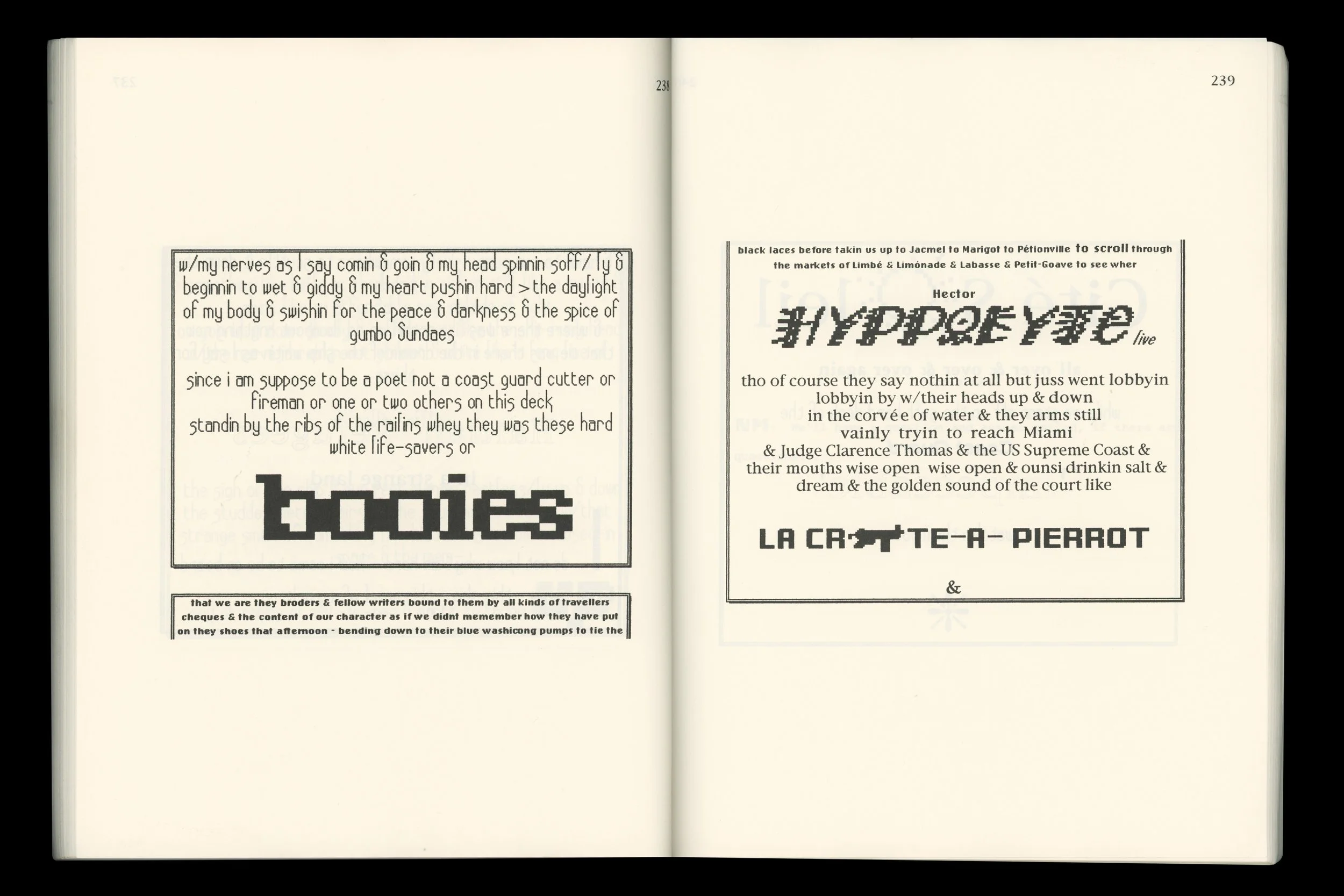
Pages 238-239 of conVERSations with Nathaniel Mackey by Kamau Brathwaite (1999). Sourced from Are.na, scan by Bryce Wilner.
conVERSations has since become a well on my desk, which I drink from in bursts. Sometimes I rest my eyes unfocused over a page and only absorb its essence, globs of ink and striated stripes with bold, black rectangular borders. At other times, I linger within singular visions:
There is a point, Both morph to sit
around page 115, where at either side of the Blue
Mont Blanc and Mt. Kilimanjaro are Mountain range in view from
at odds with each other, the former standing as the Brathwaite’s village in Irish Town. It’s quite a
pinnacle of European imperialism, the latter as lovely proposition, that text alone can move
nature, culture, indigeneity. mountains.
Some people think the machine has irreparably torn us from text but I actually think it’s the opposite I think we’re closer to words now than we ever have been because with our knees pressed into the proverbial ground begging begging begging the machine to eloquate on our behalf we have enough leverage to reach our arms up to reach our fingers behind the words to feel around and maybe comb through and braid that invisible nothing empty space there which was probably the point all along really to poke blanknessssssssssss into somethingnessssssssssss,
somethingnesssssssssss into blanknessssssssssss.
I stretch out to that something that’s neither here nor there, like trying to
touch the bottom in the deep blue, and as I’m stretching I can sense I’m
not getting any closer but instead other things come up to meet me, a
constellation of new and unexpected things, and I’ve come to notice that
when I try to really hold on to them and make sense of them they
disappear but new things start to emerge in their place, or maybe right
next to where they used to be, so I’m learning and I’m trying and learning
to let them just exist there and just float there and I try to be as still as
possible with them so I don’t mess with them too much.
America. I’ve spent two-thirds of my life bracing against its subsumption, but I’m allowing myself to loosen the slack now – this is the most American I’ve ever felt. America has never not been a total abstraction, an invisible concept hurtling full throttle, decimating any virtuous obstacle on its path. Along its winds I find myself grabbing my freedom by the bridle, picking my Americann(ess)ssss up by its bootstraps. I revel in it, I feel around in it, let it wash over me, propel me forward forward forward, ultimately till I’m fleshless, nothing but engine and memory: this is, in part, what citizenship allows,
naturalized or otherwise.
When Melissa came I was living in Philadelphia
and it was Halloween and the sky was grey and I
knew it wouldn’t hurt me there but of course I
worried. I had just returned from living in
London, a place where the sky feels closer to the
ground but people feel further away. Both
birthplaces of an imperial power that’s
crumbling and rotting in ways seen and unseen,
yet remains ever more powerful, and places that
found me squirming and held me upright as I
transplanted my roots.
When Gilbert came Brathwaite was teaching at Harvard,
distancing himself from Irish Town and the mountains
and the trauma of Zea Mexican’s death. Everything was
buried under a landslide, covered in muck and destroyed;
maybe everything was still salvageable if he had gone
back right after it happened, but he didn’t have the
emotional strength to face the ruin and the mud right then.
He pleaded for restoration help from the Jamaica Defence
Force and the University of the West Indies – both
essentially asked who the hell he was to think he’d be
deserving of personal help from them. In the wake of
great absence, he moved forward from memory:
“tho all the time is like walkin on one foot or tryin to clap
with one palm of your hand”.
References
Brathwaite, K. (1999) conVERSations with Nathaniel Mackey. Berkeley, CA: Small Press Distribution.
DeLoughrey, E (2018) Revisiting Tidalectics: Irma/José/Maria 2017, UCLA Department of English.
Fécu, Y. (Spring 2019/Winter 2020) ‘Sycorax’s Other Son’, Cabinet Magazine (Issue 67: Dreams).
Madera, G.I., Wilner, B. (2026) ‘Kamau Brathwaite’s “Sycorax video style” with Gerardo Ismael Madera and Bryce Wilner’ [Presentation]. Center for Art, Research and Alliances (CARA), New York, NY, January 22, 2026.
Cover image: ...the song the tempest sings, traveled the undercurrents to be heard and..., Deborah Jack, 2021, Archival print on fine art paper, paper, gold leaf, salt. Sourced from Artsy.