Telling Salads with Jacques Rivette: On lying and Scènes de la Vie Parallèle
I’ve been accused of being insincere. In March, I had a Paris love affair. The shooting of Braquâge (une évasion) caused Jacques Rivette to have a nervous breakdown.
Shot in June 1975, but only released in 1978, the film, a western set in Paris about a jewel thief and her sales girl accomplice whose title combines the words braquage (robbery) and âge (age), was intended to be the third filmed and fifth released in a quintology of films Rivette called Scènes de la Vie Parallèle (Scenes from a Parallel Life). Hot on the heels of the great success of Céline and Julie Go Boating, his harebrained plan for this film cycle was to spend three weeks shooting each one in the spring, and devote the summer to editing them with his long-time collaborator, Nicole Lubtchansky. The intended release order differed from the shooting schedule for practical reasons: the two other films actually completed in this era, Duelle (une quarantaine) and Noroît (une vengeance), were supposed to be the second and fourth released respectively. One of his main aims for this series of films was to eschew the conventions of both scripted and improvised performance through written lines that act more like mantras than traditional dialogue and fostering an interplay between actors and live musicians shot in the scene, with a great emphasis on the gestural and physical.[1]
If this all feels a little convoluted, you’re right: in practice, the shooting schedules ballooned, the scripts for each day were often only completed the night before, the actors were frequently confused because Rivette could only tell them what he didn’t want, cast chemistry suffered from the minimal preparations, and, of course, Rivette, facing another two rounds of this, burnt out completely shortly after principal photography on Braquâge, leading to the project’s abandonment.[2] The final result was three very visually interesting, well-blocked, incoherently-structured films, whose main innovations come through in the edit, rather than from the performances, which waver from brilliant to stiff, that emerged from this new mode – and even then, it could be said that the limited, long-take-heavy footage captured in these rushed productions necessitated creative workarounds in post. Duelle and Noroît (both 1976), and later, Braquâge, were only shown (initially) in small film festival runs. Rivette’s dream of creating a brand new cinema, it seemed, was dead.
But Braquâge achieves particular success, in my view, in its illustration of a practice that I’ve found immensely useful in my day to day life: lying (as a woman). Here, I’m using lying in a broad sense, to include joking, fantasising, and doing a bit, but always in opposition to someone or something. The film concentrates this persistent motif in his work – think Céline and Julie toying with their suitors, or Frédérique feigning interest in various men to fleece them in Out 1. And where Duelle and Noroît are dour and mysterious, Braquâge is (comparatively) light and fun, once you get past the strange pacing.
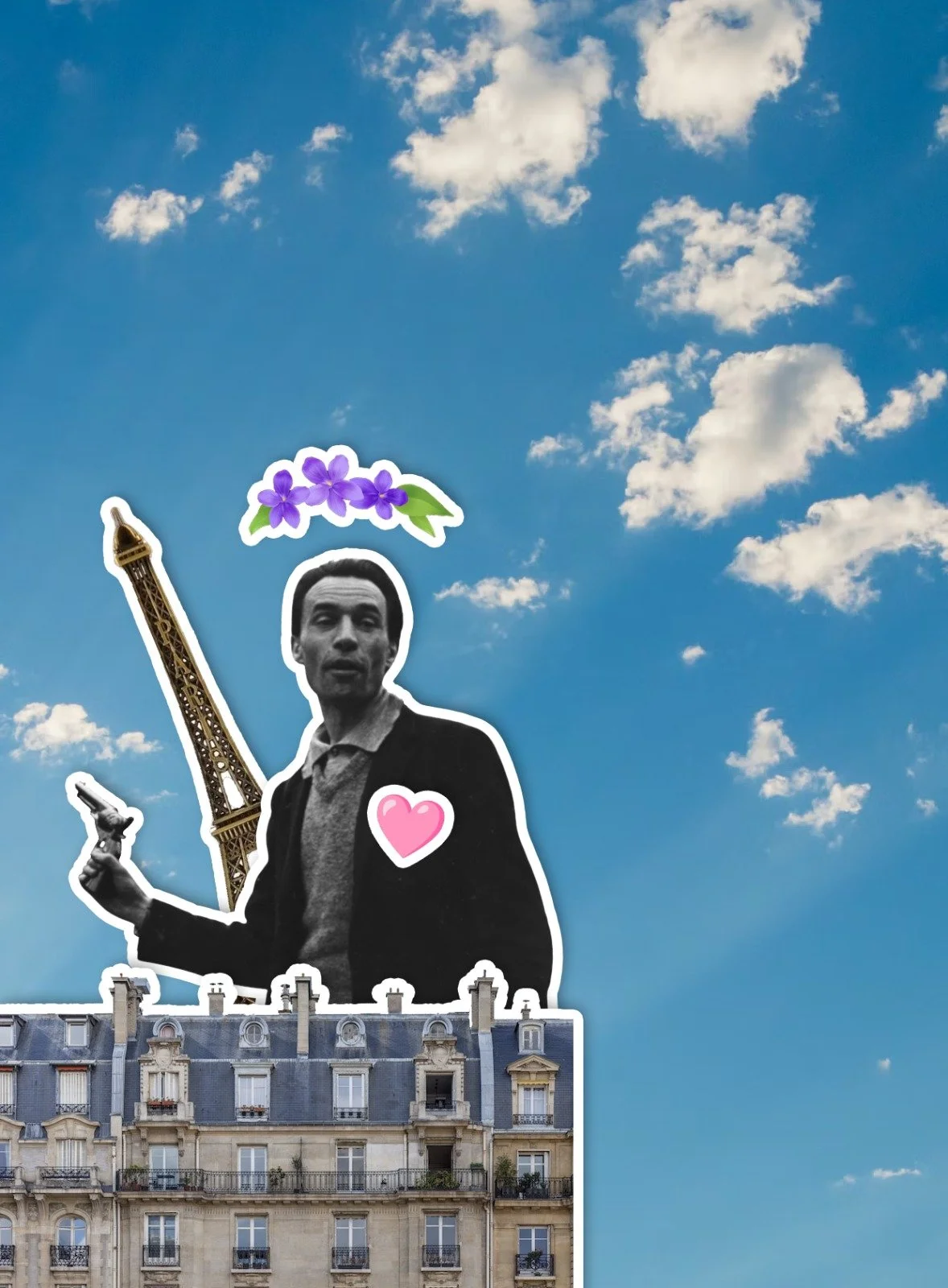
Collage made by writer.
It opens with a stick-up at a jewellers. We are first introduced to Clara (Blanche Colport), the sales girl, who is sedentary, dwarfed and hemmed in by the glass display cases, like a lizard in a vivarium. She fends off the advances of wealthy customers and complains that the glare is giving her a headache. Just as she goes to take a smoke break, Yolaine Lastuce’s character, Hermine, or La Magicienne (as she’s known in the papers), bursts in with her merry band of robbers and two Spanish guitar players strumming a lively flamenco accompaniment, all in bandit masks and outfits more lustrous than the sapphires on display. She announces, “This is not a robbery. I am the Magician: it is only a performance. Thank you for your participation,” holding her pistol up in the air and smirking. For Clara, Hermine, with the sun flooding in through the now open door behind her, is a silhouette of indeterminate size, perhaps that of the Statue of Liberty, with a gun for a torch. To soothe the customers as the gang dance around the shop floor taking what they can, Hermine is weaving them a story, speaking of a paradise by the sea, assuring her audience of hostages that they are in fact not here but lying on the sand, Planteur in hand, watching the sunset deep in the Bermuda Triangle, like she’s guiding a collective meditation.
Clara is hypnotised by her command of the room and her joie de vivre, to the extent that she practically has the jewels bagged up for the troupe before a gun is even waved her way. Touched, Hermine addresses her directly, telling everybody she’s being crowned Queen of the Beach, that there’s fireworks and frankincense and myrrh, dolphins are leaping for joy, the sun is beaming her image across the surf… In fact, Hermine gets so caught up in her own reverie that she doesn’t notice a serviette fall out of her pocket as she wraps up both her story and the heist. The crowd, almost won over, rush to the front to watch them ride off on their scooters down the boulevard, giving Clara time, after a moment’s contemplation, to scoop it up and stuff it in her shirt, preventing a key bit of evidence from falling into the hands of the authorities, and, through the name of the café printed on it, acquiring a lead on Hermine’s whereabouts. The bit had landed with Clara, and through it, the two strangers had built trust, without ever uttering a word of the truth.
I met Bian at a lesbian bar in the Latin Quarter. In one of the walls, an old stone slab was exposed, upon which was carved a list of writers including Paul Verlaine and Oscar Wilde. At one point she asked me what I did for a living. I told her I was a Lib Dem MP. I insisted I hadn’t even run, I just found out I’d been elected from the news one day. She was from Prague but thankfully understood enough about UK politics to find the idea of being a Lib Dem MP funny. “What are your policies?” she asked. I said I was caught between bringing back lead paint and legalising marijuana for small business owners. “What about a TikTok tax?” she added. There was nobody else present during this interaction – so who were we railing against? I would argue it was the conventions of conversation, those that dictate that somebody’s occupation or education are of prime importance, that deny connection in favour of networking. For trans women in particular, steady employment is scarce[3], so it’s not a topic that ends up being particularly prevalent when I’m getting to know another doll. And in the same way that Hermine’s spiel spoke to Clara, I think that falsehoods can often transmit more useful personal information than truths.
After being interrogated by and lying to the Sheriff, a man who says he uses Truth as his “North Star”, Clara tracks down Hermine, and charms her way into the gang by insisting that she is a retired cat burglar. They commit a string of fantastical robberies, and we learn that Hermine is after a special jewel that can make humans immortal, and otherworldly beings human. This is part of the mythological framework employed by Rivette over the quintology, where fairies and ghosts can interact with the mortal world for 40 days during the traditional period of Carnival.[4] Clara is a ghost and Hermine is a fairy; the pair also loosely correspond with Persephone and Hermes (hence the name), and the disruption the initial robbery brings to Clara’s dull reality can be seen as her rescue from the Underworld. In this way, the usual identifications are reversed: the criminal underworld is the “true” world and the life of wage labour is the abyss.
One by one Hermine’s accomplices (save the guitarists) are captured by the Sheriff, but she isn’t worried about them giving her up – she has “never told them anything useful”. We also find out from his persistent questioning of Clara that the Sheriff knows their plan and has been deceiving his men, purposefully delaying Hermine’s capture until after she has stolen the jewel. He wants to become immortal, by being the man to catch La Magicienne and by possessing the enchanted gemstone for himself. Hermine, on the other hand, wants to become mortal, and retire into anonymity. All Clara desires is an escape from drudgery. For this purpose, the robberies seem almost incidental. It is weaving joint fabrications in the jewellers’ and pulling the wool over the eyes of the Sheriff that she enjoys most, and it is this sense of having a shared secret from the forces of conformity that allows her to feel free.
It is easy, as a (trans) woman, to end up in an exhausting conversation with a man. Even easier, I imagine, if you are also a person of colour. Bian was flung headfirst into one such interaction after the Ninajirachi gig (and that’s the truth![5]) she got me into with a spare ticket. It was at a newly refurbished venue in the Parc de la Villette two days after our first date, and some of her guy friends were in attendance. Said friends and a selection of other attendees were hanging out post-show, and once we joined the circle properly, Some Guy, a hanger on that nobody seemed to know, immediately hit Bian with the “are you a boy or a girl?”. Most of the group leapt to her defence in that awkward cis ally way, and then it passed mostly without incident. But after everybody started talking about where they were from (London/Berlin/Almaty/São Paulo/Vienna…), and Bian told the Guy she was from Prague, he followed up with, “And your parents are from?”, a.k.a., as she pointed out, incensed, “Where are you really from?” We told him off but it was clear he did not understand what the issue was. Bian and I retreated into each other for a while – nobody ever seems to eject a man from a conversation for his microaggressions. This Guy clearly noticed our affection for each other because when we rejoined he asked if we were a couple; before she could answer, I decided to take a minor form of revenge against him, and told him we were married. “We’ve been married for 20 years!” I said. He had difficulty swallowing that, given we were both clearly in our twenties, but seemed to mostly believe me. “Wait, really?” he asked, slack-jawed (if I'm being uncharitable). “No, she was kidding,” Bian interjected. “We got married yesterday! This is our honeymoon.” He bought it, despite the fact Bian already told him I was fucking with him. And thus, for the first time, we had agency in the conversation, because he was self-evidently making a fool of himself on our account. This type of joking, I think, can be used as a litmus test for cis people that are chill to be around. If they accept any old stupid lie you feed them at face value, they clearly view trans women as unknowable aliens. But if they engage with what you said, either rejecting it, or knowingly going along with it, it’s possible that they might just see you as a person.
The finale of Braquâge, what Rivette in a low moment called “the only truthful scene in the film”[6], sees our heroines, having just narrowly avoided capture by the Sheriff, in possession of the jewel, hiding among tourists in the Gardens of the Eiffel Tower. They’ve donned large hats and sunglasses, and are imitating the sightseers’ poses when, through a perspective trick at first, they become giants, and then they do so very literally, by virtue of a scale-model Paris. The Haussmann tenements barely come up to their shins as they stomp gaily around. The western has become a sort of Nouvelle Vague kaiju movie. After causing satisfactory mayhem, they remark, “But where is the Sheriff?” “I can’t see him.” “I can’t see him either.” “Oh well.” “Let’s go to the beach!” In their fantasising, they have gone from hidden and on the run, to unmissable and untouchable; the city is now at their disposal and the Sheriff has all but faded from memory. Perhaps what Rivette was alluding to was that this scene, given its undeniable silliness, was more fun to film than the rest for both him and the actors, and that led to a more genuine embodiment of the intended spirit of the film. There can’t be much like watching your players gallivant around a plaster of Paris miniature of your city to remind you of the fundamentally illusory nature of cinema.
Braquâge in fact owes its existence to a lie. It is only thanks to the deceptions of Nicole Lubtchansky that it ever saw the light of day. At the height of his mania, Rivette came to her in the editing booth and demanded that she burn all its footage. There was no talking him out of it, so while he wasn’t looking, she swapped out the reels, and they burnt some unused footage from Noroît instead.[7] But it could be said that falsehoods played an even larger role in the lives of its two costars from that point onwards.
Lastuce moved on to other arthouse films, sharing the screen with Jean-Pierre Léaud in Varda’s Faire Marcher (1977), before filming A Dawn of Lead (1978) with Alain Resnais in Tokyo. While there, she attended the inaugural PIA Film Festival, where she made the acquaintance of jury member Nagisa Oshima, and landed a role in his upcoming Europa Eclipsed (1979)[8] – her final film. From there, her story gets a little harder to follow. Not a megastar to begin with, and now out of the spotlight, she did not receive much coverage; the little information available publicly was contradictory, to an extent that implies intention. Explanations offered in various outlets included that she: joined a convent in the Italian Alps; married a painter and moved to his native Hokkaido; married a musician and moved to Cuba; and married a rodeo star and moved to Kentucky. All inquiries sent to her agent were reputedly rebuffed on the grounds that she had quit the film world to “go and live out a solitary existence among the Arctic penguins”.[9]
Lastuce’s diversions had ulterior motives. Notice that all these stories point to a sexual unavailability – at least to men (that is, barring her fictional husband(s), of course), and so you could interpret her actions as an attempt to ward them off. She was, as far as I can tell, a lesbian; she never married, and there are no reports of her ever having dated a man, but there are plenty of rumours suggesting she fostered short-lived relationships to fellow actresses Bernadette Lafont (of Rivette’s Out 1 and Noroît) and Claire Wauthion (of Akerman’s Je Tu Il Elle).[10] But had Lastuce simply wanted to maintain her privacy and offer an explanation for her sudden departure from the film world, I suspect she would, and could, have offered a much simpler explanation: none at all. After all, practically nobody who knew her by her work knew where she was, and presumably the people she would meet otherwise would not be aware of her public statements. So their far-fetched nature was ultimately an invitation into her world, extolling what she did or did not place value on by what she found amusing and by the type of people she thought would be fooled by these specific lies (those who would consign women to particular existences). They might have been an encouragement to investigate further, or conversely, to just go along with it, and see where that lands you.
Recently unearthed evidence indicates another possibility: she was off the grid almost completely from 1979-1982, but the correspondence she shared with a friend during that time appears to place Lastuce in Lebanon, leading speculation she was fighting in the Lebanese civil war with PFLP forces, having made her way there via connections she’d formed with the Japanese Red Army.[11] And therefore her tall tales served as a decoy of sorts, as at the time there was a lot of international attention on the JRA. In any case, she was back in France by at least 1983[12], seemingly leading a quiet life somewhere along the Left Bank. Yolaine Lastuce would not live to see the 2015 digitised re-release of Braquâge: at age 57, she died of lung cancer. She was buried in Paris, in a close-knit ceremony that was attended by Rivette and Varda.
Unfortunately, Blanche Colport, on the other hand, is still alive. After falling out with Rivette and starring in one of Louis Malle’s lesser efforts, Fool’s Gold (1977), she moved on to work mostly in studio comedies like Hôtel Bizarre (1980) and Bouffe Ça, Mère l’Oye! (Eat This, Mother Goose!, 1983), during which time she fell in with Tibetan fraudster “Lama” Phalam Sathya’s Enlightenment Express! movement, a pseudo-Buddhist cult.[13] Colport left the organisation after Sathya was charged with extortion in 1985[14], but maintained close ties to the Tibetan independence movement, which seemed to foment in her a rabid anticommunist sentiment. It found its ultimate expression when she joined Marine Le Pen’s National Front (now National Rally) in the early 2010s.[15] She started consistently promoting the party and her own idiosyncratic “Christo-Buddhist” brand of racism, xenophobia and homophobia in public[16], leading to a sharp downturn in the number of roles she was offered, which had already been dwindling since the mid 2000s. Then, true to her contrarian nature, she split from the RN in 2020, denouncing what she saw as their role in the “Great COVID Hoax”.[17] This culminated in a run for Mayor of Paris in 2026 with the far-right Nez Coupé party she had co-founded with her husband, the shellfish magnate Guillaume Cochon-Épais.[18]
Thankfully, Colport’s candidacy was a disaster. Early in the campaign trail, she made international news after being tricked by a Le Gésier journalist into pledging to deport all “illegal Khemedian immigrants”[19] (Khemed is a fictional Arabian state from the Tintin comics). Later on, it was alleged that the party had received the majority of its funding from the Falun Gong[20], a controversial Chinese new-age, anti-CCP organisation, perhaps best known for its Shen Yun performances, which Colport had promoted on Twitter no less than 11 times.[21] She was eliminated in the first round of voting, having finished eighth, just below her National Rally rival and the candidate for the Trotskyist Corbeille Rouge, with a mere 0.9% of the vote.[22] For the majority of her life Colport has been under the spell of hucksters and charlatans. The falsehoods she has traded in have not been for connection or self-determination, but for personal gain at the expense of other, more vulnerable people. The monstrosity of her beliefs is seemingly only matched by the propensity she has for stepping on rakes – we can only hope this last one knocks her out for good.
Bian had to leave Paris before me. We walked together to Gare du Nord to prolong our goodbye, and on a bridge over the rail lines, we saw one of Colport’s campaign posters. Somebody had written MDR (short for mort de rire, meaning “died of laughter”) on her forehead and crossed out her eyes. To amuse Bian, or more likely, myself, since she hadn’t seen Braquâge, I added below her portrait:
Renvoyée aux enfers!
which means, “returned to the underworld!” The last thing I said to Bian was, “I’ll see you tomorrow.”
On my last day, I visited Yolaine Lastuce’s grave in the Cimetière des Bavardages, smaller and less star-studded than the Cimetières du Père-Lachaise or de Montmartre, to leave her some violets. I was alone, and had to spend an hour searching for it – the one staff member there, from what I could glean, had no idea who she was. Her headstone read:
Je faisais semblant !
Or, in English:
I was only pretending!
References
[1] Rivette, J. (1977). Rivette: Texts & Interviews. British Film Institute, pp. 89-90.
[2] Wiles, M. (2012). Jacques Rivette (Contemporary Film Directors). University of Illinois Press. p. 63. (The other two planned films were later resurrected, under different conditions, as Up, Down, Fragile and The Story of Marie and Julien.)
[3] Living Wage Foundation (2022). 'It's a fundamental issue of social justice': Gendered Intelligence on low pay, precarity and good work for trans people. Available at: https://www.livingwage.org.uk/news/its-fundamental-issue-social-justice-gendered-intelligence-low-pay-precarity-and-good-work (Accessed: 13 April 2026).
[4] Aldair, G., Graham, M., Rosenbaum, J. (1975). ‘Les Filles du Feu: Rivette × 5’, Sight and Sound, (Autumn 1975), p. 235
[5] Wilson, N. (2025). London Song. NLV Records. (To open this show, Nina replaced ‘London’ with ‘Paris’: I have never been to Paris… and that’s the truth!)
[6] Hughes, J. (1975). ‘The Director as Psychoanalyst (An Interview with Jacques Rivette)’, Rear Window, (Autumn 1975), p. 38.
[7] Labourier, J. (1980). ‘Nicole Lubtchansky sur la déformation de l'espace’, La Salle de Montage, (Summer 1980), p. 16.
[8] Yoshiharu, T. (1997). No Restrictions: 20 Years of the Pia Film Festival. Botamochi Press, p. 22.
[9] Delpy, C. (1982). ‘Ou est Yolaine Lastuce?’, Les Vedettes Imaginaire, (February 1982) pp. 9-10.
[10] Keener, D. (2014). Une Femme Veut une Femme: Where are all the New Wave lesbians? Ph. D. Thesis. University of Edinburgh, p.15. Available at: https://era.ed.ac.uk/items/a9458956-b71b-42c5-8641-e22d87596e10 (Accessed: 1 April 2026).
[11] Cooper, B. (2025). Underground — Art and Left-Wing Terror. Copperhead, pp. 112-113.
[12] Delpy, C. (1983). ‘Ouï-dire divers’, Les Vedettes Imaginaire, (March 1983) p. 9.
[13] Fourmi, A. (1982). ‘Bienvenue, Blanche Colport !’ Éveil Express!, (January 1982)
[14] Cuiller, N. (1985). ‘« L’Avatar de la Paix » inculpé d’extorsion’, Le Mat, 19 August, p. 12.
[15] Corneille, P. (2011). ‘Les stars soutiennent le Front national’, Le Dorante, 24 November, p. 8.
[16] Fauteuil, M. (2012). ‘Notre Père, qui es au… nirvana ? : Le « christo-bouddhisme » émergent de la droite’, Le Recul, 27 November, p.15.
[17] Aigre, S. (2020). ‘Colport quitte le RN : « Assez de collaboration ! »’, Le Dorante, 10 July, p. 7.
[18] Narine, H. (2023). ‘Un nouvel espoir pour la France : Nez Coupé’, La Morve, 14 July, pp. 1-2.
[19] Glibb, D. (2025). ‘Far right Paris mayoral candidate pledges to deport nonexistent ‘Tintin immigrants’’, The Guardian, 5 November. Available at: https://www.theguardian.com/world/2025/nov/05/paris-far-right-mayoral-candidate-deport-tintin-immigrants-blanche-colport (Accessed: 31 April 2026).
[20] Balourd, Y. (2026). ‘Nez Coupé : l’ingérence chinoise?’, Le Mat, 9 February. Available at: https://www.lemat.fr/2026/fev/09/nez-coupe-lingerence-chinoise-falun-gong-paris (Accessed: 20 May 2026)
[21] Penis, C. (2026) 14 February. Available at: https://x.com/ZeroSuitCamus/status/1211457758937174016 (Accessed: 1 August 2026) .
[22] Les Décodeurs. (2026). ‘2026 French municipal elections: Results in key cities’, Le Monde, 16 March. Available at: https://www.lemonde.fr/en/les-decodeurs/article/2026/03/16/2026-french-municipal-elections-results-in-key-cities_6751486_8.html (Accessed: 15 March 2026).