On Collecting
Votives, archives, storehouses, bric-a-brac shelves, the magnetic side of my boiler, mantlepieces, picture galleries, display cases, messy drawers, white IKEA Kallaxs and shelving units from Habitat, pinboards, Pinterest, the area of skin that starts under my right arm and goes down to my knees, Encyclopedia Madonnica, hard-drives with the orange rubber lifejackets, a jeweller’s well-worn fingers. With varying degrees of difficulty, these are all reliable homes for a collection.
In 2001, inside a disused department store located in one of London’s busiest shopping districts, Michael Landy added a functioning assembly line to this list, endeavouring to display the entire contents of his life on a snaking system of his own design. As his bounty passed over the conveyor belt in a series of yellow crates, workers armed with power tools, shredders, scales and screwdrivers set about quietly (or not so much in the case of those using electric saws)1 dismantling the life of the artist. He called the piece Break Down, itself a probe into the meanings we attach to all our worldly possessions.
Some of the 7,227 items catalogued and destroyed by Landy’s team include:
P2683: Eleven packets of Walkers mixed flavour crisps, purchased at Iceland supermarket, Commercial Road
C535: Nike single grey cotton sock with black text on side found after service wash at laundrette
F1292: Large white feather boa used as wall-hanging from Sam Taylor-Wood's party after the Turner Prize Award
K1590: Potato peeler with black and orange plastic handle, used by Gillian Wearing for chicken dinners
P2677: Single square teabag2
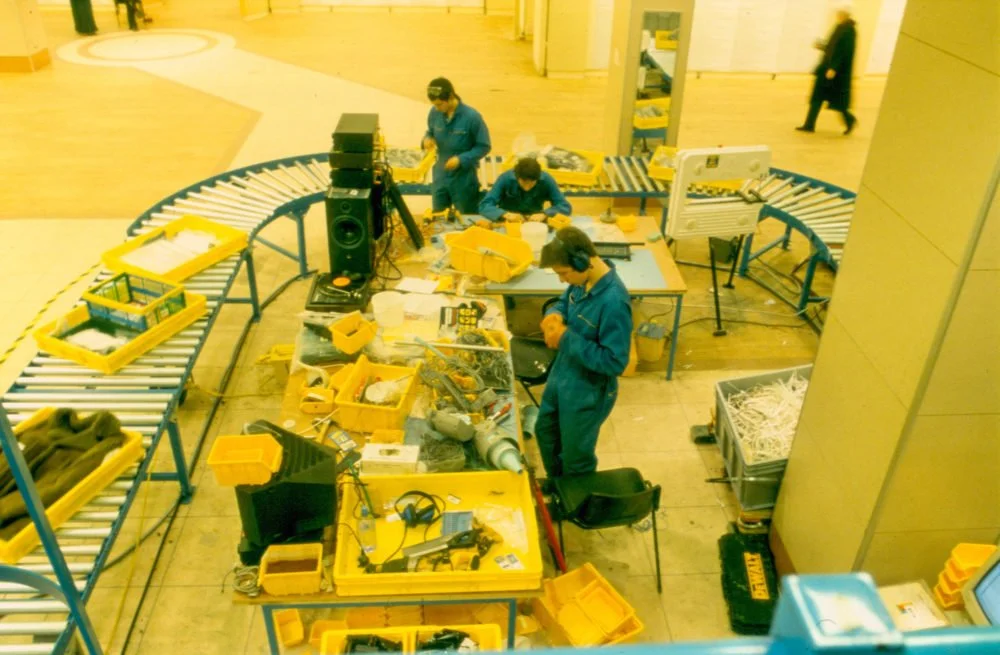
Break Down, Michael Landy, 2001. Image sourced from Archive of Destruction.
Artworks from his peers, Young British Artists such as Gary Hume and Tracey Emin, were amongst some of the most valuable possessions to be destroyed as part of Landy’s ‘everything must go’ ethos, as well as the artist’s car, a red Saab 900, and his birth certificate. But final blow came in the last crate, which had been circling the rollers for hours: a brown worker’s coat, belonging to Landy’s father. His mother had spent a year paying it off on credit before he was injured in a tunnel collapse and subsequently left unable to work. The coat soon became too heavy for his father to wear. Years after his father’s suicide, its functional presence was something of an albatross, the sartorial embodiment of their shared grief. To the shredder it went.
In the end, having detached himself from all things acquired and inherited, Landy was left only with his blue worker’s scrubs, likening the material rebirth to watching his own funeral (he also describes the period as the happiest two weeks of his life). Plenty of people have sought a similar liberation from life’s trappings, skipping town with a bus ticket and the clothes on their back in the hopes of starting anew. Maybe you’ve been thinking of doing the same, mulling over just how long it would take to bag up and drop off all (and I do mean all) of your tat at Oxfam, palming off the bigger bits to friends while fielding offensively low offers for your most valued pieces on Vinted, all for a chance at a clean break. A fresh start.
It’s not so much the bigger pieces I’d miss, like an old flatmate’s hand-me-down rice cooker, more than the inconsequential, tiny records of all the things I’d done, that when catalogued, could reveal a thousand secrets about the workings of my inner mind. Maybe one day an AI would use them to sell me protein supplements or placate my brain with videos of baby monkeys doing human things. Destroying the long-outdated train tickets and crumpled fortune cookie slips still hiding in my wallet would feel like a betrayal to the memoir I would surely be tasked with writing one day: an erasing of so many memories in their lasting physical form.
A Break Down of my own immediate vicinity might read something like this:
T101: Lady Gaga Meat Dress caganer (Catalonian nativity figurine depicting a famous figure mid-defecation to encourage prosperity)
T76: 2x plastic dinosaurs, Kinder Egg Surprise easter gift from George Clarke
T32: Glittery matchbox with ribbon fastening
T8: Michael Clark replica Big Nob badge from the Barbican gift shop
P43: 1 packet of Laila’s Paprika 100g, half-used
H22: Don’t Smoke Make Love ashtray with ceramic cock
F12: 3x Bauhaus-style lampshades, 2 still boxed
H65: 1 broken candlestick from a nameless trendy homeware store, moving-in gift
L89: A stack of tapes (Björk, Interplanetary Criminal, Madonna, Oliver Sim)
F27:An entire Habitat cabinet of assorted art books & fashion magazines (uncounted)
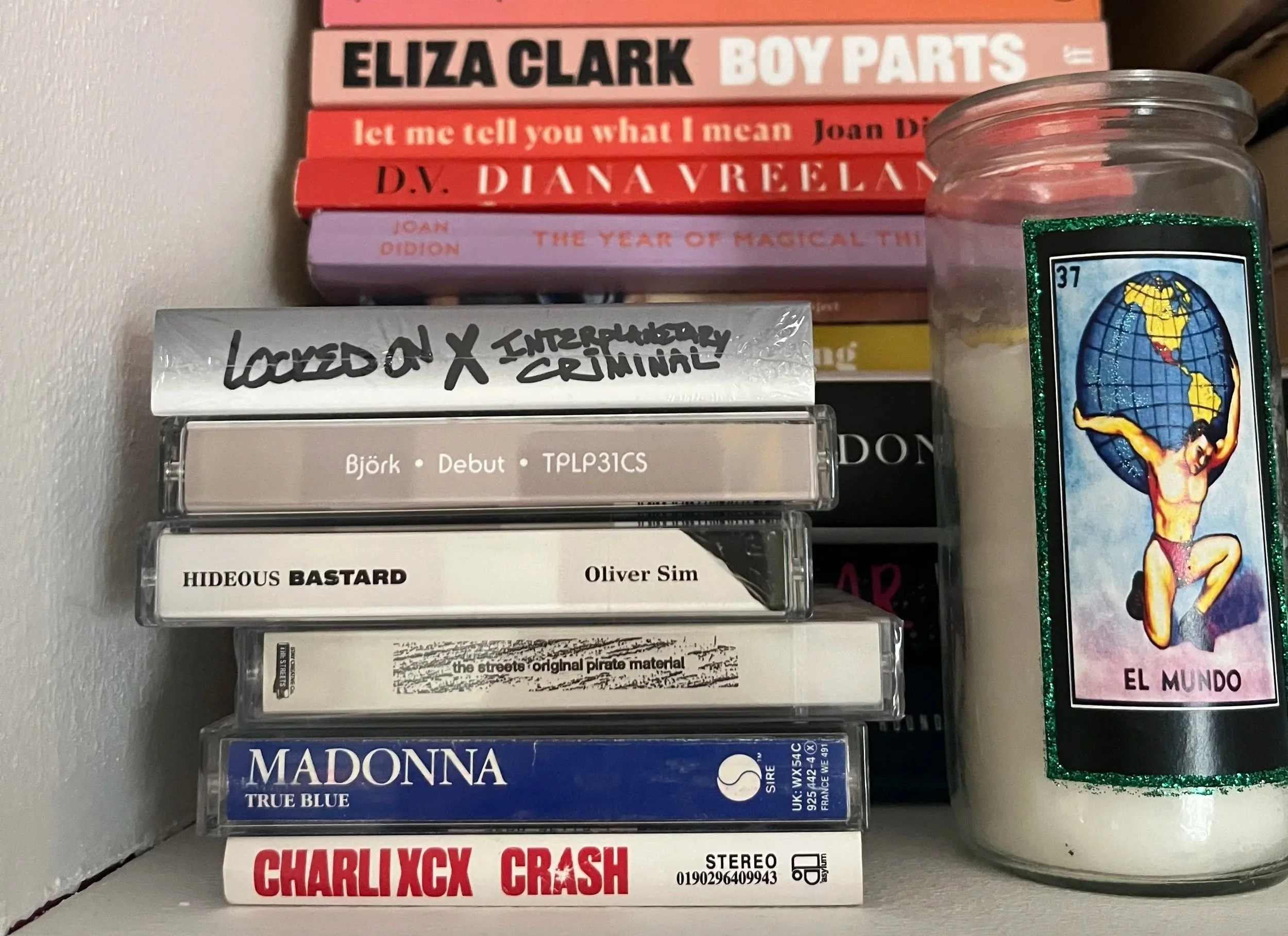
Writer’s tape collection (L89). Courtesy of writer.
Perhaps what this scene says most about my accomplice (read: boyfriend) and me is that we are serious amassers of stuff, mostly heaps of printed matter, vinyl records, drinks coasters, what many have called ‘the best fridge magnet collection in East London’ and several under-the-bed boxes stuffed with life mementoes culled from our early teens. Early dates in the city would involve poster swiping on scales both large (A1, Dazed & Confused cover, Kingly News) and small (A4, 2018 SOPHIE gig poster, Rough Trade East), eagerly happening upon glossy treasures we could repurpose into bedroom wall compositions or hoard for various craft projects that never materialised.
Coveted with a different kind of adoration is the humble tchotchke, a Yiddish term for the kind of decorative items, often small, that line the bookshelves, boudoirs and desks of millions of accidental collectors. Where someone like my brother would take to busty anime figures and McLaren F1 hats (don’t ask), an office dad may opt for a framed family holiday snap, the cab driver a dancing hula girl. Inside Gallo Nero, an Italian deli that has been serving Stoke Newington’s finest paninos for over forty years (named after Italian icons a la Donatella & Monica Bellucci), the accumulation of beautiful and tiny things like this seems to have no limit. Miniature figurines of legendary football players, busts of Pavarotti and The Sopranos crew, holographic stickers, tasteful magnets, trading cards, olive oil cans and vintage signage populate each square inch, waiting to be discerned by hungry eyes. But why?
‘I guess the nostalgia of seeing these things reminds you of childhood,’ Marco, the deli’s owner, tells me while slicing the prosciutto for my Canavarro, set to meet a dousing of pesto and mozzarella any second now. Flourishes of his Tuscan heritage flood the room; many of the portraits hanging beside us are relics from the original restaurant, made over since he took the reins of the family business. It’s a living testament to boyhood, stocked with symbols of a national identity, a yearning for home that exists somewhere beyond these walls.
You pass shrines like this every day; some are rows of body-building pictures at the stud gym around the corner, a gallery of oily juiceheads and chiselled ladies, sun bleached or signed with signed dedications to “pump till you bleed”; others, far away in East Dulwich, constitute a garden full of massacred doll heads and charming plastic sculptures. The latter, aptly titled The House Of Dreams, is a living art project cum home renovation that Stephen Wright was set to complete with his partner before his untimely death in 1998, inspired by the make-shift ethos of Outsider Art.
In the wake of this tragedy, Wright made things, spurred on by the catharsis of repurposing broken Princess Diana crockery into light switches, or finding homes for a litany of plastic detritus, remade in the colourful gay tradition. He printed soul-bearing diary entries onto mosaic tiles and rescued tiny toys from every flea market he frequented. Tomb-esque in its approach to memorial, this kind of collecting is as much about life as it is about death, articulating why things matter at any given time. Never had there been such a testament to Susan Sontag’s view that the monogamous collector did not exist. ‘Sight is a promiscuous sense,’ she said in her 1992 novel, The Volcano Lover, the avid gaze always wants more.’
The other thing Sontag had right about collections is that they always contain more than necessary. ‘Not only because they can always be added to,’ she continues, ‘but because they’re already too much.’ You see, a collector’s entire M.O. is the ceaselessness of the sport, chopping and trading and polishing front-runners and rotating out less fortunate objets d’arts into storage purgatory. Speaking for the more Tumblr-addled of us all, those whose interest in mismatching eras, materials and decorations comes together to form a whole sum, I’d say we do it because it feels good, to make visitors jealous of our worldliness, to feel part of something bigger than ourselves, to preserve all we deem important.
But Sontag touches on a universal truth here: there will never be enough to satisfy us. Another addition, higher in quality, bearing a colourway you never knew existed, is out there waiting for you. The avid collector, of course, chases the high relentlessly, not only because the journey for the most degrading and explicit holiday magnet will surely take us somewhere transcendent, but because the thrill is in the not knowing. Where will you go to seek beauty otherwise, how will you prove it exists? For me, it’s simple, you’ll just have to go and grab something from my fridge.
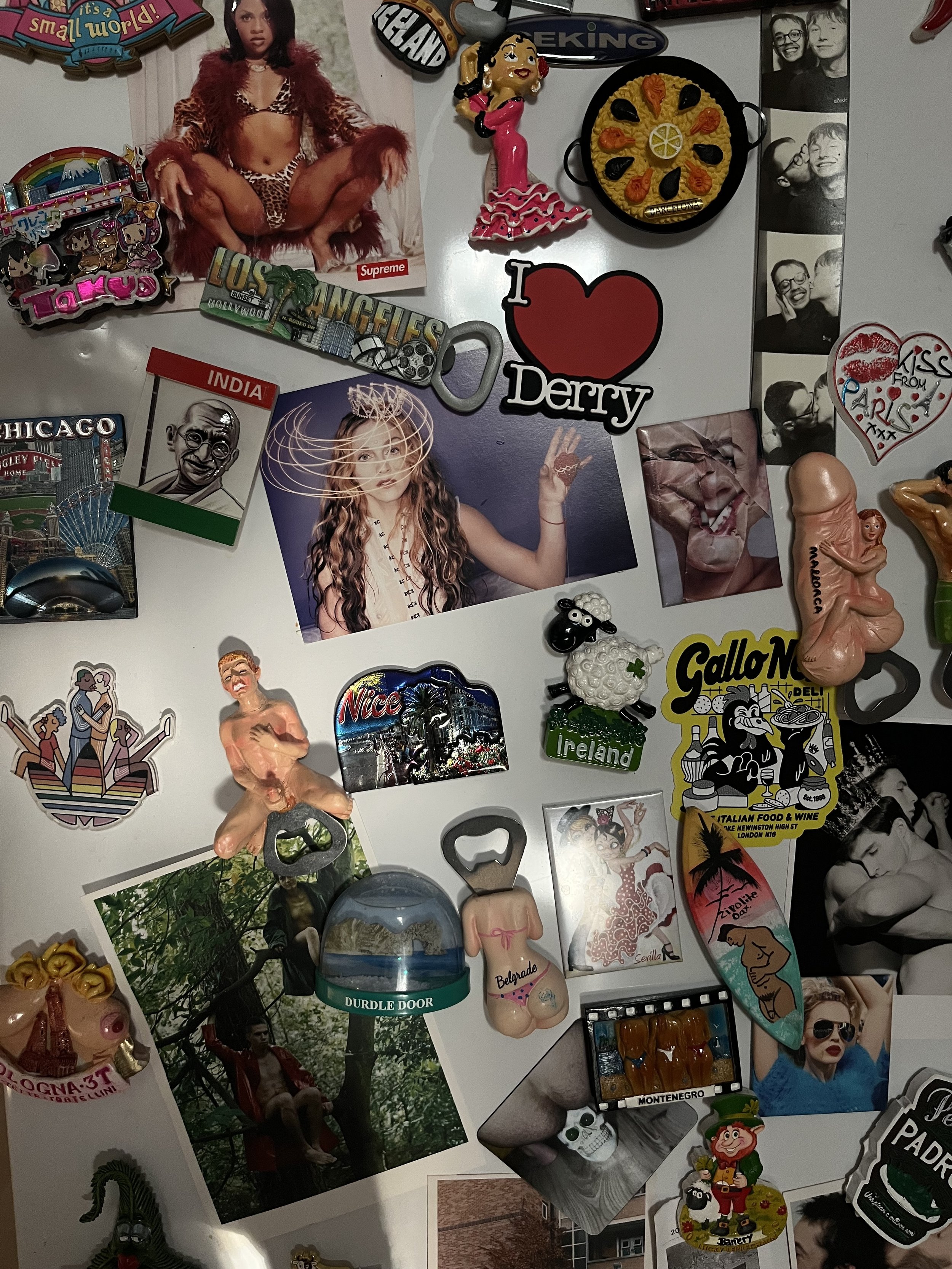
Writer’s fridge, detail.
References:
1. Documentary: Breaking Down, Artangel, YouTube, https://www.youtube.com/watch?v=IAJg7rH_EMI
2. The Inventory, Artangel https://www.artangel.org.uk/project/break-down/the-inventory/
Cover image: writer’s fridge magnet collection. Courtesy of writer.