Not Writing
Taking on a lecture titled ‘Why I Write’, Lydia Davis struggles with the why and decides instead to focus on the how. Into the Weeds[1], a book edited from this lecture, delivered annually to commemorate the awarding of the Windham-Campbell Prizes, started by Donald Windham and Sandy M. Campbell and administered by Yale University, opens with the initial invitation. Twice, Davis writes, ‘When I was invited, last fall’ – to give the lecture, to write on the topic – and twice, she does not continue with ease: ‘I wanted to be willing’, ‘I agreed’, but ‘the subject proposed is difficult’.
Davis’s first and main design on why write is to talk about how, not why. And anyway, she would sooner think about reading – or, as she says on page 54 of this small 139-page book – ‘why I wrote and why I preferred to think about why other people wrote’. Written in fragments, Davis spends a lot of time on technical language, from wheelbarrow making (the result of a long, careful read of a 1923 book, The Wheelwright’s Shop by George Sturt) to seafaring (Moby-Dick). Davis writes about John Ashbery (and his why-I-write lectures, the Charles Eliot Norton Lectures at Harvard in 1990, collected in the book Other Traditions), about Karl Ove Knausgård and Knut Hamsun (Davis has taught herself Norwegian and translates from the language, a detail that seems crucial to the formation of this list of influences). About Elena Ferrante, Henry David Thoreau, nineteenth-century poet John Clare, Flaubert.
It is not the most organised of books. Fragmentary, Davis moves fluidly between writing and reading, more musing than statement. Time is broken up in ways that are not linear, books are returned to, discussed, moved on from. Discussions of the weather change the air – it is a Tuesday in July (fan on face), then perhaps a tornado is coming involving high winds, heavy rain, floods. It is winter on the first page, when Davis begins thinking about why she writes. It was fall when she was asked to do so. The Wheelwright’s Shop was a Christmas gift, so it arrived as Davis was thinking about this lecture, this book. I never thought I’d be interested in wheelbarrows, but apparently, I am. Or: I am interested in any aspect of life as a writer sees it. Davis is not a reader of wheelwright’s technical manuals either, but she is interested in Strut’s character, as it comes through in his stories, and in the style of his writing: it is, Davis says, ‘above all, exact’.
One of the hallmarks of Davis’s writing is its precision – her stories can run only a few hundred words, and none are spare. I remember my first impression of this precision, in a 2014 profile of Davis published in the New Yorker where the journalist is sitting with the author at her kitchen table, and there is a hardcover novel by a popular writer, who Davis asks she not name (‘I don’t like to hurt people’s feelings, and I don’t like to knock other writers as a matter of principle’). She then discusses how she sees a looseness in contemporary fiction – a sense that something is wrong. A mixed metaphor, an insensitive comparison. The example from said hardcover: ‘acute intimacy that had eroded into something dull’ – Davis explains, like a writing lesson in one line: ‘Acute is sharp, and then eroded is an earth metaphor’. Another: ‘A paper bag stuffed with empty wine bottles’. I rememberreading this issue of the New Yorker on public transit and pulling out a pen to highlight this moment, as if I’d keep this one loose issue of paper-thin type because of this incredible summary of how the wrong verb turns the writing. Davis explains: ‘“stuffed” is a verb that comes from material. It’s soft, so it’s a problem to stuff it with something hard.’ A writer can’t get away with this.
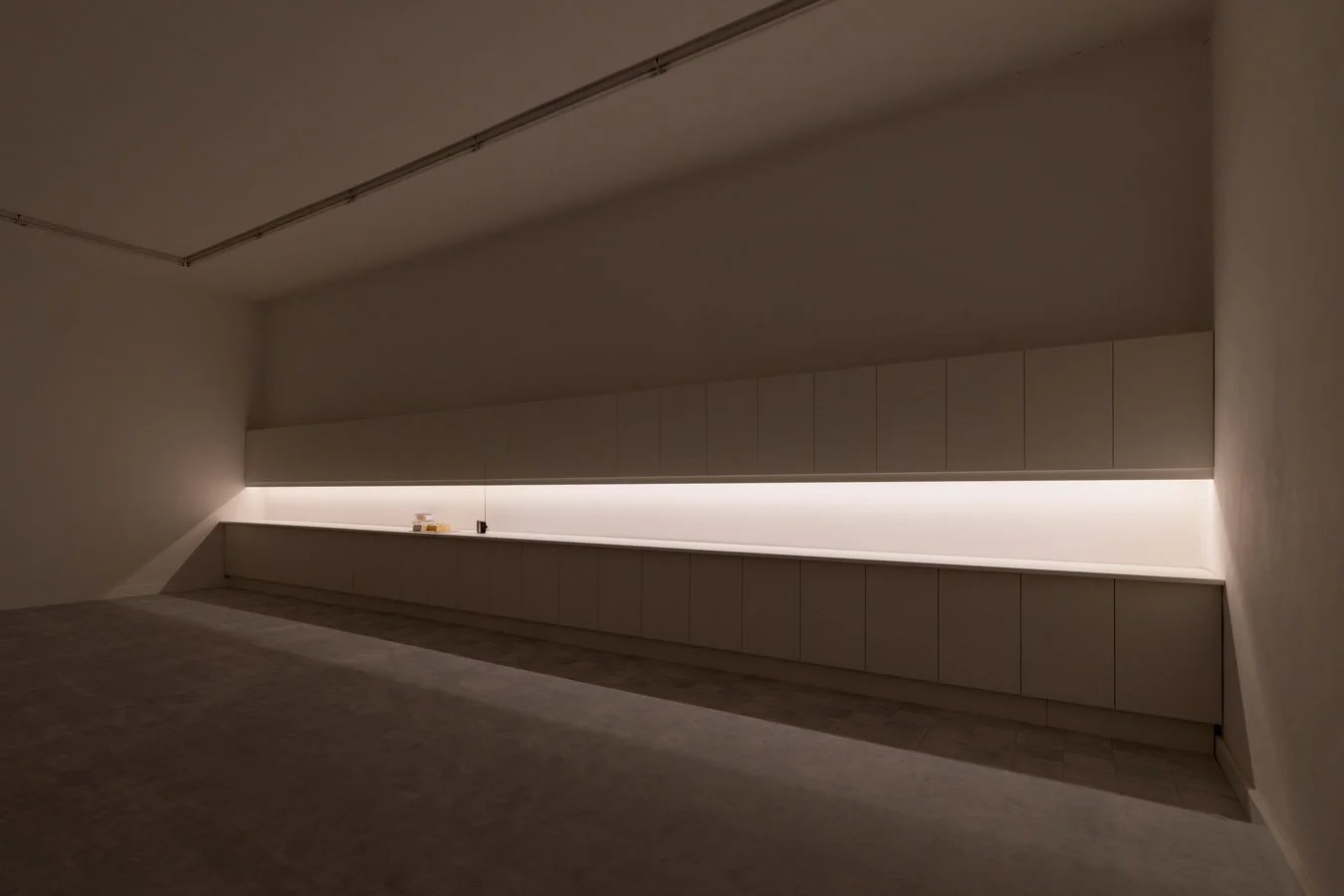
Something to Remember You By, Steve Bishop, Melamine covered chipboard, carpet, PVC flooring, LED lighting, PVC model cake, polyethylene storage containers, radio, 2019. Installation view. Image courtesy of the artist and Carlos/Ishikawa.
The thing about exactness is, once you are attentive to it, you can’t help but aspire to it. Reading Into the Weeds, I want to keep reading, but also write. That is, I want to write, then stop to look at my writing, revise it, search for weak words (my mortal enemy, ‘seems like’), be intentional, find all the right words.
Intent and precision are related in a way I would like to be able to nail in one clear, sharp line, but I think what I am trying to describe is the entire process of writing. And what I want to write about is not writing, or perhaps, writing as something to want. Something that can feel familiar, still very distant. I have not been writing much recently.
I have also not been reading much. I read Into the Weeds in the midst of a period of not-reading. Once, my greatest question was how to reconcile the desire to be in the world with the desire to read about the world. I wanted to be out, with others, talking, but also in, reading, reflecting – and I wanted both all of the time. Falling in love split this desire and instead I found myself one of two people who read, who have stopped reading (perhaps temporarily) in order to word the world together. Not-reading has been a confusing joy that has found me in the midst of not-writing, anyway. The not-writing has to do with reasons beyond reading and writing. Or, it has to do with publishing, ambition, career, confusion.
When I pick up Into the Weeds while browsing a bookshop with the reason I am not reading, I point it out, I say, I want to read it, and the person I am not reading with jokes, ‘why are we even here; we are two people who have squandered the gift of literacy’. A confession: planning this essay, I cycled over to several libraries, picking up several books – research – which I was thrilled to include, then continued not to read. I still haven’t read Stephen King (in general, or the book on writing). I want to think about Ursula K. Le Guin’s carrier bag theory of fiction, I want to read Nabokov’s essays on writing, I want to look again at a book I have borrowed from the library so many times I should have just bought it (Kae Tempest’s On Connection) for the warmth of its vision. I may return them all, unread. I may renew them all, because even without a deadline and an essay, my desire to engage with them holds out. To read a book about writing in the midst of a period in which you are not writing remains inspiring. It gives permission to let yourself love something, still not do it. Or talk about doing it, still not do it.
Of course, Roland Barthes never writes the novel he plans to write. He teaches a series of lectures and seminars at the Collège de France about planning to write a novel in 1978–79 and 1979–80. Instead of said novel, the last book Barthes completes before his death in 1980 is The Preparation of the Novel, the texts of the lectures, that is, an experiment between writing and pedagogy. Because planning to write is part of writing. Because wanting to write is, also.
Barthes’s novel-in-planning was called Vita Nova. I always thought he would have something complex and nuance to say in it about writing and life. Surely, I should too, but all I have to offer is, they have a difficult relationship.
There’s the practical question about art and life: How do you make time to write? I know so many people who do so much in order to make writing possible. Who work jobs they wouldn’t want to, who wake up early before their children in order to write, who need to go away, who give up things. Also, so many people who do not know how to find that time, by which I mean how to make that time, by which I mean: life gets in the way. One of my friends once joked, nothing is worse than having cleared time to write your novel. Expectations swell when you have no excuses.
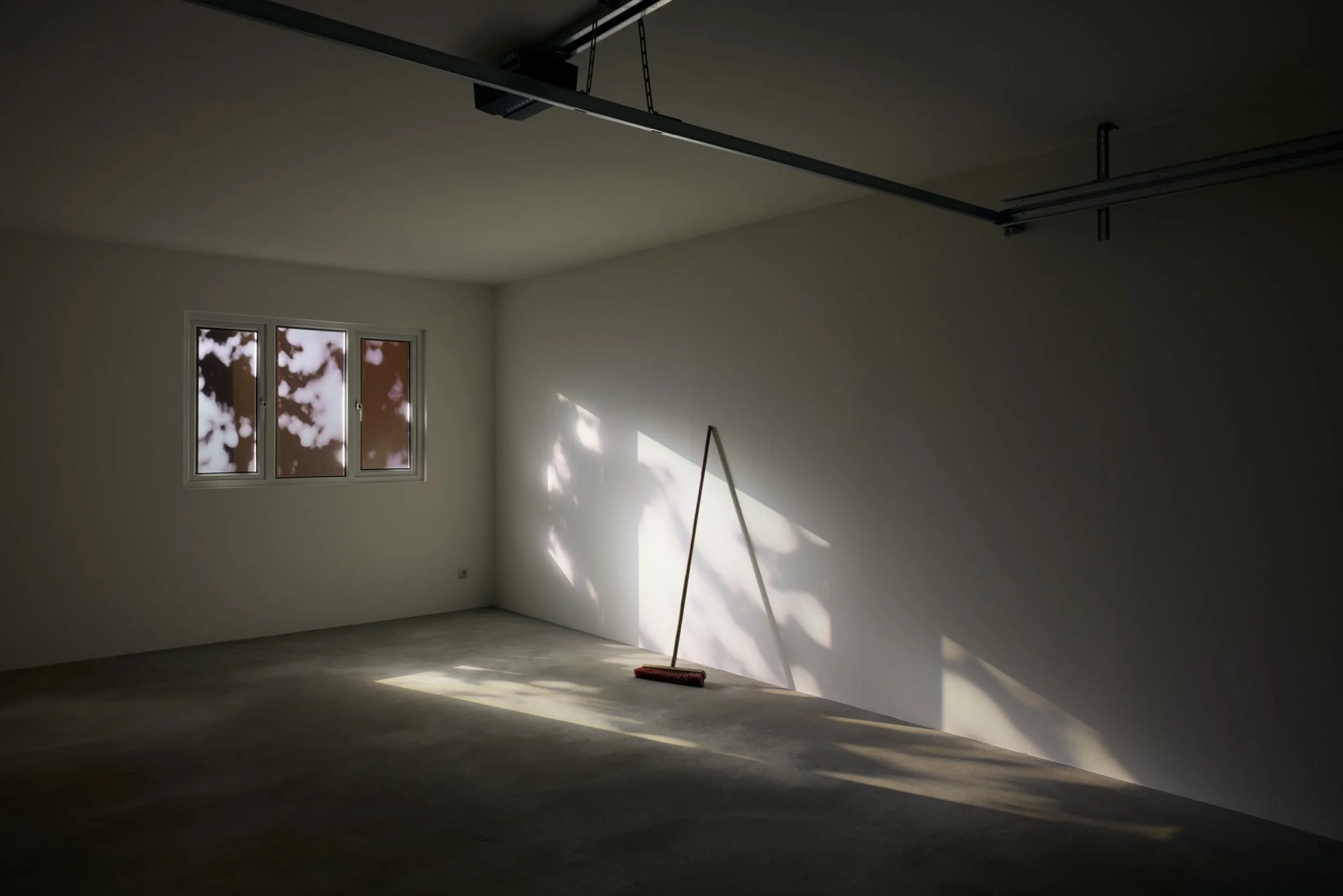
On the Street Where You Live, Steve Bishop, Garage with articulated door, side door and window, car, security lights with passive-infrared-sensors, video projection, broom, chest freezer with storage containers, ice bags, PVC, cardboard boxes, diesel, car radio, 2024, detail. Image courtesy of artist and Carlos/Ishikawa.
One of the issues with my not-writing is that I could. But I can’t and won’t. I want to write an email to my literary agent titled ‘on not writing’. I want to email everyone who gave me deadlines and all the pending work I have to do saying, well, no. Instead, I do not write. And I think about one conversation I once had with an artist friend about making art and making a living. One night at the pub, we talk about the meaning of it all, we ask: What are we or would we be without the art? He jokes: a middle-aged dad who works for an estate agent. In this logic, I am a full-time copyeditor. I sometimes think I insist on the idea of the self as a writer. I sometimes think it is a cautionary tale. Do not stop writing lest you no longer make jokes at the pub about the meaning of it all.
The art, the life: throughout the book, Davis describes how so much of those short, precise pieces draws on life. On learning German, on one’s grief, on a view out the kitchen window.
A spoiler: Davis reaches a conclusion about why write. On the last page, she describes writing a story using the simple construct ‘giving form to’. That process – ‘relieving myself of the burdens of strong feelings, by taking them out of myself and putting them into an objective form’ – is then public. A form of meeting, a connection. The title of this book, Into the Weeds, is taken from a reflection on gardening: Davis describes knowledge exchange, and a consideration of public space through gardening with the people around her. A roundabout way, like not-writing, still reading about writing like I have a stake in it. Gardening, like writing: a process. And then the conclusion: writing’s relationship to life, ‘a form that can also be shared by others out in the world’ – another reason, Davis says, why write.
[1] Lydia Davis, Into the Weeds (Yale University Press, 2026)
Cover image: Something to Remember You By, Steve Bishop, Melamine covered chipboard, carpet, PVC flooring, LED lighting, PVC model cake, polyethylene storage containers, radio, 2019. Detail. Image courtesy of the artist and Carlos/Ishikawa.