The Emptiness of Bodies
I know people know what death looks like and I knew what it looked like before I saw how my mother wore it but there was no way for me to know what she would look like dead until she had died which feels unfair. I think there should be a test-trial of death, to get you used to the idea of how this person will look when they’re dead, how they will not walk and not talk and not eat and not sleep because dead people do not need to walk or talk, eat or sleep.
The body is a thing to be animated, designed as a shell on which God abandons parts of himself that he dislikes and wants to burden someone else with. How inhuman or subhuman or nothuman or toohuman we all are. How not right we all look when we’re dead.
There is a man on the wall, high up, and I wonder what this man thought about in his final moments. I wonder if his soul, whatever the hell that is, could see, feel the crucifixion. The body is called the “Anatomical Crucifixion” the man was called James Legg, and he was already dead when he was crucified. He was hanged. Then the body, for it was no longer him for he no longer had a place to be, was crucified. It was done in public in the way this particular act seems to demand. It was in the name of science. A cast was made of the dead body, then it was removed, flayed and another cast was made. This cast is what I look at now. So, I suppose I am incorrect when I say that the body I am looking at is that of James Legg; as I am not looking at a body, and it is certainly not one belonging to a Mr Legg. It is a mimicry. My mother did not look like her when she left. So much so that when I first flew into the room, I was convinced that the speed at which my brother and I had launched ourselves down the hallway had meant we had run into the wrong room. That she was next door, a mistake had been made, that she was okay now, her body was hers again and we could all leave.
It seems to me that since my mother died I have been reduced to a thing that thinks about bodies. I think that we are likely trapped in God’s body, probably his stomach, and our view out to space is in fact our view out of God’s bellybutton, and our stars are fluff and lint that collect there and, since God only showers once every ten millennia, we will be looking at the same stars for a while longer. I think about the crucifixion of Christ and how he suffocated under his own weight, how his legs being broken and sides being split by spears was a blessing because he died faster. I think of my mother gasping for breath as my brother and I left the room. We were going to Sainsbury’s to buy dinner. We got the call that she left as we were trying to check out. For some reason we made sure to scan and pay for everything before we left the shop.
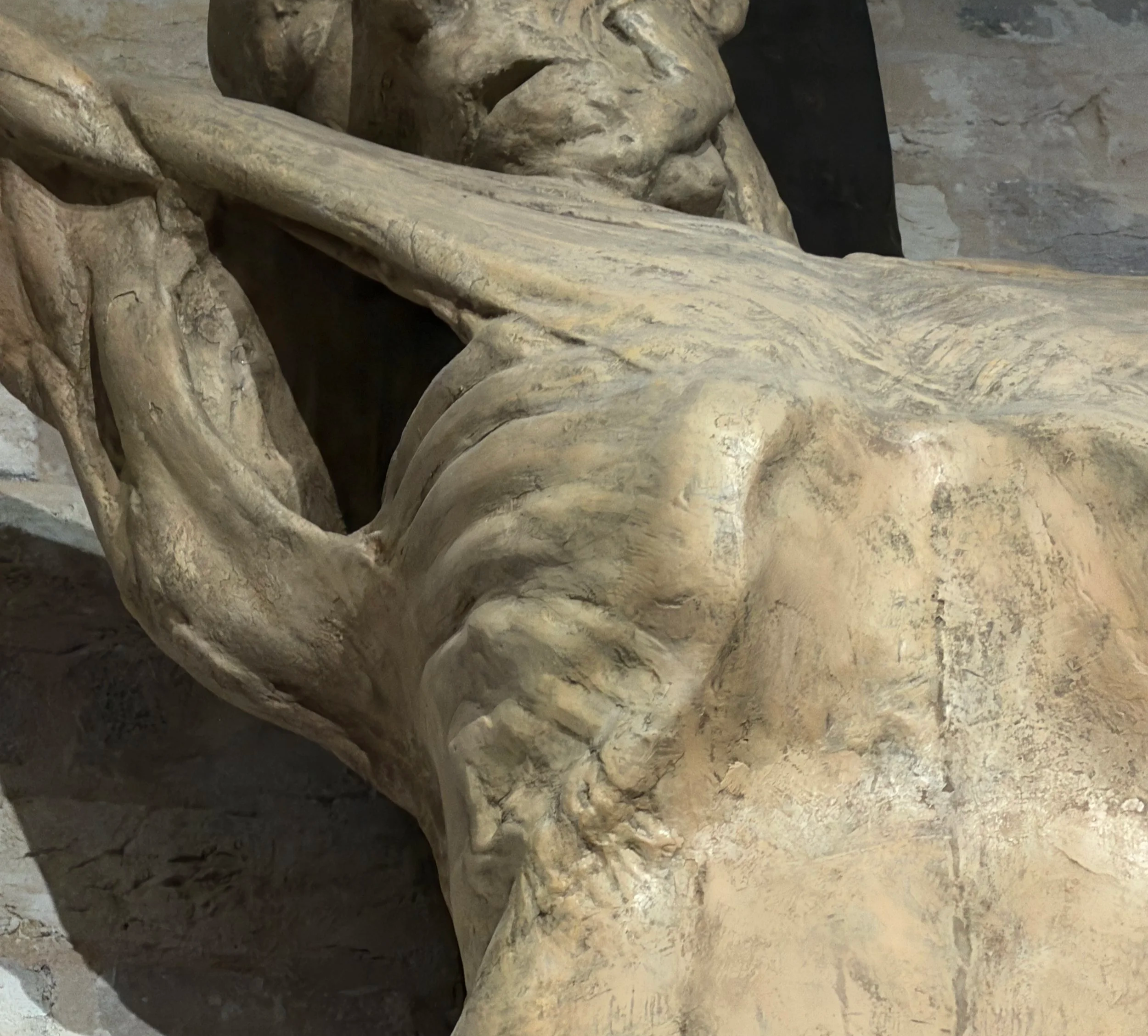
Anatomical Crucifixion, detail.
There is a man on a wall in the Royal Academy of Art. The thingness of the man on the wall is alarming and sad and he looks like he is in pain, still, though he was already dead when he was crucified. An odd second death for a man who is named first as an “Anatomical Crucifixion” and second by his name: James Legg. His flaying makes him far more and less thing-body-like than having skin. A body with skin is identifiably a body; a body without skin is also identifiably a body in the same way that a dream about a place you know very well feels like you are in a new place that you have never been but a place you have never left. It takes me a while to realise that he has no genitals as a result of being flayed. Jesus was naked on the cross, a fact that is often left out of accounts of it, as if his nudity was a shameful thing which I suppose it was because of his father’s treatment of Adam and Eve in the garden of Eden. I digress. This man on the wall is a man who has died twice and has no genitals and I am looking at him and thinking of my mother whose body was so empty and thinglike at the end that I could have counted her ribs and her vertebra in the way that I can with this “Anatomical Crucifixion.”
In a room that has the same lighting you find in hospitals there is a body curled up on its side, clasped in rocks and sand, a bad mimicry of a dead thing because dead things should not be put in glass boxes. He was dead, in Egypt, he died five thousand years ago and then he was made alive again. We reanimated him and moved him and placed him in a way that we thought best represented the burial practices of him and his family and his culture and, in doing so, he is now alive and dead and a thingless thing that has no place. My mother is in a box. It’s a funny sentence, in theory. But I mean whatever is left of her body; she went somewhere long before her body ceased being a body and, instead, became a thing that takes up space in a hospice bed, whilst we struggled to organise a funeral home to come and pick her up. No one tells you how quickly that needs to happen. My mother is in a box in the airing cupboard, tucked between sheets and towels and she is safe.
There is a man on his side in what would be the foetal position but he is too big to be a baby, he is too big to have ever been a baby and this death is too permanent ,he can only ever have been this dead thing on his side in The British Museum, being looked at and pointed at and photographed and people will go home from their days out in The Big City and tell their family and friends that they saw a dead person, a real life dead person, and they will brandish their photos like trophies. I could cry every time I see him. I wonder what his name was and if his family said it in that specific way that families say the names of people they love.
I cannot escape the thingness of bodies. The thingness thinglessness of them how familiar they are to me and how odd and absent and far away they all seem. That last touch I can feel imprinted on my body is my mother’s hand curled around my left foot that I propped up next to her on the bed in the hospice. There had been a strength to her grip that had allowed me to believe she had longer than she did. I have never been touched in a meaningful way. My body is nothing more than a thing that I haul around with me, a house for my soul. And oh the soul. These people had souls and thoughts and feelings and I know that logically but, looking at them, I cannot reanimate them in my head to anything other than dead looking things that are not wholly dead because they are somehow animated by necessity, as if they are being paid to look not fully dead. My mother was not fully dead for a while. But she was mostly dead long before she was actually dead like her soul, that fickle thing, had decided it was done with her, with this life, with being my mother, and wanted something else. But her body, that even more fickle thing, had decided that it would stay for the thoughts and the prayers and the morphine.
I was given fentanyl for a procedure before Christmas and it was the best early Christmas present I have ever been given. The thing that is my body became a thing entirely as my soul and I wandered the plains of ecstasy. I cannot blame my mother’s body for holding on for so long, not when the promise of divinity was only ever a few hours away.
The emptiness of bodies has always been a point of concern for me. By which I mean the ease with which they become empty. The act of dying is enough to reduce a body to a doll, a marionette whose strings have been cut. The body is no more a thing than a chair is a chair, the insides of a body the veins and arteries and bones and sinews make a body a body, but they themselves are things. It is all things and thingness that makes us, and that is a complicated enough concept. The emptiness of my mother’s body was odd. She had been empty for days by the time she finally left. But her absence was a determined sort of thing, a refusal to be in a body that didn’t want to keep being a thing that had a soul. Perhaps her body wanted to be its own master and kicked her out so it could finally orchestrate itself in the way it had always desired.
Cover image: Anatomical Crucifixion in the Royal Academy hall. Image taken by (Parentheses) Review.