Relatively Conscious Rage
The winter wind hitting your exposed skin feels sore; the two collide to create a fissure on the plain of your neck like brittle land. Your hands are red and swollen, ankles charred from the chill. You are on your way back from the gym, spurred by an early afternoon burst of energy. These are rare. You make sure to utilise each eruption when it occurs. It was lower body day – you worked mainly your glutes and hamstrings, straining each muscle until a soft, warm vibration muted any feeling of pain. And to conclude, a fast jog; feet thumping on the looping treadmill as endorphins storm your brain in a frenzy. Now, your legs feel electric; that euphoric, post-gym rush pulling you swiftly down the street. Your eyes, wandering and myopic, discern a figure in your orbit. It is small, slight, and shuffling with age. As you approach the figure, it becomes clear that it is a lady. She has on a burgundy hat and a matching wool coat. It does not matter what you are wearing. You are sure that the lady will have caught your figure too. You are tall, limbs long and agile, though that does not matter, not really. You notice that her mouth is ajar, the corner of it twitching as the dead space between you both becomes smaller. The sun’s December shell gives everything an icy hue as silence hardens what is left in the gap between your bodies. Her feet take a timid step back and she stands, frozen, frightened, muscles stiffened. Your presence creating a force field through which she cannot pass. This reaction is not unfamiliar. As your vessel continues to oscillate through the earthly sphere as one that is racialised, you are faced, again and again, with its reverberations. But this encounter is enough to shock you out of your post-gym high. Frantz Fanon said, ‘In the world through which I travel, I am endlessly creating myself.’ In your world, you find yourself created, endlessly; patched together in another’s mind. Your body is real and it is heavy.

Still from Sinners, 2025, Dir. Ryan Coogler. (Warner Bros. Pictures). Sourced from Wikimedia Commons.
You go to see Marty Supreme with your partner. It is that part of the year, just after Christmas, but before New Year, where the days feel fuzzy and impalpable. The two of you had been waiting to watch it, excited during its relentless marketing campaign. You’re now two of four Black people in your local cinema screening. The film follows a narcissistic white man as he thrashes through life in an attempt to become a world champion ping-pong player. You enjoy it, your partner, not as much – though it is its aftermath that leaves you both reeling. Variety gave Marty Supreme golden accolades during its opening weekend, hailing lead star Timothee Chalamet as the ‘King of the Christmas Box Office’. You immediately think of Sinners, a film you both adored; Black-made, with a majority Black cast, painting the tale of a juke joint in the Jim Crow South and the vampiric forces that come up against it; a tale ripe in symbolism, musing on the richness and vibrancy that come with Black existence. Sinners, and its narration on subjugation, the extraction of Blackness at the hands of whiteness, omnipresent and leeching. You remember that during the opening weekend, Variety questioned its profitability, despite it making over double the initial revenue of Marty Supreme.‘…the Warner Bros. release has a $90 million price tag before global marketing expenses, so profitability remains a ways away’, reads the X post attached to the article. Toni Cade Bambara said that words are to be taken seriously. You, like her, believe that words set things into motion. Your mind pulls the two Variety articles together in a painful suture, a reminder of the microscopic gaze latched onto Black expression.
You noticed it when watching The Traitors before anyone else with you did. It only took the first episode to realise what was unfolding. Their shaky assumptions rumbled and clustered before turning sedimentary, spat like embers into a burning belly. Most of the contestants are white, of course, but the few Black contestants are marked as untrustworthy and eliminated almost immediately. If it is not for being too loud, it is for being too quiet, too involved or too distant, too suspicious or too something else that they cannot put their finger on. You wonder if the white contestants use this to their advantage, play on racial mistruths to smoke up suspicions and further themselves in the game. The show brings in millions of viewers each night, so you are sure that you are not the only person to have this observation. You cannot be. You read an article naming it a ‘pattern of bias’, though you know that this oversimplifies the ways in which racism is incessant, parasitic, both unconcealed and almost imperceptible to those unaffected. You think of the kaleidoscope of speculations that make up your outer shell, the ones that are not yours, really, yet handed to you all distorted and smudged. You are not surprised when those around you do not comment on it. They are not thrust into themselves when watching TV, nor are they made to observe the ways their body is unhideable. The Traitors is not real – you have never eaten fresh fruit and croissants inside a castle or convened at a turret in a hooded cloak or rowed across a lake to collect pouches of golden coins. But you have sat around a table with strangers, and had them unpick you in ways you could not control. You noticed it first because you too are created, endlessly, in the minds of others.
In a 1961 interview, the literary genius, James Baldwin, said, ‘to be a Negro in this country and to be relatively conscious is to be in a rage almost all the time.’ His words reverberate through the walls of your world. Though most of the time, you are barely conscious, floating through life suspended in a haze. Because to be relatively conscious would be to notice your stride, your frame, your body that shakes and makes groans. Though most of the time you are barely conscious, you spend the majority of it enraged.
They are relentless in your email inbox, she is chronic on your screen. Lily Allen is performing in London, and Spotify thinks you should see her. You enjoyed her recent album in the way you enjoy most media made about a woman’s hurting – though you found this to be in an unrelatable white, third-wave feminist way that Allen has never really grown out of. You like her because she reminds you of being twelve; of finding her first album in British Heart Foundation and buying it with almost all of your pocket money. Those years of your youth hang in her syrupy voice, thick, like clouds just before rain. You Google her name with the heavy postpositive – ‘racist’ – something you do with all white-made media you find yourself enjoying, or sometimes, not enjoying. You remember vaguely hearing of the Hard Out Here video, where she used scantily clothed, twerking Black women as props – a juxtaposition to show what she definitely is not. You learn that the word prop, is short for property. Your mind cannot help but jump. Revelations such as this mould your life in the aftermath of slavery, this tentative life. A period Christina Sharpe calls ‘the wake’.
It takes many next page clicks to find the article. You wonder how it has been buried in the depths of the internet. You wonder how many other controversies are lost in the online abyss, left to rot and collect digital dust. The image that confronts you is ugly and harsh. In the midst of a Twitter feud with Azealia Banks, Allen tweets a picture of a penis, in blackface. Plastic googly eyes, a wide, smiling mouth with thick, red lips, some fuzzy, black material you assume is supposed to resemble an Afro, and something gold – a chain, you think. It is blurry so you cannot really tell. What it is does not really matter, for what it is supposed to be is clear with blinding intent. The image appears magnified on your laptop screen; it is nauseating and inescapable. You are, it seems, the only person in the world to care about this. You pull up a Reddit thread posted just after her recent album release titled ‘Why do people STILL think Lily Allen is r*cist?’, and glance at the comment ‘A LOT OF PEOPLE WERE OPENLY RACIST IN THE EARLY 2010s’. You recognise that people, here, is not a neutral noun. You wonder why whiteness enables a continual rebirth. The masses forget and forgive, forever at your expense. The tab is closed in a blink before you notice your fingers have moved. Your dullened reflection appears over your desktop wallpaper.
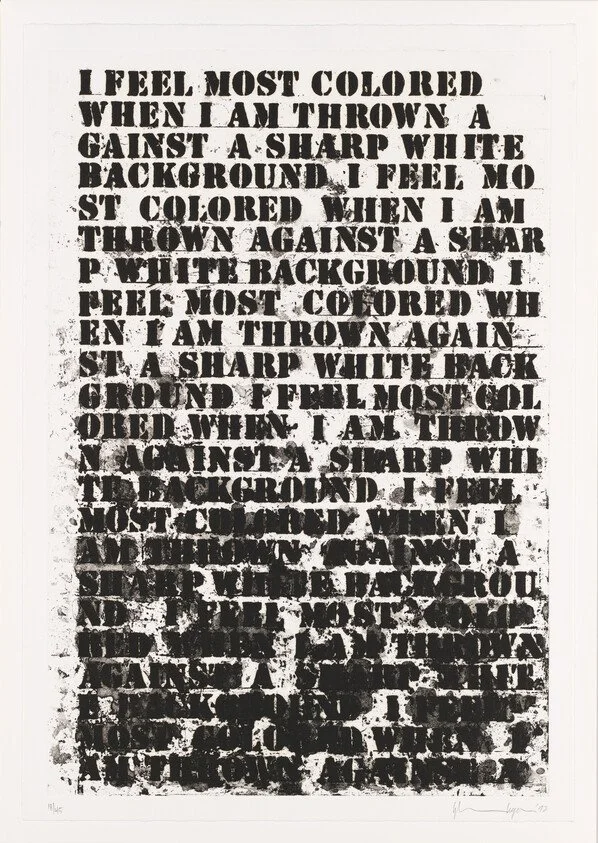
Untitled (I Feel Most Colored When I Am Thrown Agaisnt A Sharp White Background), Glenn Ligon, Etching and aquatint, 1992. Sourced from The Whitney Museum.
You grew up in a predominantly white area. In your primary school, you were the only Black child. In your secondary school, you were one of ten in your year, peppered through hallway seas of white. This was difficult and painful in ways that the teenage language struggles to bend and mould to encapsulate. The chemicals you lathered monthly on your hair were harsh. Sodium hydroxide, glycolic acid, glutaraldehyde, and other things that confused your tongue. Sometimes they would leave sores on your scalp, explosions of purple-red flesh gaping. Numerous studies have linked the chemicals to a worryingly high increased risk of breast, uterine, and ovarian cancers. You learned to fight the pain when it burned. You let the chemicals assault the bonds in your tightly curled hair because you couldn’t bear the weight that with it, your body brought. This year, like every year, you watch Love Island with your housemate. You are unabashed in your love for reality TV. Every year seems more uncomfortable than the last, and you are unsure if the racism is getting worse or if you are growing wearier. This year, like every year, the Black contestants are picked last. The Black women, specifically, are rarely desired and seldom complimented, despite their profound beauty; instead, propped like an afterthought amongst men whose type is ‘blonde hair and blue eyes’. You flinch when they are told they are aggressive for voicing their emotions or defending other women or for having a bad day. You feel your insides lurch when their strength and resilience are assumed in the face of hardness. You are sure it won’t be long until a news article comes out, relaying some unearthed racist post of one of the white cast members. One of the greatest writers ever, Zora Neale Hurston, said, ‘I feel most colored when I am thrown against a sharp white background’. You wish you could run into your television and cradle the Black women on your screen.
Cover Image: James Baldwin writing. Sourced from Pinterest.