Boars, Pigs, and Butterflies
Trigger Warning: discussion of sexual abuse
When she was a little over seven years old, her mother, Mrs Roy, found a family who could take care of her when Mrs Roy was overwhelmed with running a one-of-a-kind school in Kottayam, in the southern state of Kerala, India. The chosen family lived in a big, airy house. The problem, however, was the “respected” senior who was the patriarch-grandfather. For some, he was the brown, bubbling Santa from the Rotary Club Christmas party, wearing a red jumpsuit, and entertaining the children with his ho-ho-ho. But he turned into something else for her after she was sent to their house – a wild boar. His ho-ho-hos turned into a wordless snuffling and groping between her legs and the rolling down of her underwear. She could somewhat sense what he was doing was wrong. Perhaps it was something to do with having babies? She realised she must escape. Not just that once, but the next time, and the next. It was an ongoing hunt, and she was his prey.
Later, she was sitting in the Rotary Club-turned-classroom of her mother’s school, unable to focus on the teaching. Sitting on the low wooden stool, she wondered if she got away from the wild boar’s hunt. What exactly had to happen to make her have a baby? Had she got away in time? She broke out in sweat at the consideration of this question. If she had not got away, was she pregnant? Her cold sweat began to trickle down the back of her leg – she became convinced that this had to be a sign of pregnancy.
This classroom scene is seared into my brain after reading the 35th page of Arundhati Roy’s memoir, Mother Mary Comes to Me. Each word from that chapter was like an intrusive stroke to form this visual of a seven-year-old Arundhati Roy wondering if she was pregnant after being molested by a wild boar Santa from Kottayam. Blood-red is the colour of Roy’s hard-bound version of the book, and for me, that is the colour this scene is tinted with, too, because of its emotional and physical violence.
I shut the book, gripping it tight, feeling the pressure on the edge of my right index finger that was holding the mark at the 35th page. And I stared at my couch, as I usually do when I am wounded or stabbed by the words on the page. Kafka would encourage these reactions to the book. He asserted that we ought to read only the kind of books that wound or stab us, and that wake us up with a blow in the head. This classroom scene from Roy’s book brought up another scene in my mind with a blow – a scene from the life of a different seven-year-old.
The scene started with me, at first, feeling excited to answer the tring-tring-tring of a black rotary dial telephone, which I had just gotten tall enough to reach over the wooden chest of drawers in the living room.
‘Hello.’
There was the voice of my aunt, my mother's sister, on the other end of the telephone. At the same time, the hurried opening of the door of my mother's bedroom, with my aunt’s husband rushing out, gesturing to me to tell my aunt that he was not where he was. I made a split-second decision.
‘Is V. uncle there right now in your house?’
‘No, aunty, he is not here’, while staring at his half-unbuttoned salmon-coloured shirt, trying to ignore the stink that always came home with his presence. Saying that didn’t feel right in my seven-year-old body. But I perhaps conformed to his request in an attempt to feel physically safe.
This scene came up to the surface after reading Roy’s classroom scene, possibly because this was the moment I had first realised that what he, the wild pig, was doing was wrong. After this, I began hearing my mother’s muffled screams and noticing her covert acts to defend herself. By virtue of being my mother’s uncle in addition to her sister’s husband, this wild pig’s hunt was easy. Her escape was more difficult. Locked doors that he would push through, or bolts that he would dismantle with hours of persistence.
The next scene that floated up took place in the same living room, a few years later. That day, my mother’s attempt to escape was the hope that my presence would turn the pig away. It didn’t. My mother sitting on the left end of our new beige sofa, and me on a different single-seat sofa just a few feet away. His loathsome body sat on the armrest of the sofa, brushing against hers, while his sweaty, stinking arms slipped under her nightie, caressing her breasts. Her half-resorted, half-desperate attempts to push him away or stop. Me, half-ignoring, half-desperately attempting not to cross over into the hunting ground that was our living room.
Both scenes are in an elongated loop in my head, as I still stare at my couch in a different living room. Tring-tring-tring. Beige sofa and stinking arms. Tring-tring-tring. Beige sofa and stinking arms on my mother’s breasts.
To shake away these scenes, I remind myself that I’ve already processed, extracted, archived, and righted these experiences. I also managed to prevent the wild pig’s stink from entering our house years after that phone rang. No need to replay or unarchive it now. I look at the picture of an adult Arundhati Roy smoking in cool defiance on the dust jacket of the book and reopen it.
Roy continues on the 35th page, ‘I never told my mother about the wild boar, or the hunt. I am not sure why.’
These words are like the password that opens and surfaces up another processed, extracted, archived and righted scene, one that is garish and gaudy. The wild pig was hunting at my house, like a weekly ritual that it was. That day, my mother’s escape was into the shower behind locked doors. The wild pig saw another prey that could satiate his hunger – a thirteen-year-old-me. He snuck into my room and asked about my studies. While I was on the verge of leaving my room, I was stopped by his forceful and tight hug from behind to feel my breasts. Wriggling and unlocking myself, I escaped.
I, too, never told my mother about this hunt. But, unlike Roy, I knew why. For six years, I had learned that our home was a hunting ground. My mother had resorted to being preyed on. So, would she help me? I never took the chance. From then on, I always escaped.
After ten years, I gained the perspective and strength to oust the pig. I made it clear that his pig-identity would be revealed to everyone we know, and who thought of him as a man, if he were to ever try pushing through our doors again. Its stink was finally eliminated from the house, and it stopped preying on my mother’s breasts.
In the final chapter of the book, Roy writes about her mother’s funeral. Amidst her shock and grief, she greets many visitors. Among them, Tulsidharan, a master mason who built her mother’s revolutionary school, Pallikoodam, after it outgrew the Rotary Club-classroom, roughly fifty years before the funeral. He reminisces about her mother’s creation of the subversive institution where she was the matriarch for all those decades. While recalling her visionary leadership, he remembers her young children:
‘She had two children who were always running wild. Where are they?’
‘Here’s one in front of you.’
‘But aren’t you the writer? Arundhati Roy?’
‘Even writers were children once.’
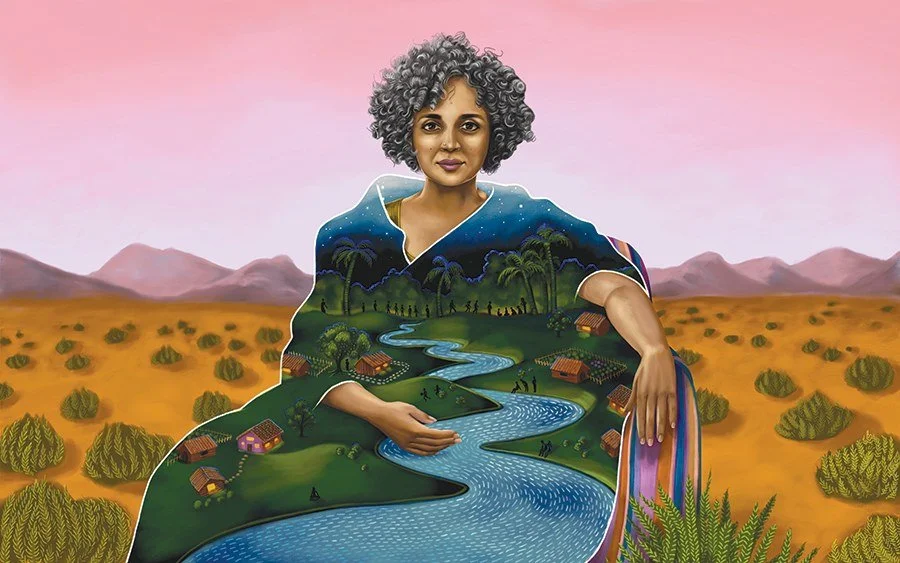
Arundhati Roy
Illustration by Shyama Golden
Art director: Zak Bickel
After moving forward from the wounds and stabs that sprang from the 35th page, the next one came from the 88th. Roy is talking about Tamil and Malayalam cinema in the 1970s. My mother also grew up watching them, along with Kannada, Telugu, and Hindi cinema. She writes, ‘as a young girl growing up on a diet of these films, I used to believe that all women were raped, it was just a matter of when and where.’ These words ceased all the visuals from my mind and, instead, injected an array of emotions into my being.
Rage, as it reminded me that almost all the women I grew up with said ‘me too’ when I shared my experience of being preyed on. Indignation for all those mainstream Indian films made in the 1970s, ‘80s or ‘90s where assault or rape of the heroine was depicted with a vigorously shaking camera focused on the ceiling fan or petals dropping off from a flower. Ferocious anger for the structural oppression of women, the existence and nonchalant acceptance of toxic patriarchy that made the child-not-writer Arundhati Roy wonder if she was having a baby at seven years old. In addition to the ferocious anger, an excruciating pain and helplessness because my mother, perhaps not only believed that all women were raped, but she had also accepted that it would be in her own home.
There was also a feeling of relatability that was alternating with hope. Relatability from my seven and thirteen-year-old self with Roy’s. If the child-not-writer Arundhati Roy at one point believed that to be true, but at a different point became the fearless Roy who redefined the laws of survival, perhaps other child-not-writers like me and many others, would continue to shut the door on the stinking pigs and boars, let the hunting cease, and make new laws of survival.
While processing this amalgamation of feelings, I flip open the book’s dust jacket with Roy’s picture to find the hidden, beautiful, black butterfly etched underneath Roy’s name on the book’s red cover. I blink through my tears to see it flying.
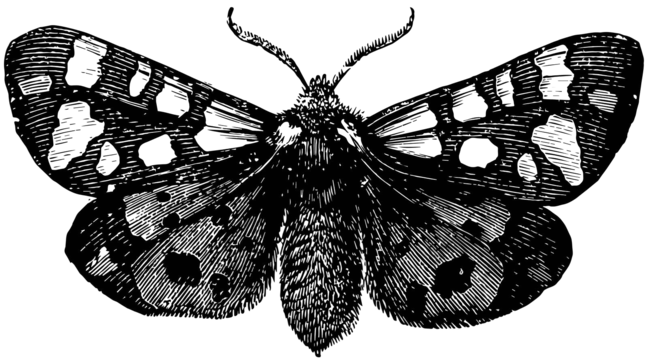
Cover image: courtesy of Amritesh Mukherjee (@aroomofwords)
Mother Mary Comes to Me by Arundhati Roy is out now via Penguin Books.