Rose and Gasoline
My grandparents’ house had a large garden which bordered three-quarters of the property. The walls were painted a dark, earth green to blend in with all the plants, trees, and flower bushes they had planted and tended to over the years. Between the trees and flower beds, my grandparents had laid a path of stones, winding its way through the back of the garden. When you followed this path, you would appear in clearings and disappear behind thick foliage, reappearing further down by the blackcurrant tree. My grandmother and I would go on walks together through her garden where she would tell me stories of all the fairy folk who made their home there – slept in the centre of the flowers, snoozing their days away, riding on the backs of bumblebees and screaming with joy. She would look inside the roses to make sure there wasn’t a sleeping fae before asking if I would like to smell them. Sticking my nose as far inside as I could, I would take the deepest of breaths, wanting to gather all the smells of where the fairies liked to hang out. I remember wishing to be able to keep the scent forever. Somehow bottle it or have it waft around me, always. I didn’t know what perfume was.
Behind the garden wall was a heavily polluted main road, with traffic at all hours, and a petrol station which stood on the opposite corner. Fumes from the exhausts crept their way up and over the boundary, spilling into the garden. The aromas would mix, transform and permeate one another. Some days, the smell of the garden would win, and on others, the petrol and combustion engine gases. Others, a perfume of mixed emotions: rose meets gasoline. Can they hold hands? If I think hard, close my eyes and focus, I can still smell it - that intermingling.
Every night I scroll TikTok in bed and recently the algorithm has been feeding posts about perfumes. The carousel feature, which allows users to upload multiple images, is being used by “fragrance influencers” to present collages of niche perfumes, showcasing the fragrances to use if you want to smell like a cyberpunk city, a vampire’s wardrobe, or the wings of an angel. Take, for example, one detailing how to ‘smell like Tokyo at night’: a collage of neon-lit streets, laced in purples and blues, and four fragrances, which appear often in these posts. One, Age of Innocence, by the Romanian brand Toskovat, is also the scent of a time-sensitive playground, David Bowie, a childhood memory, and a Deftones track. Views range from a few thousand to the millions.
According to these collages, if I want to smell like a Windows 95 desktop wallpaper, I must part with hundreds of pounds to get this very niche and exact fragrance. The bottles surround a collage of images (pulled from Pinterest or generated by AI) that allegedly best describe the scents or the aesthetic they fall under. TikTok is filled with these “aesthetic” posts, from cutlery to sofas, bookshelves to desk curation; which I must admit I am enamoured by. Then we have the East London meme accounts who display the “right” kind of shoes or beanie to wear, the “right” perfume to be that freelance creative with a dubious source of income, so coveted. When I walk past the coffee shop by my house, which appears frequently on these meme pages, the air is filled with Le Labo’s Santal 33 or Another 13. The bodies draped in oversized coats; tabis or Salomons on foot; flat whites in hand; reading Joan Didion. The uniform. Everyone looking the same, behaving the same, and now smelling the same too. For the most part, I think I could look at these people flooding out of this café and name every perfume they have on their vanity.
The thing about TikTok, about Instagram, is how they cultivate a need to “fit in”. A desire to be adorned in the “right” way, to signal that you are in the know, to not stand out too much. This is what I find most curious about these posts: the way their recommended fragrances are completely and utterly removed from any lived experience and boiled down to how to smell like everyone else who must inhabit a specific aesthetic, regardless of personal taste or history. I concede, I do fall under a number of these tropes positioned by these meme accounts. I’m wearing Salomons, sipping a flat white as I write this. I read Joan Didion because I’m told I should, even though she always puts me into a reading slump. I think I should buy a bottle from Le Labo. And I’ve already situated myself into an aesthetic: I’m a writer who exclusively wears black clothing, silver jewellery, and I carry a tote bag from a blue-chip gallery. When it comes to how I smell, however, I can’t help but feel a need to break away from this: from the desire for a scent to match an aesthetic, above all else.
Smell is one of the most personal senses. To smell is to get up close. To smell is to have particles enter your body; you spray a perfume directly onto your skin, your pulse points: neck, wrists, the inside of your elbow. When you hug a friend and your nose brushes against their cheek, their hair falls around the side of your face, and you breathe in their scent. The one they chose that morning, maybe the one they wear every day.
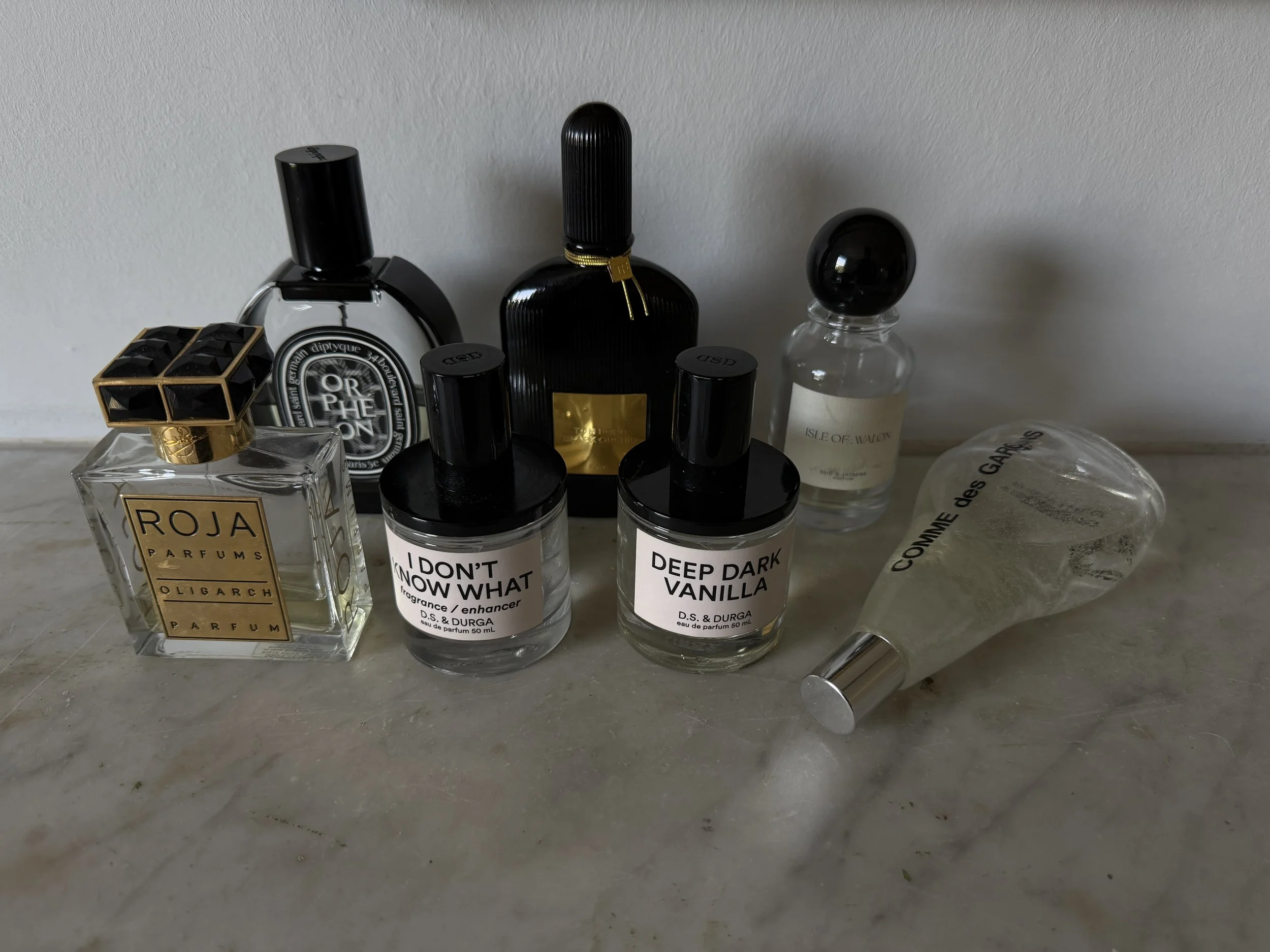
Writer’s perfume collection.
I have seven perfumes displayed on the marble fireplace in my bedroom. The sole citrus fragrance I share with my partner, S, and I wear it exclusively when I miss him; it’s the only one he wears. I spray it and let the lemon and lily wrap around my neck, give me gentle kisses. Bring my wrist up to my nose, inhale, and rest my hand on my heart.
To smell is to remember.
Most people I know, me included, are in search of a signature scent. A smell that will be associated with them wherever they go, to whoever they meet, love, fuck. A scent that clings to their pillow long after they’ve risen and left the flat, only for their lover to pull it close and think about them.
Sometime in 2017, freshly single, I was walking to the studio to work on a drawing for the second year of my undergraduate degree. A man walked past me, I didn’t see his face, and for a moment I thought it was my ex, F. They wore the same, popular perfume, one composed of white florals and leather. I thought of resting my head on F’s shoulder on the train coming back from a gig, nuzzling my face into the fabric of his jumper. I thought of walking out of his house for the last time; the final text to me saying, ‘just know I loved you the most.’ I felt a tear roll down my cheek. It smelt of white florals and heartache.
I still don’t like that perfume. It’s tainted with ghosts.
Maison Margiela’s fragrance line, Replica, attempts to capture this edifice of memory. They bottle a moment and location: sitting in a jazz club in Brooklyn, 2013; Dublin, 1967, after the rain stops; On a date, Provence, 2014. All moments experienced, I assume, by someone. It doesn’t necessarily have to be me. Or you. But they are still fabricated. Something I’d be forced to associate with the fragrance. Memories which aren’t mine but made to feel like they are. Perhaps, it might be nice to step into the shoes of a Brooklynite hipster, circa 2013, with my suspenders and plaid overshirt, sipping an Old Fashioned to dull the reality that I don’t actually like jazz at all. But then I’d still be assigning something to this smell that isn’t wholly mine. Making a collage of images on Photoshop and posting it online.
Some years after my grandmother passed, my grandfather gave me the crystal she would carry in her bag. It still smelt like her. The crystal is about an inch long, with a small arm protruding from its side. The shaft is rough, with tiny crystals covering its surface, and at the top, a pyramid with smooth faces, having been cut by someone unknown to me. She used to take it out of her bag and run her thumb over the bumps: a kind of worry stone. For years, I kept it in a small box, taking it out only a few times to smell it, to think about her. I would keep it out only briefly for fear of the scent dissipating. Being only ten when she died, my memories of her were foggy, and I was trying to anchor them to this object and to the smell it carried. What was to happen when the scent finally left?
Marcel Proust said, in his megalith work, In Search of Lost Time, how ‘after the death of people, after the destruction of most things … smell and taste still remain … like souls, remembering, waiting …’ The smell of her perfume has long since left the crystal, and it now sits on my nightstand. My memories of my grandmother remain. They are still misty and distant, much like a perfume slowly losing potency on a wearer, yet I’m always brought back to her when I smell a wonderfully fragrant rose, or the fumes of traffic as I drive past a petrol station.
As I spend more and more time scrolling through these collages, as I search the perfumes on Fragrantica (an online fragrance encyclopaedia), hunt them out in boutiques and pilgrimage to sample them with my own nose to see what all the fuss is about, I start to think that these accounts have got it all wrong. I smell one that is meant to be a fallen angel, so the post goes, and the first thing I think of is sitting in the coffee shop where I wrote my Master’s application, surrounded by espressos and half-eaten croissants. I don’t think a fallen angel would smell of a cafe in the South of England; of burnt coffee and caramel. To be honest, I don’t know what they would indeed smell like. What I do know is that my breath, and skin, my laptop keys, and application were tinged with coffee and cigarette smoke. I bought a sample to remember that time.
This is the thing about scent: it’s so intrinsically linked to our perception of memory. The nexus exists within our own anatomy. The processing unit in the brain for scent, the olfactory cortex, is surrounded by other areas responsible for processing memory, behaviour, and associative learning. Therefore, it goes without saying, that a memory triggered by a scent tends to be autobiographical in nature insofar as the reactions are deeply personal. It pulls from our history. This is why when you stand next to a stranger on a crowded Tube, early morning, sleep in your eyes, and catch a stray whiff of their perfume, you could recall a Sunday morning with your ex, tangled in bedsheets. The aroma of a smoker can bring forth late-night conversations in the student house you shared at university, wondering if your dissertation would write itself, or if that man will ever text you back.
These are the things I want to remember when I smell. I want to remember my grandmother. Smell S on my wrist when I spray a citrus perfume because I miss him. I want to smell incense and think about my upstairs neighbour who burns it at all hours, casting a sandalwood, sometimes lavender, haze throughout the building. I don’t think a TikTok or Instagram account can capture these. They belong to me. I assign perfumes and fragrances to them. I search them out, or they find me on the neck of a stranger. They appear in places I couldn’t reasonably have thought them to be.
Last week I went to a niche fragrance store in Covent Garden; I asked to smell Age of Innocence. The sales assistant sprayed it on one of those little strips of paper and handed it to me. I could smell gasoline, rubber, and rose. I didn’t think of David Bowie, Tokyo, or a transtemporal playground. I thought of my grandmother.
Cover Image: Writer’s perfume collection.