Light Reflections on Snow
There is a very particular shade of blue that is created by shadows left when sunlight reflects off snow. Luminous and cold, tinged with white light, it catches in drifts and at the base of trees.
I am in Monson, a town right in the middle of Maine, with a population of less than seven hundred. I am here on a writing residency, with the programme Monson Arts which has provided myself and nine other artists and writers each a house in which to stay, a studio space in which to work, meals cooked by the local restaurant, and credit at the general store, and all the time we could possibly want to write or paint or sculpt or read or do nothing. My studio is in a building that balances on wooden stilts over the edge of Lake Hebron, the bank on the other side of which is two and a half miles away, as the loon flies. Right now, the lake is frozen solid, eighteen inches thick, I’m told, and covered with a deep layer of perfect, uninterrupted snow.
I am unused to having such endless, unscheduled, time, free of commitment, no routine to which to adhere, nowhere I have to be at certain times. I have, therefore, been doing a lot of looking out the window at, or walking in, the snow which has fallen thick and fast, and blanketed Monson with a thick, undulating white quilt, a foot or so deep.
It is the kind of deep winter that slows things to an almost stop. Even on the brightest of days, the sun never reaches its apex, preferring to hover just above the horizon, flirting with the tops of the tallest fir trees and throwing long, dramatic shadows across everything below. The moon, just the thinnest of slivers on the day of writing, hangs nearby too, fearful, maybe, that the sun’s reticence to rise may hamper its own cycle.
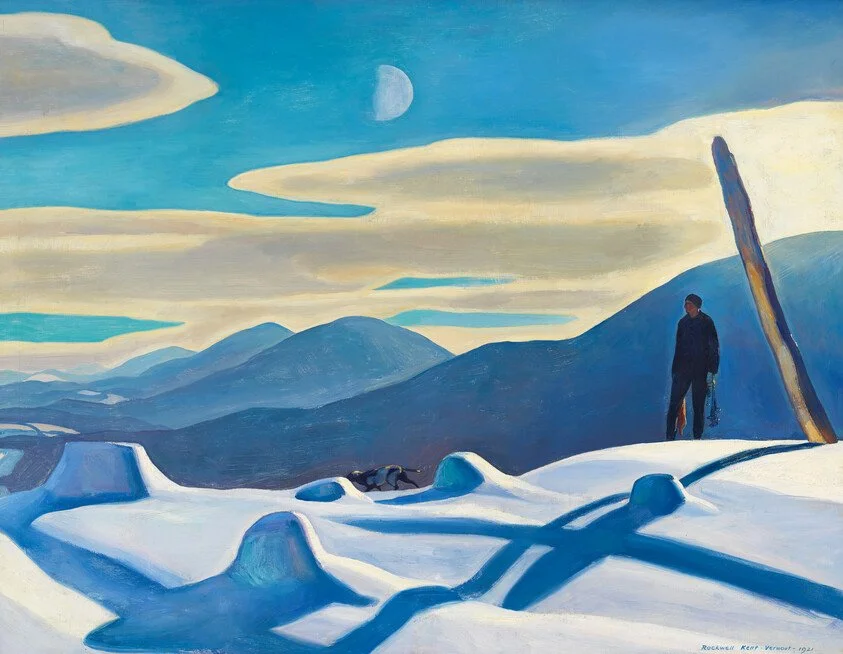
The Trapper, Rockwell Kent, Oil on canvas, 1921. Sourced from Wikimedia Commons.
Today, the sun shines warm and bright, wispy clouds parting, the wind lifts snow from the icy lake and swirls it around in a haze over the tops of the skeletons of trees on the far bank. My phone tells me it is -14 degrees Celsius. The sunlight on the snow is so bright it hurts my eyes, so instead I look at the blue shadows at the base of the trees, and I am reminded of a painting by Rockwell Kent from 1921 – The Trapper. A lone figure stands to the right of the canvas, looking across a landscape of pure, white snow that renders rocks or bumps in the ground unidentifiable. A halfmoon hangs, right in the centre, of the brilliant blue sky, as clouds of pale-yellow swirl below.
In the painting, the sun is unseen, but its presence felt in the long shadows cast by the figure, the bumps in the ground, a single wooden pole that rises out of the snowy bank. The shadows are a deep shade of almost electric blue. Even the white snow is tinged with a pale blue, barely distinguishable at first, but the longer you look the bluer it gets, borrowing this hue from the clear blue sky beyond the clouds.
The mountains in the distance are blue too, and they recede into paler shades as they tumble away towards the distant horizon line.
Rebecca Solnit talks about this blue, ‘the blue of distance,’ in her short book A Field Guide to Getting Lost. The world, she says, ‘is blue at its edges and in its depths. This blue is the light that got lost.’ With shorter wavelengths than its warmer complementaries, blue light scatters among the molecules of water in the atmosphere, giving far away objects a blue hue. The sky is blue for the same reason, millions of tiny wavelengths of blue light bouncing around form in a vast sea of atmosphere. Deep water, too, is full of this scattered light.
The blue of shadows on snow is the same, light refracting through crystals of ice.
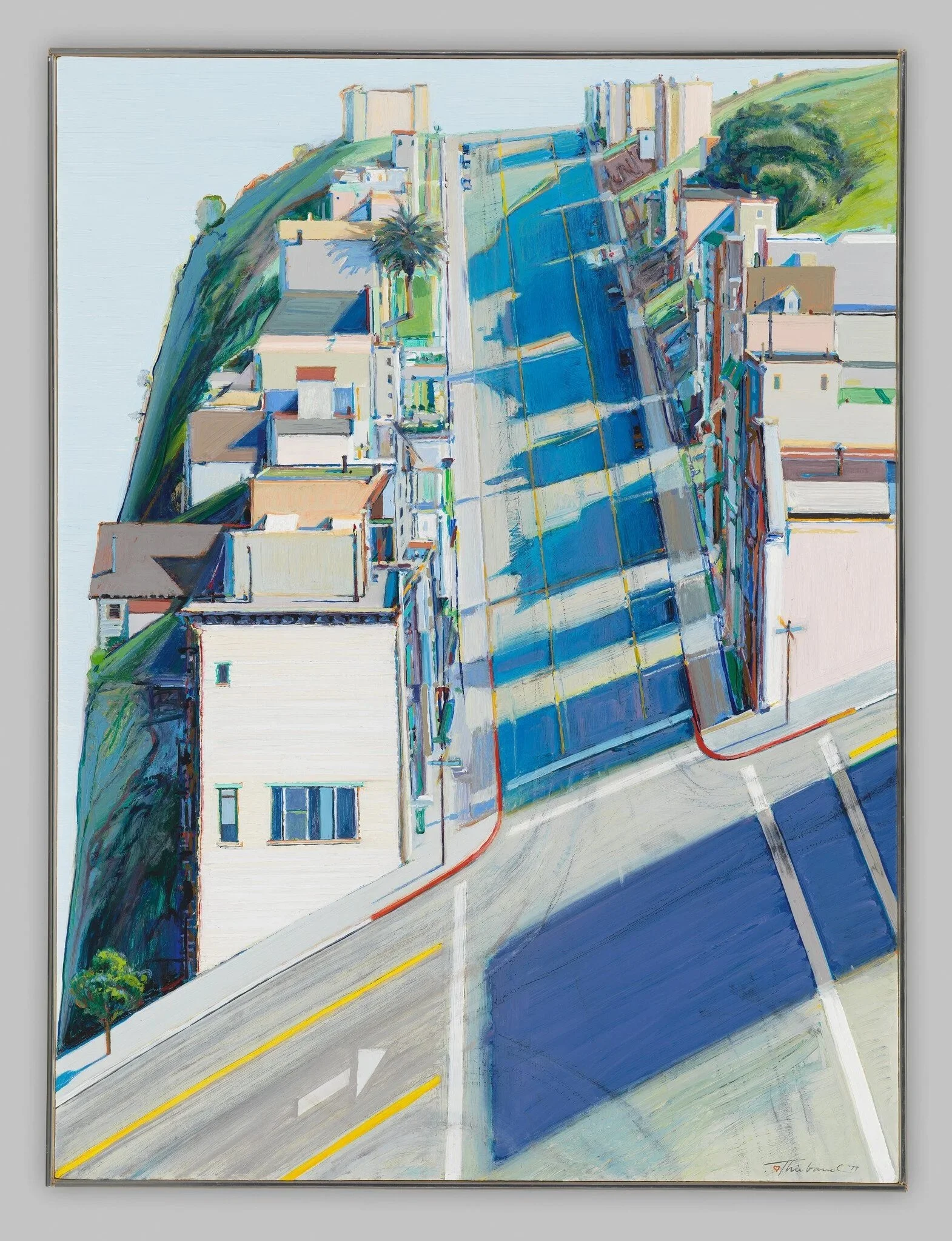
Ripley Ridge, Wayne Thiebaud, Oil on canvas, 1977. Sourced from The Whitney Museum.
In Wayne Thiebaud’s 1961 work, Boston Cremes, slices of pie line up, arm in arm, and throw rows of blue shadow across white plates and table. His 1977 painting, Ripley Ridge, does the same, though this time it is a line of houses that cast their long blue shadows across the road in the hot white California sunlight.
This is nothing new. Artists have been painting shadows blue for centuries – Cezanne was at it, the Impressionists too. Leonardo da Vinci had his own theories about why the sky is blue, and the blue of distance too. He knew to use shades of blue to paint distance, writing in his notebooks ‘those you wish should look farthest away you must make proportionately bluer.’
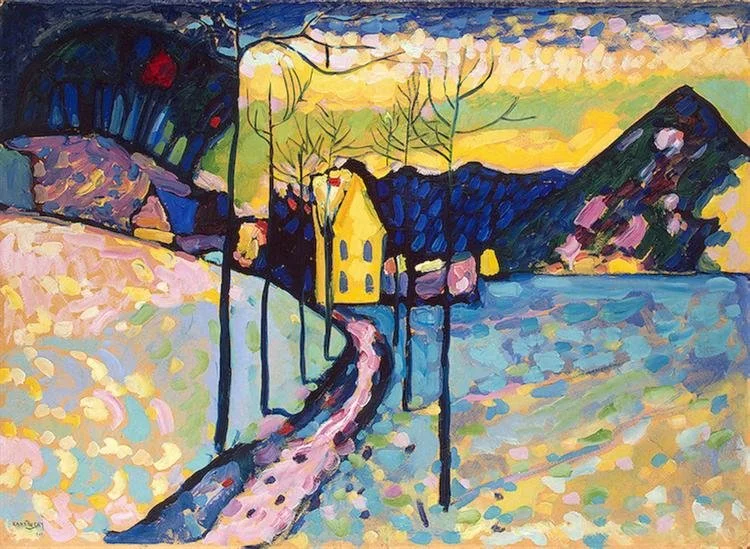
Winter Landscape, Wassily Kandinsky, Oil on canvas, 1909. Sourced from Wikiart.
When Wassily Kandinsky paints snow in his 1909 Winter Landscape he does so without the use of white. Instead, his snowy banks are made up of orange with dabs of pale yellow and green. He knows that snow glows in sunlight, that tiny fractals of the spectrum of light bounce off frozen water molecules such a way that flat white paint will never suffice. Flecks of yellow sunlight contrast with the blue of their neighbouring shadows. As the snow recedes toward the village in the background, there is that cold, luminous blue, gradually getting darker until it meets the almost black hills in the background, themselves mottled with daubs of blue, a hue that matches Kent’s own shadowy mountains that glow with the blue of distance.
Solnit says, ‘the blue at the horizon, the blue of land that seems to be dissolving into the sky, is a deeper, dreamier, melancholy blue, the blue at the farthest reaches of the places where you see for miles, the blue of distance.’ For her, the blue of distance is synonymous with longing. She describes a view of San Francisco from the edge of nearby Mount Tamalpais, as a city of blue, ‘a city in a dream,’ and she describes her ‘tremendous yearning to live in that place of blue hills and blue buildings,’ even though she already does.
One day I walked a mile and a half or so across the frozen lake, past the ice fishers who have set up camp in little huts, and docks that are rendered redundant by a frozen bank of solid ice. It was slightly eerie, this world of white, punctuated by the blue of shadows cast by trees on the shore, or bumps in the surface, where the wind has moved snow into little drifts, too small to see but for the tiny shadows they cast.
Another day, as the sun started to set over the far shore of the lake, I trudged down a snow-covered path through the woods to a little black sauna, powered by a large woodburning stove. I sat in it, sweating, my skin pink, and when the heat became unbearable, I ran down the path to the lake, out onto its frozen top and plunged, gasping, through a hole cut in its surface to the dark water below. Chunks of ice bob on the surface, frozen rungs of the ladder stick to wet fingers. As I ran back up, the soles of my socks froze on my feet, collecting clumps of snow.
Some days the sky is grey, and snow comes down thick and fast, an endless torrent of tiny white, icy flakes. As the air warms up, the flakes get bigger, large, cumbersome clumps that amble down towards the frozen lake.
I put on snowshoes and trudge across fresh mounds of the snow in the woods as snow continues to come down, clinging to branches and trunks of trees and turning the front of wool hats white. On the weekends people drive their cars out to the middle of the lake, park, drink beers, play music. Snowmobiles race across the ice, darting from the snowy tree lined trails through the woods onto the ice.
I kick my feet through soft snow on the side of the road as I walk to the general store and think about how a winter like this – one so deep, so unwavering – changes the very stuff of life. The rhythms change: the pace slows. Katherine May talks about this very thing in her book Wintering: The Power of Rest and Retreat in Difficult Times, in which she likens winter, an inevitability in every year, to hardships in life, which cannot be avoided and must therefore be endured. She believes that humans were not built for the constant productivity so often demanded by modern life, and instead, we should take a lesson from nature, which slows down during the winter months. Animals hibernate, trees lie dormant, and, traditionally, winter festivals honoured the darker months with periods of pause and rest.
The world needs winter. Many seeds rely on the cycle of freezing and thawing to crack their shells and bloom as the earth starts to warm. Fruit trees need exposure to cold to produce buds, and their period of dormancy starts as the days begin to shorten in early autumn. A balmy winter can lead to shorter flowering bulbs with smaller blooms when spring finally blows in. The world is well versed in rest. It knows that winter cannot be rushed. It knows to let it happen.
We – my fellow artists in residence and I – talk a lot about winter. It used to snow like this in New York, says one, but not for many years. Others hail from California, Maryland, Texas. In London, where I live, to have one or two snowy days a year is remarkable. We talk a lot about ice. We talk about being snowed in, both in literal terms of the winter, and creatively, thanks to the residency. Both are forcing us inside, to our studios, where there is little else to do than create.
We talk about the slowness of time caused by residency-cum-winter, how our days are punctuated with the repetition of pulling on boots, zipping up coats, stamping off clinging snow, taking off coats and boots, putting on, taking off, putting on, taking off. It seemed laborious at first, but now, remarks one of my co-residents, it has become a moment of meditation. It’s a little ritual that must be performed. I start to realise that the simple fact of me being here is more interesting than any of the work I am creating, that just living in this kind of deep winter, waking up to fresh banks of snow on my front porch, walking to my studio across a frozen lake, is a project in, and of, itself.
Across the world, we are losing winter. Even here, where winter seems so inevitable, it has rained on a couple of days that had been forecasted snow. The rain mixed with slushy snow on the streets and the top of the lake, refreezing to turn everything from soft, inviting powder to hard, slippery ice. The snowmobilers, upon whom so much of this town’s economy relies during the winter, were kept away, hard to snowmobile with no snow. Across North America, ski resorts are experiencing record low levels of snow. In some parts of the Alps, the period of snow cover at mid-mountain elevations has decreased by nearly a month in the last fifty years.
I realise, as I walk back to my temporary home in Monson, Maine, one evening in a relentless flurry of snowflakes, that like Solnit says, I long for the blue of snow. I long for it, even though I can see it right now, from the window in my studio. This morning, the clouds are slowly melting away, the yellow sun emerging. The sun on the rooftop opposite is blue – unmistakably, glowing. I settle into another sludgy, unstructured, wide open residency day, and, today more so than almost any other, that dreamy blue snow is tinged with melancholy.
Cover Image: The Trapper, Rockwell Kent. Sourced from Wikimedia Commons.