Ambers
An amber is a fossilised tree resin. It's considered to have medicinal qualities across cultures. It was believed to have magical properties, manifesting victory, fertility, and fortune. In Ancient Rome, Callistratus thought it could protect against madness and treat ailments when mixed with water or honey, taken as a powder, or worn as bracelets. In 2022, research found that amber extract can protect neuronal cells, promoting the prevention and treatment of Parkinson's disease.[1]
The handmade mobiles were composed of other medicinal and symbolic materials. Pink opal, seashells, carnelian, stones, bundles of lavender and sage. When I entered the space and saw the ambers, my first thought was of my sister. She was named after the gemstone. It was also the colour of her irises, and the profession she chose – to become a doctor. Maybe also, because she was one of the people I miss the most since moving to London.
We used to make mobiles just like these from seashells we collected. It was impossible to move on the porch without receiving their answer. I had to resist passing my hand over the mobiles in the exhibition, like I used to do as a child when the wind settled. Everything about the two rooms at Gasworks, with their soft pink walls, felt extremely intimate to me. I had an urge to take my shoes off, to leave, or to apologise for my intrusion.
Marie-Claire Messouma Manlanbien drew on her embodied memories of femininity, motherhood, and trauma, alongside the heritage of folklore and traditional craft from Guadeloupe and Côte d’Ivoire, to create Mémoires des Corps. While Manlanbien learned to weave and use the pottery wheel, she may have absorbed other aspects of her heritage. There is something in the continuous process of concentrating on a shared craft that releases the tongue – a quiet story, often told without looking at one another. Did her grandmother share tales of living under colonialism while teaching her to thread? Did she learn of the folklore of the Akan before she knew of her own family history? Records of this narrative were there in the tapestry, in the small figurines of goddesses, in the imagery of female organs and pregnant bodies.
The term trauma can appear in one's life as a strong vibration that recharges meaning into mundane language; it might transform into a beacon, become familiar. But the sudden availability of the term may also be revealed as another linguistic tool. It can create order or chaos. I don’t talk about my traumas on first dates. I do bring them up in interviews for clinical placements.
For me, a traumatic experience is a force that disrupts the natural order. Suddenly, an emptiness forms, pushing the internal organs outward, turning the skin inside out. Any touch from the outer world might feel like direct contact with the living flesh, while the inside is vacant. The internal order can become uncontrollably exposed by the abstract. It can surface during a children's film, a traffic jam, a haiku, an ink blot, or an exhibition. Things that seem far suddenly appear close, and what is supposed to be familiar seems estranged.
Freud names this experience of estrangement Uncanny. Unheimlich in German should have been translated into 'mysterious' in Hebrew, yet it is called Al-bait- ti (אלביתי), meaning the Un-homely. Three weeks after I arrived in London, I went with a friend to Brockwell Park. I lay down, turned onto my stomach, and opened my book.
A sudden vertigo, nausea. My own voice boomed in my ears – this is not my land. This is foreign ground. The skies are not mine, the grass is other, and all those things do not know me, and I do not know of them.
Then, a shift.
What? You miss the blood-drenched land? And what is 'yours' exactly? Are any skies yours?
It’s a five-hour flight. I can be there in ten hours. I can be there in ten hours. I just miss everyone. And I know of the ground, and trees, and sky.
I breathed, and it passed. This has never happened to me before, and as alarming as it was, I found it fascinating. In the weeks that followed, I kept looking for signs of this internal experience of estrangement. I didn't expect to find an external experience of reconciliation.
In her interview at Gasworks, Manlanbien explains that her art allowed her to deepen her knowledge of care practices, such as indigenous medicine and lithotherapy. She created new remedies from therapeutic materials such as leaves, raisins, and stones. This helped explain why the exhibition calls for engagement through senses other than sight. I wondered about the sound of the sela seed shakers; I leaned into the scent emanating from the bundles on the mobiles and in the bowls scattered under the tapestries. I did not know the names of the gods or recognise all the stones. I could not name the techniques or read the story behind every thread. However, the foreign space posed solace. A familiarity.
In his book The Body Keeps the Score, Dr. Bessel van der Kolk explains that traumatised people may feel unsafe in their body. A body that flares up warning signs constantly, a body that can be jumpy until a person feels numb, a body that may be ignored. Recovery may come only after becoming acquainted with the internal physical language.
"Angry people live in angry bodies... (they) need to become aware of their sensations and the way that their bodies interact with the world around them."
Memories surface through different indicators. Although we tend to think of it as an orderly archive, memory changes every time it is brought forth. Traumatic memories may be stored in the body, strong and unchanging, as if our cells are made of amber.
Formed by free radical polymerisation, amber is made of a macromolecule that can preserve life delicately for millions of years. After forest fires, trees would release amounts of resin to protect their wounds, which became fossilised underground, bottling earthly memories. And so, some of the first proof that dinosaurs had feathers was found in amber. People who have suffered through trauma might realise that even though they go through life as if they have scales, they have been feathered all along.
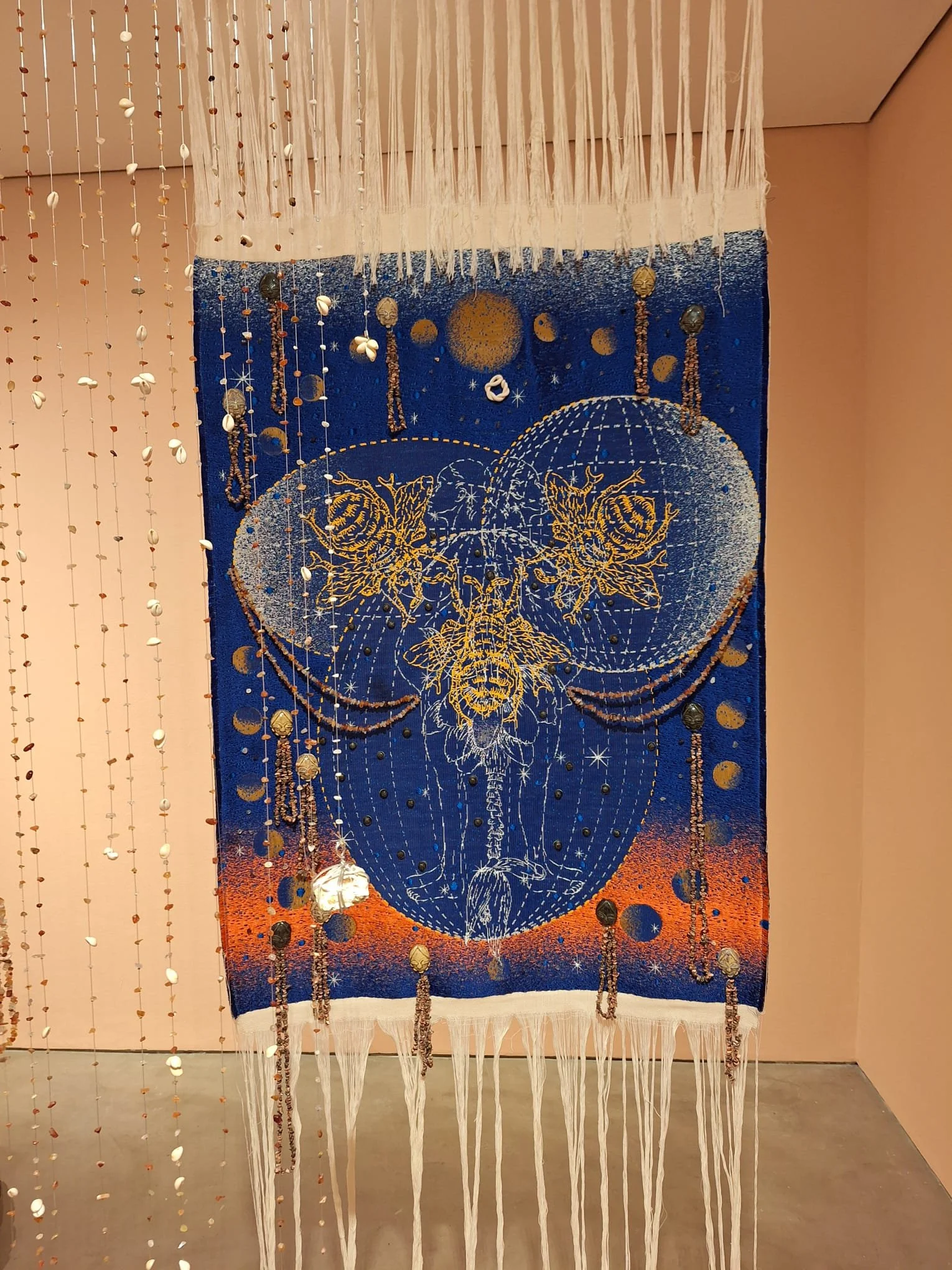
Marie-Claire Messouma Manlanbien, Mémoires des corps, 2025. Image courtesy of the author.
Bees
In his book Global Oracle, Alec Finlay refers to bees as the daughters of the sun, in relation to Egyptian mythology, where it is said they were created by the tears of Ra hitting the desert ground. He notes how they use honeycombs to navigate, communicate through dancing, the honey they produce can be used as an offering, a cure, a building block, and a means of preservation across cultures. In a performance of the poem, the buzzing of the bees is heard alongside his own voice repeating and recurring sounds, the space between words reduced to a current. It corresponds with his own terminology: a swarm is a singing cloud; a buzz is a sense of decision.
In the second room of the exhibition, two digitally made tapestries of bees hung from a metal bar wrapped in cast, with a white, bone-like quality. Behind the strong yellow and black of the bees stand two naked pregnant women, enclosed in fine white parallels and meridians. The ancient Akan people were a matriarchal culture ruled by a queen mother, Nyame, the one who creates all. The pregnant women seem represented and protected by another realm of female-oriented life forms.
The bee remembers
any point within the day
in its body
exactly
[Alec Finlay]
It seems as if the truth of embodied memories is known in many disciplines, while also concealed, missed, or ignored. Often, those who experience trauma are wrongly diagnosed with depression, personality disorders, autism, social problems, and so on. They are expected to hold the same impression of reality even if their life taught them otherwise; they are expected to act their age, even if time continued and their growth stopped, leaving their body frozen at the age they experienced something they could not accommodate.
More than anything, they are expected to find their way back to themselves, to who they were, and back to society and the role they should play in it. In her essay, ‘Wouldn’t you like to be normal?’ Lucie Elven describes how writer Janet Frame was 'released' from this obligation by her psychiatrist. He encouraged Frame to get National Assistance Funding and to concentrate on writing, without feeling like she should 'join in'. Frame wrote for the rest of her life, dedicating several of her books to him. Yet many people don’t come across the same mindset.
Often, women who suffered through complex trauma would also be diagnosed with borderline personality disorder (BPD). The connection between these psychiatric diagnoses and fibromyalgia syndrome, characterised by chronic bodily pain, is researched but still inconclusive.
A ghost-like condition that may be treated but not cured. It can compress pain complaints into a noisy current, within which things go amiss. From talking to friends who were diagnosed, it often feels as if they were not heard as girls and cannot make people listen to them as women. They are considered either too loud or too quiet. Either unseen or hysterical. Weak, a nuisance. Aside from giving them a category established by men who studied mainly other men for centuries, there was a consensus that not much could be done for them. When one of my friends was diagnosed, my sister said, "Now, nobody will listen to her."
The body is a voice
[Susie Orbach]
Through life, a singular experience may be so strong that the pain takes root and stays, even after the seizure, the assault, the betrayal, the desertion, the colonialism, the occupation, the persecution, the bombings are over. It stays in the body. It moves through the bloodline, becomes a family heritage, carries the burden of memory, told many times or hidden, taught through fearful, unexplained body language, across generations. An echo that will not be silenced. Is a different personality not to be expected? How can it be addressed, instead of being undressed, drugged, or ignored?
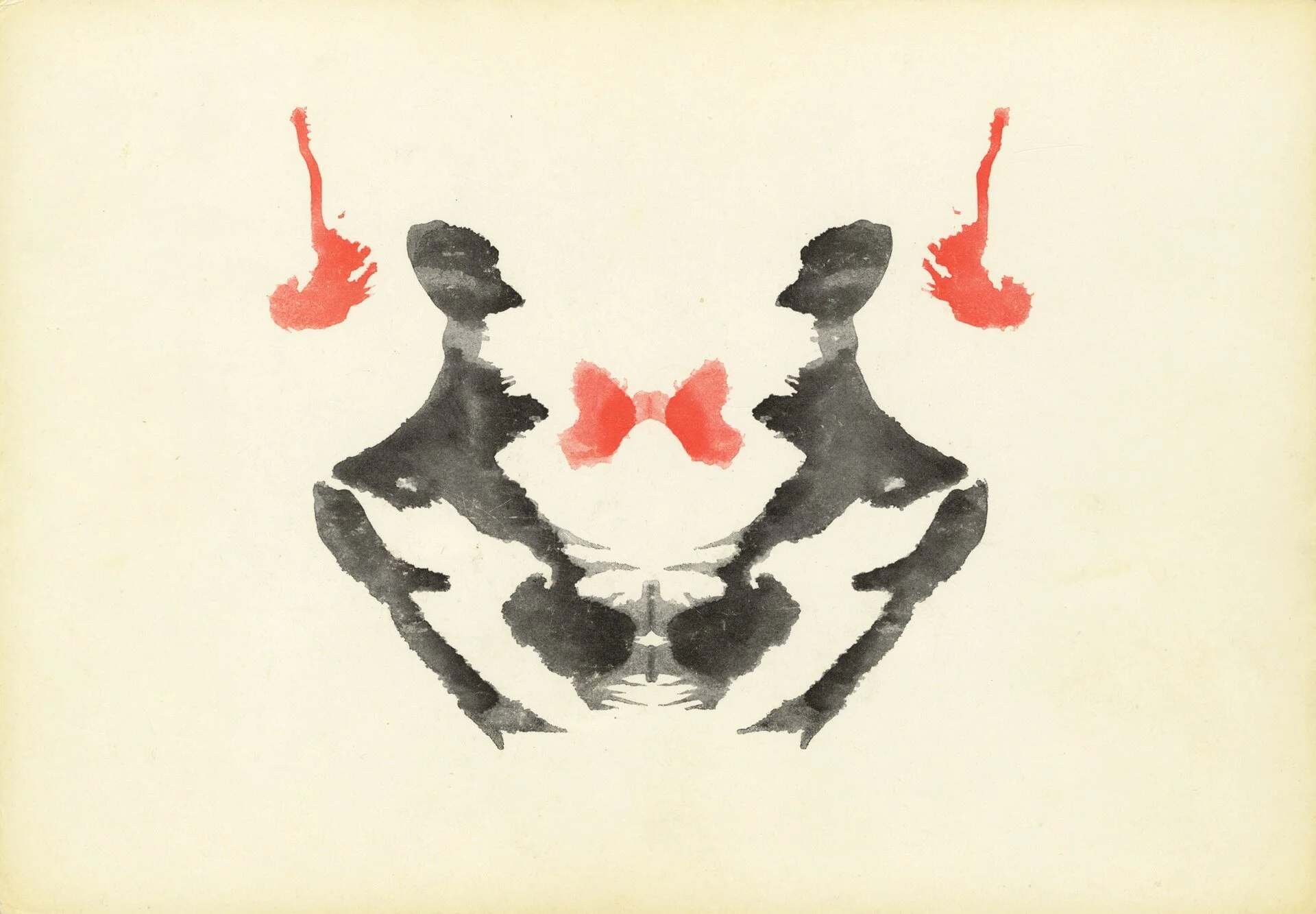
Hermann Rorschach, Public domain, via Wikimedia Commons
Rorschach
An unapologetic, pink, detailed, exposed uterus was floating under a galaxy of the moon cycle, in the main space of Gasworks. Ovaries, fallopian tubes, cervix. From its end, thin white lines are released downwards, like roots searching for soil, or female sperm. It was surrounded by mobiles, swaying lightly above the offerings laid out on the floor below, with rose water and seeds of calypso. Does everyone see what I see? I looked around. No one seemed startled. Why was I?
The tapestry reminded me of card number III in the Rorschach test. Famous for its symbolism, the Rorschach is a crucial part of the common psychodiagnosis process. Aside from tests that measure IQ, the battery comprises different projective tests. A projective test means that you can’t really hide your perspective of reality. Like the joke of a patient going into a therapist's room, where a painting of an inkblot is on the wall, asking – why do you have a picture of my parents fighting?
Considering the difference between academia and practice, therapeutic discourse is often about the patient instead of with them. It may exclude the person from their own narrative, undermining their decision-making and judging whether they are ready to know a grand truth about themselves.
When I was a student, there was an emphasis on the individual case: to learn the diagnosis but remember that each person is their own. Yet when a person encounters the system from outside, the first thing that may come is not their narrative, but what their symptoms accumulate into. For efficiency. So the system can continue, even towards its demise.
Yet there are so many indescribable things. What of the bias of a mere person? What of the aspects perceived only by another interchangeable mind? Between two people, sitting in a room, observing one another through an imaginary lens of hierarchy of the mind?
In training to become a therapist, you are taught to be attuned to your blind spots. Your own emotions become information; you search to turn the unknown into an observation. Why am I sad now? Why am I hungry? Why do I lose concentration every time they bring up this topic? Is this me or the other, or is it a ghost of another dynamic? A father, a friend? Even if it means to look without seeing. Into nothing. You ask questions; you go to a supervision group. You find yourself wandering through a mental hall of mirrors again and again, trying desperately to see another reflection.
I remember asking my practicum supervisor if it's normal that I find myself thinking of something a patient told me relentlessly. As I was chopping vegetables or driving. One month after a session, one year. A lifetime. And still. Is it enough? The blind spots are there. The point you cannot reach behind your back. Something that will become clear only after we parted, or it never will. I should have said something different; I should have noticed. The therapeutic space can be a healing space, but its properties are set, limited, and for some people – unreachable.
The exhibition Manlanbien created is a space that takes into consideration the psyche and imagination of those who visit. Through the potion she left for the visitors, by incorporating a plaster casting of her own lips on the mobiles, and one of another woman's nipple. By enabling the needed distance, using mobiles and seashells, to form a handmade protection field between the tapestries and the spectator.
This is not a concealment of trauma, or a dissection of it, but a sanctification of its existence and needs. Through her art, she not only talks about embodied memories, but speaks to them, and those who relate will recognise it in their bones.
Manlanbien left parts of her own story without labels. Aside from the name of the exhibition itself and the art, there are no descriptions. She did not try to explain herself, restoring control of the narrative to the onlooker, to feel, to rely on their perspective, without right or wrong. She contemplated not just how space will serve art but how her art could serve the community within which it's presented. Using materials with medicinal properties, sharing her history and her present trials. She created the exhibition while staying in the artist residency at Gasworks, with a newborn baby and her mother.
All of these transformed the artwork into a dynamic ritual, where the observer is an active participant in creating their own experience. A reconciliation. A room where one may perceive another through attunement to oneself. Instead of hierarchy, a mutuality.
This is not scientific testimony. It comes from conversation, research, classes I took, and observation. It comes from my own experience living with trauma. It is the ripples created by contact with another's art.
Footnotes and References
[1] Luo, Yuening et al. “Protective Effect of Amber Extract on Human Dopaminergic Cells against 6-Hydroxydopamine-Induced Neurotoxicity.” Molecules (Basel, Switzerland) vol. 27,6 1817. 2022, doi:10.3390/molecules27061817
Cover image: Marie-Claire Messouma Manlanbien, Mémoires des corps, 2025. Image courtesy of the author.