On Being Alone
Being alone, when it works, is a gorgeous paradox. What to me seemed singular, or individual, or individuating about aloneness has been wonderfully disturbed by the writing of Donald Woods Winnicott. In a paper originally given at the Extra Scientific Meeting for British Psychoanalysts in 1957, Winnicott explores what might be obvious to some: that we can only truly be alone in the presence of an other.
“Although many types of experience go to the establishment of the capacity to be alone,” Winnicott writes, “there is one that is basic”: “that of being alone, as an infant and small child, in the presence of mother”. The mother is a very particular kind of other, but by no means defined by gender essentialism. They are simply someone who is “reliably present”, whose presence enables an infant to carry on being. (For now, I am leaving aside what’s generative or destructive about just carrying on.) But, strikingly, their reliable presence, as well as being literal, can also, at least momentarily, take the form of a “cot or pram or the general atmosphere of the immediate environment”. There is a circularity to this definition since the capacity to be alone hinges, first, on already being alone, in the presence of the mother. But this imprecision or openness, I think, gets at something specific about the indeterminacy of being alone. That is to say, being alone has something to do, too, with what’s in the air.
This, by definition, can never be something wholly or absolutely one’s own. The air you breathe, the environments you inhabit, the spaces which hold and shape you, and which you shape, too, are always and necessarily shared. We are born into a world that existed before us and will exist long after we die. In the hopes of moving past the potential banality in these truisms, part of what I want to get at is just who or what affects our time alone. Because what’s at stake, Winnicott shows us, is what’s personal – the very possibility of having a personal experience at all – where the personal is never understood as an isolated, merely private thing.
The mother thus occupies a delicate position. They are “someone present, although present without making demands”. They provide something delicately poised, a strange physical and affective space, a sort of fold or slit in experience which stems from the sort of attention that reassures and secures whilst allowing us to get lost, alone, and to which we can safely return.
Here is Winnicott at length on the importance of the scene of being alone:
“It is only when alone (that is to say, in the presence of someone) that the infant can discover his own personal life… The pathological alternative is a false life built on reactions to external stimuli. When alone in the sense that I am using the term, and only when alone, the infant is able to do the equivalent of what in an adult would be called relaxing. The infant is able to become unintegrated, to flounder, to be in a state in which there is no orientation, to be able to exist for a time without being either a reactor to an external impingement or an active person with a direction of interest or movement .... In the course of time there arrives a sensation or an impulse. In this setting the sensation or impulse will feel real and be truly a personal experience”.
When we are done being alone in this way, having survived our floundering directionlessness, what Winnicott insists is real rather than false, is so only because it has already been shared, though not in any obvious way. These impulses – imagine the flailing child discovering that their legs can kick – are fruitful when the attentive other becomes part of the object of the infant’s sensations. “The personal impulse is not wasted”, Winnicott writes, only when our being alone (paradoxically) includes someone else’s being there.
Winnicott’s remarkable claims make me spin. Would it be wasted to have an isolated personal experience? Is this even possible? Is the personal really only constituted by the presence of an other? If the presence of the other is flexible, open, indeterminate, then what counts as the personal being shared? Before I can go any further, I first need to touch on what’s absolutely contemporary, what conditions some of the specific material and affective realities of aloneness today.
The sociologist and neuroscientist Sarah Stein Lubrano recently noted in an interview with the LRB that although we are now empirically more alone than ever – thanks to social media, working from home, the degradation of social trust, etc. – we do not actually report feeling more lonely. For Lubrano, this is deeply concerning. That we don’t feel lonely while being alone means “we are los[ing] the parts of our brains that are good at social interactions”; a foundation of the social fabric is thus being eroded. Perhaps Lubrano conflates aloneness with loneliness here in a way that seems self-evident, but which the data does not back up. But I think what she’s also pointing to is the quality and texture of aloneness today, something which Winnicott helps us to discover and potentially transform.
Consider the thrill and thrall of an electric conversation about, say, a film, in praise or despisal. Imagine the desperate need to get out what you feel so intimately, and how you struggle; then, how these feelings and utterances augment and modify as your friend says something totally unexpected, shocking. How you hold back some opinions and say some things you didn’t even know you thought. You feel novel. You are moved as you move others. That exaltation in moments of resonance. The wildly gesticulating arms and dancing fingers. That flash of enlivening joy.
When I imagine this scene, I am walking down Southbank at night, locked in a back-and-forth against the backdrop of the glistening, moonlit Thames and the beauty of London’s skyscrapers beckoning in the distance. I do not think that what’s enticing about all this simply exists all the time (mostly, I find skyscrapers oppressive); what’s enticing has precisely to do with what’s generated by the strangeness of cinema, in this instance. This is a form which enacts exactly that sense of being alone, together; then, being together because of what was experienced alone.
I do not want to suggest that technology today is incapable of producing this. In video calls and text messages, I have certainly experienced a thrill. But imagine, by contrast, what is prevalent in time spent alone today. Phones, namely the doomscroll, and the inattention of the dual-screen experience – television and phone on simultaneously (a phenomenon advertisers are currently exploiting).
If, as adults, we are “able to forgo the actual presence of a mother or mother-figure”, someone who has always been indeterminate in form (cot, pram, immediate environment), I want to suggest that it is worth paying attention to what takes their place. Caught in the normalcy and coldness of algorithmically fuelled absorbing little machines, I hazard that we have a mother replacement incapable of reliably giving us the fold to disappear into alone. There is too much, in too much intensity. Phones are also, in my view, mostly rigid, predictable, containing nothing of the openness Winnicott describes in the mother or mother substitute’s presence, nor do they provide the free-floating surprise of experience that constitutes the truly personal. The phone is undoubtedly present, but, unlike Winnicott’s mother figure, it also always makes demands. If we think of phones as something that we are in a relation with, to what extent does this afford the freedom to exist without aim? Can we be alone with something that is so imposingly just there, there, there?
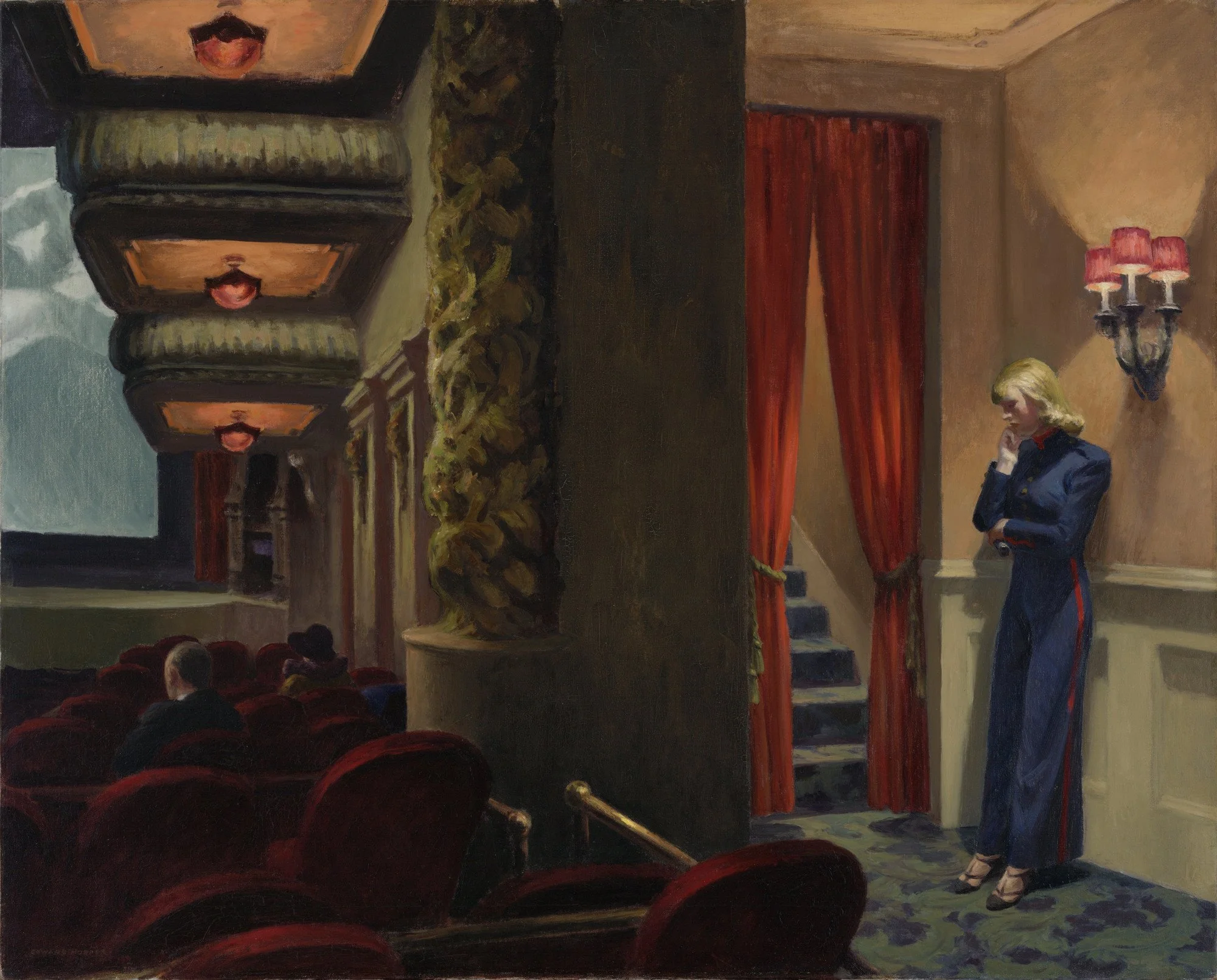
Edward Hopper. New York Movie. 1939. Sourced from MOMA
As I was researching this piece, I happened across Jeremy Cooper’s Brian, a novel which follows a lonely civil servant on his enlivening journey as a film buff. Musing on what seems to be the “joy of immersion” – something like Winnicott’s floating relaxation, in the cinema – Brian problematises the concept of losing oneself in what one loves. He finds instead “that the opposite was true, that being a buff was the consummation of the self”. At work, commuting or in the pub, “he was not himself at all, was no one, nothing, in fact, and it was only in the cinema that he became a person”.
Paradoxically, however, anonymity is “an integral part” of this experience; “drawing any kind of attention to himself was anathema”. What strikes me is that, like the indeterminacy of the mother and of the personal, Brian’s very sense of self seems to exist only in the cinema, and yet he withdraws at one and the same time. In front of a “high wide screen, entranced,” Brian “found feelings inside himself he did not know existed, replaced the next night by a different film and new sensations”. Brian has truly personal experiences in the cinema with reliable continuity. They are novel, surprising, entirely unpredictable, unlike much of what happens in the short form. But more than that, at the cinema, Brian is never truly solitary.
For most of the novel, Brian refuses to watch a film in any home cinema set up, travelling to the BFI every single evening. His stringent commitment to routine, something almost pathological – Brian makes his trip to the BFI even if he is running late, and the film will be over by the time he arrives – —provides the only infrastructure he has found for being truly himself. (Note that Brian developed this “independent self-discipline” after the death of his mother.) Why does he do this? It would seem, at first, that Brian is a purist. As an older, grumpier man in retirement, he berates a young buff for having watched all the films he has on an Apple Mac: “Spluttering with rage,” Brian tells him “that he [has] not in fact seen a single one of these films”.
But, shortly after this explosion, due to his debilitating eyesight, Brian subscribes “to various film streaming services in order to watch where possible the day’s films at home before pretending to see them at the BFI”. Brian goes to the cinema and experiences the truly personal, it is revealed, precisely in order to share, to comment, to be with others.
The other buffs, a community consisting of almost entirely unnamed, undeveloped characters, are the crucial, easy-to-overlook structural point of Brian’s capacity to have an experience he can call personal. It’s not that cinema is therefore subordinate to the buffs or vice versa, but that the two are co-constitutive, like mother and infant, environment and selfhood itself. Brian watches cinema in order to be in community; the screen provides a really felt experience, and the co-presence of other buffs, each with their own niche attachments to film, ensures the experience is not wasted.
The relation between the personal and the collective, however, is fraught throughout Brian. Our narrator tells us that he deliberately separates “cinema from life”. Lynne Littman’s nuclear disaster film, Testament, for instance – horrifying in “its emotional conviction” and “tense portrayal of human suffering” – merely gets Brian thinking about and admiring it years after the screening, “without, however, transferring the narrative fearfulness into his external everyday”. He berates “himself for lacking political, religious or any other firm belief”. Yet, “finding unforgivable his lack of social responsibility for anyone else, all he could think of doing was to close the doors of his mind yet tighter against everything other than film”.
The force of Brian’s commitment to cinema and the buffs is as remarkable as it is uncomfortable, and radically problematic. It is at a café, by chance, alone, meditating on a remark of François Truffaut’s that Brian, however, comes to this conclusion: “his contradictory purpose in watching film was to escape from the world and at the same time to learn about it”. Another paradox, another simultaneous encounter and withdrawal. This had always been ongoing; now Brian attends to its rhythms. Knowing this shores up Brian’s fierce commitment to cinema to the extent that it is almost literally life-giving: “He would fall down dead, he knew he would, if unable to see cinema”. Being a buff provides a medium, a space or fold, in which the truly personal is encountered in the fleeting intensity of what happens alone in front of a screen, night after night. But it is the collective – and the world he ostensibly shuns – that has drawn Brian in all along.
What does Brian teach us about being alone? If, with Winnicott, I have touched primarily on the infant’s early experiences, Brian shows us something of the fraught attempts to have a personal experience as an adult. It seems that being truly alone is rare, precious, delicate. For decades, before the novel begins, Brian had nothing that he could call personal or communal. Something about the mother’s special position – there and not there, providing the protective fold of aloneness – augments as we enter adulthood. Brian exits the world precisely in order to encounter it, here, before the profound effects of the screen, entwined with the presence of the group he calls film buffs. Winnicott’s insistence on co-presence, but his relative openness in describing its form, indicates that being alone, experiencing what is truly personal, lies beyond even our most stringent controls. What might be discomfiting about Brian’s relentlessness also gestures at the desperate importance of the other. That the other can be lost.
I do not think, then, that there is anything necessarily good about the personal and its sharing as such, especially if one is frustrated by Brian’s explicit political avoidance. But I do feel that reading the intensity of Brian’s commitment, the joy of the cinema in conjunction with conversation with friends, reads as something under threat in the age of being alone but not feeling lonely.
The specific but not wholly capturable form of being alone Winnicott describes was explicitly put forward because, it seemed to him, “a discussion of the positive aspects of the capacity to be alone” was overdue. It is beyond the bounds of this, and possibly any essay, to absolutely prove that going on your phone is worse than going to the cinema with friends, or reading, or going to a gallery, or conducting research, or walking, or just doing nothing. Rather, I want only to encourage attention to the quality and texture of the different ways we spend time alone, especially to what’s normal about being alone and scrolling.
What’s concerning about what Lubrano points out, which Brian’s desperation indicates, too, is that these other possibilities are not guaranteed. Not merely because of decreased funding of the arts and third spaces, but because of a whole new set of desires. Why make the effort when you can stream? Why head to a restaurant when you can sit back and wait? Why struggle to choose a film with friends when you can watch whatever you want, isolated, sharing nothing?
I began this essay in the hopes of being precise about what it means to be alone today. I wanted to discover an antidote to the concerning forms of being alone Lubrano identifies. Instead, I am caught in the utter indeterminacy of the thing, something which problematises its exploration in writing, and which I can only glance at in the beautiful works by Winnicott and Cooper.
What’s important about being alone lies in this uncertainty, freedom, and attachment to an object I cannot fully describe. Truly being alone both disturbs what seems solitary while affirming the personal, casting it in a very different light. The personal matters, then, because it is not private, it has never been autonomous or cut off from the world. It exists only because others have given us a holding environment which we do not own, which, hopefully, they have taught us to provide for yet more others. We fall into and out of this net in a myriad of ways.
If what seems personal arises without any connection, if we avoid the struggle to return to what always exists but takes work to get in touch with, then the specific rhythm and textures that generate what’s personal begin to fade away. Instead: one lone, flat and forever engrossing but not enlivening thing.
As an adult, it takes effort not only to experience reverie but also to find the sort of co-presence that makes it all worthwhile. And reliability is perhaps even harder. I think over periods where I read for long stretches, and then failed to return to reading for weeks. I think of so much time spent alone – not all of it on a phone – when I lost any sense of connection afterwards. Any energy or drive to be out in the world. A person “in solitary confinement”, according to Winnicott, is “not able to be alone. How greatly he must suffer is beyond imagination”. Being alone without being lonely signals something quietly radical, happening all the time. At its most extreme, everything becomes merely private, wasted, nothing held in togetherness.
This is not an individual problem; it is when alone that the absolute relationality of my most intimate experiences – joyous or depressing – is made clearest. In feeling out the textures and rhythms of different forms of being alone, I realise that some open me up to the world, however difficult, and that I like being there. I notice that I have some power, but no perfect control, over how I spend time alone. Unfortunately, I’m still not quite sure what it means.