The Line that Falters
Last November, I visited the Tracey Emin Artist Residency (TEAR) in Margate. The residency programme only accepts painters, and lasts 15 months. But as I walked around the studio spaces, I didn’t just see paintings, but dozens of leaves of paper: drawings, etchings and poems, pinned to the studio walls. One of the residents, Esme, told me that they are encouraged to create both a drawing and a poem at the beginning of each studio day. These can be throwaways: it’s not important to write well, instead it is an exercise in dual expression.
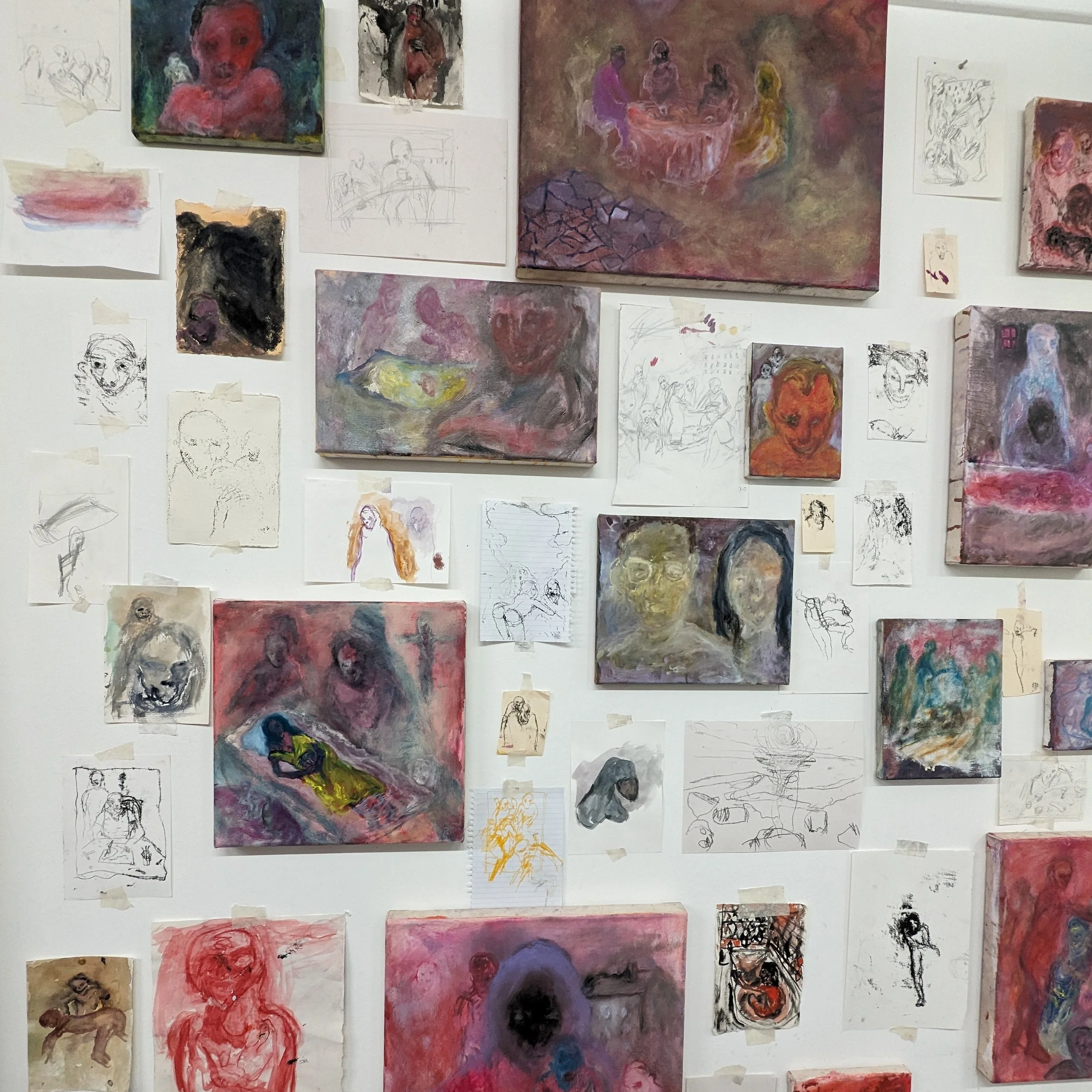
Anderson Asteclines Studio Wall at TEAR. Image courtesy of the artist.
As a curator, I have often found studios intimate in nature. Even the barest of walls still bear relics of the artist’s private hours. Paint in all its states: still drying on the canvas, hardened into clumps on the palette, soaking into carpet like blood. Sometimes, in London, where high-rise buildings are converted into temporary studios, the contrast feels jarring. Somehow, these artists are situated both within and outside the metropolis, often working with age-old, messy materials in a kind of super-modern cocoon.
I have been told incredibly personal things in artists' studios, sometimes related to the origin point of an artwork, at other times simply because the conversation drifted. I’ve never felt owed these moments of self-disclosure, just privileged to hear them. But people demand these things, even implicitly, all the time. There is the pressure to explain what it all means — to a gallerist, to a friend, to one’s self. You would think that I (as someone who works with both art and words) would have formed a strong opinion about what words can do for art. The truth is it’s a question that never leaves my mind.
It makes sense to me why Emin encourages her residents to write. For her, emotional expression isn’t secondary: it’s inseparable from her identity. Emin recalls her experiences in a multitude of materials: video, paint, neon, bronze, needle and thread. Language is yet another medium she uses. When one thinks of ‘confessional’ art we imagine a kind of boundaryless exposition of an artist’s inner life. Although Emin purges painful events — heartbreak, abortion, cancer — her inscriptions exercise a great deal of restraint. Something Wrong, Terribly Wrong/I don’t want to have sex because my body feels dead/I could have loved you/. It’s this restraint that is perhaps missing from much of amateur poetry, where people hold too tightly onto the specificity of their experience. Such personal writing can bear the weight of biography, often becoming a laundry list of trauma stripped of the emotional resonance that gave rise to it.
In Diaries of a Philosophy Student, Simone De Beauvoir contemplates a line from Maurice Barrés: ‘Why words, this brutal precision that mistreats our complexity?’ Beauvoir recognises something of her own self within it. Her own words, she writes, ‘damage the feelings that they intend to define’. Yet despite this, the quotation empowers her: ‘to see someone adequately explain and define a rather confused idea that becomes precise and gains even more strength in me…the sentences come into my life; I assimilate it’.
Barrés’ phrase ‘brutal precision’ stays with me as well. It may not even be that words are insufficient to describe our experience, but that when we stumble on the ‘right’ words, their perceived truth can cause a kind of rupture in our understanding. This is not always comfortable. Admittedly, I don’t like Emin’s paintings as much as her other work, but I think where they are strong is their ‘brutal precision’. Critics often compare her diaristic phrases to those of a teenage girl. Taken in isolation, it’s not untrue. But when her words intermingle with the force of her paint — long, violent skeins of it — the prosaic can become rhapsodic. At times, her trademark vertical drips rain over delicate writing and in other works, large red letters sprawl over neutrally painted ground.
In Emin’s retrospective exhibition at Tate Modern, which closed at the end of August, her works are accompanied by little to no wall text. There are brief descriptions of works, but no wider contexts, a curatorial decision made by Emin herself. She thinks carefully about where words belong, both in a general sense and in her compositions.
Whereas Emin shows a great deal of ease with language, there are artists who find the standalone qualities of their medium incredibly important. Platitudes like ‘a picture is worth a thousand words’ fail, because picture-word translation is not always the point. Paint is sticky stuff, physical matter that can be pushed around to create new forms, not just narratives. Early in my first curatorial job, I would turn up to studios with a mindset learnt in my master’s degree, drowning in references. The more I visited, the more artists were frank with me about ‘painting first, thinking after’. It was a position that I slowly tried to embody more as a viewer. Painting is corporeal and I believe my proximity to it brought me back into my own body. I feel more porous now, moved to tears by small things, attuned to the sensorial world around me, not just art. An artist friend was recently talking about the way light falls on a painting at different times of day — how this completely changes the image seen in space, and you become aware of it as a voluminous, fluid and mutable thing. I knew then exactly what he meant, although I would never have understood that when I was a student. Who the hell is going to make the claim that Seurat takes on a new personality at 4pm? And yet it’s true.

Tracey Emin, I Followed you to the end, 2024. Acrylic on canvas. 182.2 x 120.1 cm © Tracey Emin. All rights reserved, DACS 2024. Photo © White Cube (Eva Herzog)
One of the most often levelled criticisms against language is that there are some things that are beyond words, that they fail to describe. Going further than Barres or De Beauvoir’s suggestion that words debase our feelings, there are also things thought to be ineffable, or ‘unsayable, inexpressible, incommunicable.’ From mystical encounters to the experience of love or grief, humans have often pointed to a gulf between our most profound experiences and words. The trouble is that language is all we have. It is the very filter through which we recognise and utter the dissatisfaction. Figures like Ludwig Wittgenstein famously attempted to define its parameters. In the Tractatus, he set out seven main propositions about language, cold and concise. He tries to find out what we can talk about meaningfully — and it is right there in the first proposition: ‘The world is everything that is the case’. For the Wittgenstein of Tractatus, language, when used correctly, tells us about the world. Meaningful propositions offer a picture of reality, in that they describe ‘states of affairs’. The logical positivist circles with which he is often associated argued that the only meaningful sentences are those that can be verified, either by being logically true or physically proven. Claims about God, beauty and ethics belong to the transcendental for Wittgenstein. They cannot be spoken of in the same way, because they don't take place in the world as other states of affairs do. Hence Wittgenstein's final proposition is, ‘Whereof one cannot speak, thereof one must be silent’: a directive that feels motivated by a need for clarity rather than reverence.
For Cy Twombly, language was a problem, not just a mode of expression. What I like so much about Twombly is his simultaneous absorption and expulsion of narrative. Twombly’s lifelong passion was myth, a fascination with Homer, Virgil, Catullus. But the question of how to retell them consumed him. Like Wittgenstein, he thought about the limits of what could be expressed, only in artistic terms. Twombly took on legibility as an artistic project: he devoted hours upon hours to writing in the dark, training his line to become less regular. The poet Don Share wrote: ‘Why is it that Twombly always seems to be writing with his wrong hand? As if it pains him, the line that falters between language and image.’
The ‘line’ for Twombly was something barely legible, something closer to drawing. At TEAR, painters were encouraged to write as a way of developing their voices in a different mode. But I no longer think the question is simply what words or pictures can do for one another: both fray at their very edges. Though they are important for Twombly, it feels misguided to be intimidated by his Greek and Roman references, to try and pick up the Iliad to understand him. When he eventually moved to Rome in the fifties, where he was closer to the ancient world, his work only became more materially direct. You see him applying paint straight from the tube, smudging and smearing, sketching with complete abandon. They are love letters to myth in an uncertain language, neither wholly visual nor verbal.