Seth Price - Redistribution 2026-2007
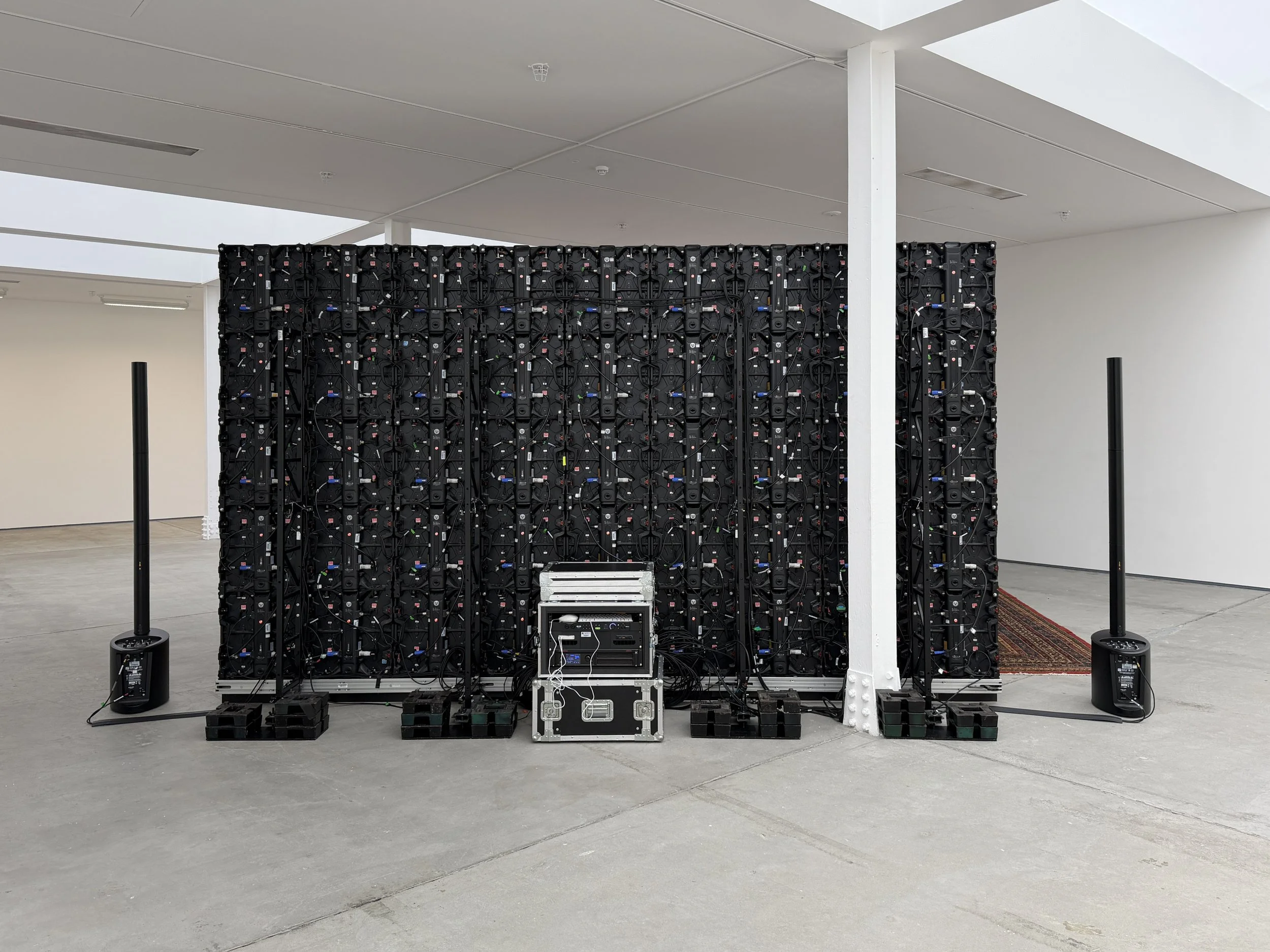
Installation view, back side. Image taken by writer.
I was sitting in Sadie Coles HQ, on a black beanbag, surrounded by imitation Persian rugs, for over two hours. In front of me was a large single-channel video, composed of approximately ninety individual screens to produce a single image, which alternated between excerpts from lectures, crude computer-generated images, digital photography and many, many other forms. Seth Price’s evolving multimedia project, Redistribution, started as a 2007 slide lecture at the Guggenheim museum, and this eleventh iteration is shown at Sadie Coles, Kingly Street, as a standalone installation for the first time.
Taking that original lecture as its point of departure, Redistribution is an ambling, sensical-non-sensical narrative, an essay (or is it a gesture?) that forces us to consider the underlying contexts of art making, and, perhaps more importantly, how it feels to navigate a world that is dripping with images, both real and fake. Manipulating archival footage through editing, dubbing and overdubbing, cutting and pasting, the work grows each time it is shown. It transforms and mutates, folds back in on itself and emerges changed, altered. In its current near 2-and-a-half-hour run time, the video meanders through a multitude of references, which anchor themselves in the artist’s practice, yet allow for, however brief, quick gasps of air as we are jolted from his cat dying of feline leukaemia, to the semiotics of shit in Bruegel’s 1560 painting, Die Kinderspiele.
The longer I sat there on my black beanbag, the denser Redistribution became. Much like an acid trip, a fever dream. Or even a life. There is no actual narrative: there are time jumps and overlays that make no temporal sense. Purposely ambiguous, recent versions of the work have begun to incorporate more intimate autobiographical elements, namely insertions of Price’s early New York years. We see him sitting alone in a Brooklyn apartment drinking a glass of wine, trying to uncover the philosophical differences between cinema, film, and artist’s video. I feel awkward talking about this, he says, before it cuts to a clip of him talking about a pillow. Yellow subtitles appear along the bottom edge, changing to white when editor-Price adds trans-dimensional commentary, leaving notes to himself to add a soundtrack here (he doesn’t), or funny afterthoughts about his past-self’s musings: but that’s all so complicated.
Across large swaths of the video, Price, in a melancholic drone voiceover, grapples with his personal history and orientation towards the artist life. For all its rather bleak, and at times slightly boring, insistence on cultural phenomena (fashion trends; the rise of the internet; the history of plastic; palaeolithic cave paintings) and global events (9/11; COVID19), the poignant potency of these diaristic interludes remains. He utilises the second-person pronoun, you, in these sections, blurring the line between self and other, between artist and viewer: why are you documenting your life in such detail, with no one to share it with? (here I am, Seth) you’re putting every wound to work, and that might be one definition of art making. It’s obviously a heavily personal work – Price is the main subject, the glue that keeps it all together – yet it positions itself as a communal palimpsest: we thought we saw it coming, after 9/11. I know you were waiting for it, after 2008 and the financial crash. And we waited after 2011 and Occupy; The Arab Spring. We were waiting after 2013 and Black Lives Matter. We waited after 2017 with Me Too, and we’re still waiting. For change. For hope. For something worth getting excited about.
Price uses recordings of his lectures as signposts in the work, but distances himself from himself by the removal of his voice replacing it with a feminised, robotic interlocutor. His unique, human sound is reserved purely for those moments of intimacy, and in so doing, creates copies upon copies of Seth Price. Mimics and want-to-bes. To mimic is to approach, but never become, something and this plasticity feels indicative of the work but also to the structure of a life and to art. Redistribution is one artist’s response to the world he finds himself in. It is a look in a mirror which lingered too long so the reflection started to talk back. It is a piece of plastic thrown away, recycled, and remade into something new. It is at once both detached and uncomfortably close.
And then it just … stops. Black screen. Nothing more to say. It catches up with itself, restarting after a 10-minute interval. When I left Sadie Coles HQ, rubbing my eyes in the middle of Soho, I wondered if this was what it would be like to time-travel. At breakneck speed. Jump into a wormhole and arrive at a destination unknown or unthought. Wonder if this was what it would be like to find a diary lying open on the seat of a bus, or a Word document buried deep in a hard drive.
Redistribution 2026 -2007 is on view at Sadie Coles HQ, Kingly Street until 16 May 2026.