Cecily Brown - Picture Making
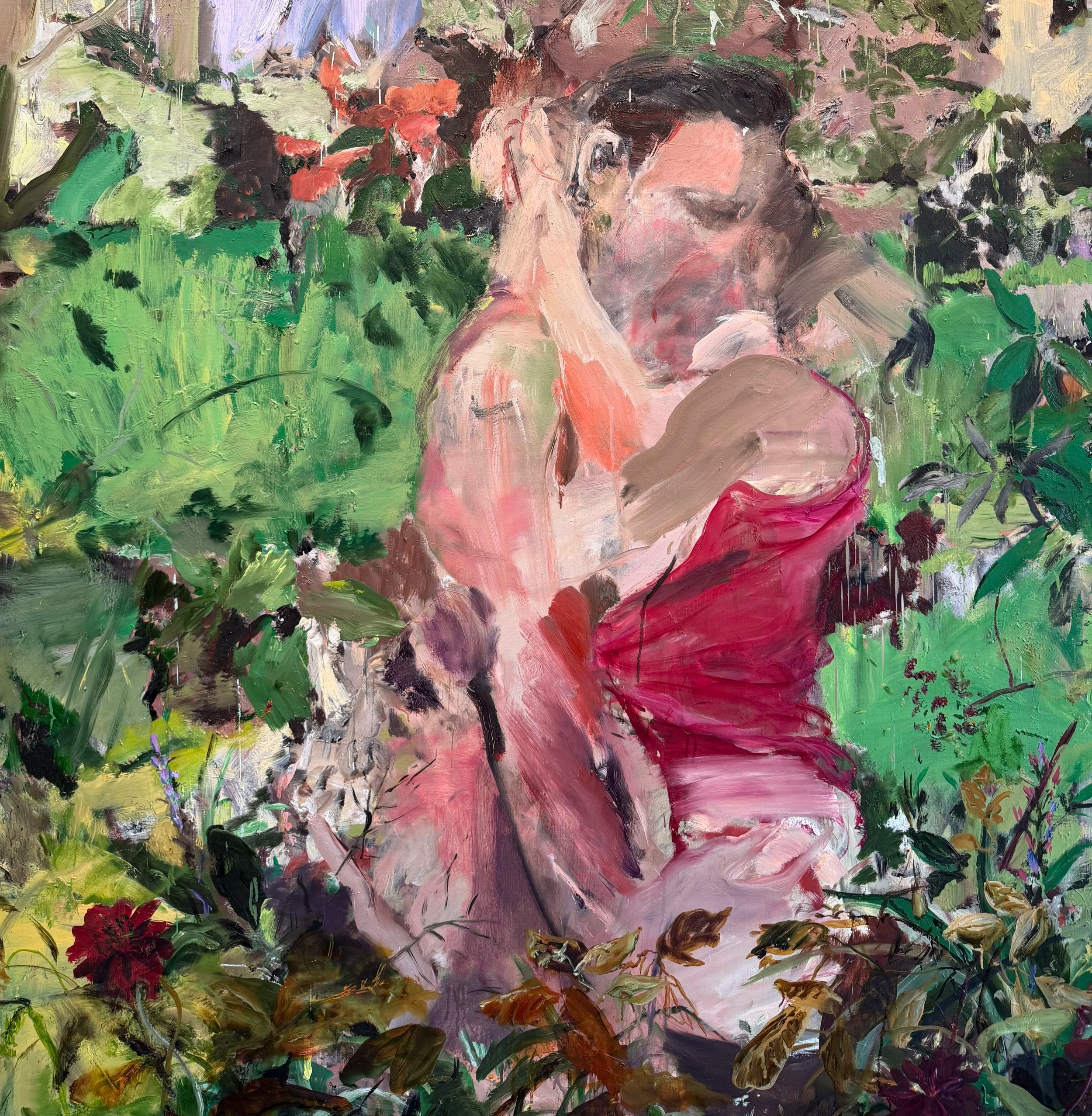
Couple (2003-04), Cecily Brown, detail. Image taken by (Parentheses) Review.
I like a painter with a landscape obsession. I feel at home with a Cezanne, returning over and over to the edge of Mont Sainte-Victoire as he tries to capture the ever-changing colour of its sloping sides. Or an Etel Adan, who did the same to Mount Tamalpais, rendering its hues in both paint and words. Then there’s Monet and his water lilies, or John Constable and the muddy banks of the River Stour.
Enter Cecily Brown and her show, Picture Making, currently on view at Serpentine Gallery, which brings that landscape legacy firmly into the twenty-first century. It opens with large vistas in browns and earthy greens, a series of paintings she calls Nature Walks. Each depicts a similar view of a river running through a forest, although, Brown’s signature vigorous brushstrokes and swirling compositions leave the viewer left wondering about the edges of the scene. Oscillating between the figurative and the abstract, at once allusive and illusive, her paintings reward the viewer that takes a moment to really see. Some paintings call for it loudly, like Trees, a lake, a log cabin, a waterfall, a deer and a sunset (2024) which urges the viewer to study the surface closely, peering behind the wild marks to make out the deer that they know exists, somewhere. It is difficult at first, but the eye quickly learns. A softened focus, a sideways glance, the deer appears. In other works, the instruction to look is less pronounced, but that does not mean the reward is any less great. She wants to, she says, ‘invoke the feeling of trying to grasp what something is – the experience of trying to remember something. I want it to be the same feeling as when a word is on the tip of your tongue, but you can’t remember it.’ And it is.
Nature Walk in Black and White (2024), is a monochromatic take on the same theme, which has a touch of the post-apocalyptic, or, rather, is more reminiscent of a concrete parking lot and grey tower blocks than the babbling brook it purports to show. It is hard for the brain to comprehend. You puzzle, scratch your head, move on.
But the unease persists. Into Nature Walk with Paranoia (2024) creeps a sense of the uncanny. There is Nature Walk with Nymphs (2024), in which almost-human faces peer out of the trunks of trees, as if morphing directly into the woods. It too has a touch of Cezanne (it calls to mind his Bathers, in which naked bodies melt into the very banks of the river). In all these works, there is a slight sense of the barbaric, the innate danger that exists in any wilderness. But there is also love.
For the last three decades, sexual encounters have been another central subject in her work. They appear time and again, moving in and out of abstraction. In her paintings, as in life, the park can be the setting for amorous encounters. In Couple (2003-04) a pair of entwined lovers melt into the foliage that surrounds them, and the longer I linger, the more bodies are appearing everywhere. Naked limbs and bare torsos emerging from the thicket, embracing lovers who think they are unseen.
The log across the stream that forms the focal point of many of these works was copied from a jigsaw puzzle. So, it is not a wilderness at all, or even a real place, but rather a fiction, a pretence, designed and built by whoever created the puzzle, and then built again, piece by piece, each time someone completes it, or Brown finishes a canvas. ‘Anything is possible in a painting. It’s a kind of artificial, fantasy realm constructed by the artist,’ she says.
The exhibition’s location at the Serpentine in Kensington Gardens is no coincidence. A park is a fabricated version of a wilderness, natural yet cultivated, and highly artificial, no matter how hard it works to mask that artifice. In a city, the park serves as a stage for social theatre, and in Brown’s case, memory. In the late 1990s, Brown left London for the New York art scene, where she has lived and worked ever since. This exhibition – her first major solo show in a UK institution since 2005 – shows the artist in dialogue with the landscape of memory. For her, the British countryside and Kensington Gardens, in particular, is a site of nostalgic Britishness, viewed from an American distance.
At the heart of the exhibition is The Serpentine Picture (2024). The gallery, seen from above, sits in the middle of a yellow canvas, while bands of pink and green and white swirl overhead. The gallery and the park are the site of something mystical; powerful, even. But it too is an artifice, a memory, a painting put together like the pieces of a puzzle. The Serpentine’s floor-to-ceiling windows flood the gallery with yellow sunlight. Outside, leaves rustle in the breeze and the sound of traffic is a mere whisper.
Picture Making is on view at Serpentine South until 6 September 2026.